By Kalwinder KaurMay 18 2012
A progressing clinical trial, partly funded by the National Institutes of Health, is investigating the potential and safety of BrainGate neural interface system. This investigational device uses brain-computer interface (BCI) to intellectually control robotics and other assistive technologies.
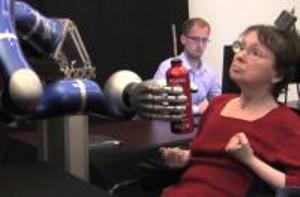 One small step A 58-year-old woman, paralyzed by a stroke for almost 15 years, uses her thoughts to control a robotic arm, grasp a bottle of coffee, serve herself a drink, and return the bottle to the table. (Credit: Brown University/Braingate2.org)
A report released in Nature demonstrates the effectiveness of BrainGate system in the cases of two paralyzed individuals. During BrainGate2 clinical trial, the paralyzed patients used robotic arms to show successful movements with their hands. BrainGate system, when partly implanted in the brain enables capturing the signals based on intentional movement. The BrainGate neural interface system includes a sensor for monitoring brain signals; the in-built computer software and hardware converts these signals into digital commands, supporting external devices. The sensor is made up of silicon measuring like a tiny aspirin square. It has 100 hair-thin electrodes that record the activity of brain cells, when placed within the motor cortex of the brain.
The BrainGate2 trial was conducted with two individuals: a 58-year-old woman and a 66-year-old man, who were affected by brainstem strokes, in 1996 and 2006 respectively. Both individuals were unable to move their limbs or speak.
During the trial, a task was posed to the individuals wherein numerous foam targets were kept elevated on a tabletop, supported by levers. Each target was individually popped at various positions and heights. Within 30 sec, the participant needs to grasp each target using the G2 DEKA Arm System. The success rate of grasping was found to be 62 % and 46 % respectively.
The woman participant was able to control a DLR Light-Weight Robot III arm that weighs more than the DEKA arm. In other sessions, she used DLR arm to reach for and successfully sip a bottled drink using straw.
Through this continuing trial, the BrainGate research team will test the technology on more individuals. The team anticipates developing a wireless and fully automated system.
Disclaimer: The views expressed here are those of the author expressed in their private capacity and do not necessarily represent the views of AZoM.com Limited T/A AZoNetwork the owner and operator of this website. This disclaimer forms part of the Terms and conditions of use of this website.