Prostate cancer is the recurrent non-skin cancer in the U.S., while radical prostatectomy has been the preferred therapeutic option for most.
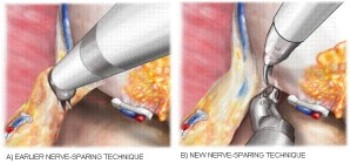 Image (A) Earlier Nerve-Sparing Technique Image (B) New Nerve-Sparing Technique
A new UCLA study on robotic-assisted prostate surgery states that post surgical effects like erectile dysfunction and incontinence can be reduced with the help of good nerve-sparing surgical technique.
The study findings will be reported in the European Urology’s June 2012 print edition.
The study authors state that an expertise surgeon with a successful history of 1,000 surgeries is qualified for performing robotic-assisted surgery for prostate cancer. Such excellent surgical skill will contribute to post-surgery recovery of erectile function. Furthermore, novel, improved techniques that enable fragile handling of the tender nerves surrounding the prostate will lead to improved erectile function.
The study features a surgeons' learning curve for better erectile-potency results. In addition, it shows improved handling techniques to avoid causing stretch injury to the nerves surrounding prostate, during the removal of gland.
The researchers also created a video that shows new techniques in robotic-assisted surgery. Lead author of the study Dr. Jim Hu says that the anatomic concepts and techniques benefit even traditional and non–robotic-assisted surgeries.
With expertise surgeons and innovative technology, Patients showed patients showed 33 % better erectile-function recovery, five months following the surgery. At 12 months post-operatively, the rate moved from 15 % to 59 %.
In addition to surgeon expertise, young patient age and strong pre-operative erectile function led to five- and 10-month post-surgical erectile function.
In traditional nerve-sparing technique, the nerves were removed from prostate similar to peeling an orange, which led to worst five-month sexual-function outcomes. The latest approach involves less peeling to reduce displacement of the nerves.