By Kalwinder KaurJun 2 2012
Georgia Tech Research Institute (GTRI) research team has developed a prototype system based on advanced imaging technology and a robotic cutting arm that can automatically debone poultry products such as chicken, ducks etc.
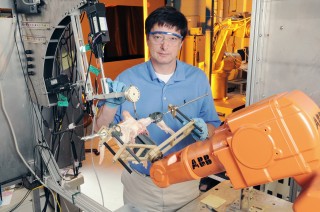 Gary McMurray, chief of the Georgia Tech Research Institute's Food Processing Technology Division
Based on a 3-D vision system, the Intelligent Cutting and Deboning System determines the exact cutting point for a specific bird. The device is capable of autonomous precision cuts that lead to minimal risk of bone fragments in the end, thereby increasing the yield.
GTRI research engineer Michael Matthews explained that Intelligent Cutting and Deboning System is a procedure where the bird is placed facing the vision system, before the precision cut. The vision system performs 3-D measurements of different location points on the bird’s exterior. Then, these points are utilized as inputs, and custom algorithms define an appropriate cut by calculating the locations of internal structures like ligaments and bones.
A fixed two-degree-of-freedom cutting robot has been included in this prototype, enabling simple planar cuts. The bird is kept atop a six-degree-of-freedom robot arm. This arm aligns the bird under the vision system in accordance to the cutting robot.
According to research engineer Ai-Ping Hu, using force-feedback algorithm, the system can identify the transition from meat to bone. With the help of this detection capability, the cutting knife will efficiently move along the surface of the bone with a constant force.
The knife will cut all the ligaments around the shoulder joint, leaving behind the bone. A similar method can be used for separating meat from bone.
Hu said that the force-feedback algorithm is based on a force sensor incorporated into the knife handle. While cutting, the sensor allows the robot to detect the bone, enabling precision cut around the bone. Fine-tuning adjustment will enable differentiation between tendon, meat, ligaments and bone.
Disclaimer: The views expressed here are those of the author expressed in their private capacity and do not necessarily represent the views of AZoM.com Limited T/A AZoNetwork the owner and operator of this website. This disclaimer forms part of the Terms and conditions of use of this website.