Teledyne’s Bumblebee X stereo vision system is redefining outdoor robotic perception, delivering long-range, high-accuracy depth, low-latency performance, and rugged reliability as a powerful, passive alternative to LiDAR for autonomous platforms. AZoRobotics sat down with Freya Ma from Teledyne FLIR to discuss the details.
For those unfamiliar with the Bumblebee X, could you introduce the system and explain its relevance to the growing field of outdoor and autonomous robotics?
Bumblebee X is Teledyne’s advanced stereo vision system designed for industrial and outdoor robotics. It delivers high-accuracy depth perception without active illumination, eliminating interference from sunlight or other light sources. With IP67-rated ruggedness, it thrives in dust, rain, and extreme temperatures.
Its high-resolution imaging dramatically improves spatial accuracy, while onboard depth processing generates real-time 3D data and frees up GPU resources, making it ideal for compute-constrained platforms. Plus, its extended working distance bridges the gap between traditional stereo cameras and LiDAR, offering a versatile solution for mid-range perception.
For industries like agriculture, mining, and infrastructure, Bumblebee X delivers the ultimate combination of precision, durability, and efficiency, empowering robots to operate anywhere, anytime, with confidence.
Bumblebee X uses dual 3 MP Sony Pregius global shutter sensors to capture high-resolution stereo images for precise depth perception. How does this high-resolution stereo data benefit tasks like obstacle detection and terrain mapping in applications like UGVs or autonomous tractors?
That means it captures exceptionally detailed stereo images for precise depth perception. That level of fidelity allows autonomous platforms to detect obstacles earlier and at longer ranges, which is critical for safety. It also enables accurate terrain mapping, allowing vehicles such as UGVs and autonomous tractors to plan smarter paths and navigate confidently in complex outdoor environments. Because we use global shutter sensors, the system minimizes motion blur, ensuring reliable perception even during high-speed operations. Combined with its wide baseline and onboard depth processing for real-time performance and an extended working distance that bridges the gap between traditional stereo cameras and LiDAR, Bumblebee X delivers long-range, accurate perception without the cost, power draw, or interference issues of active sensors.
In short, it gives outdoor robots the vision they need to operate safely and efficiently in any condition.
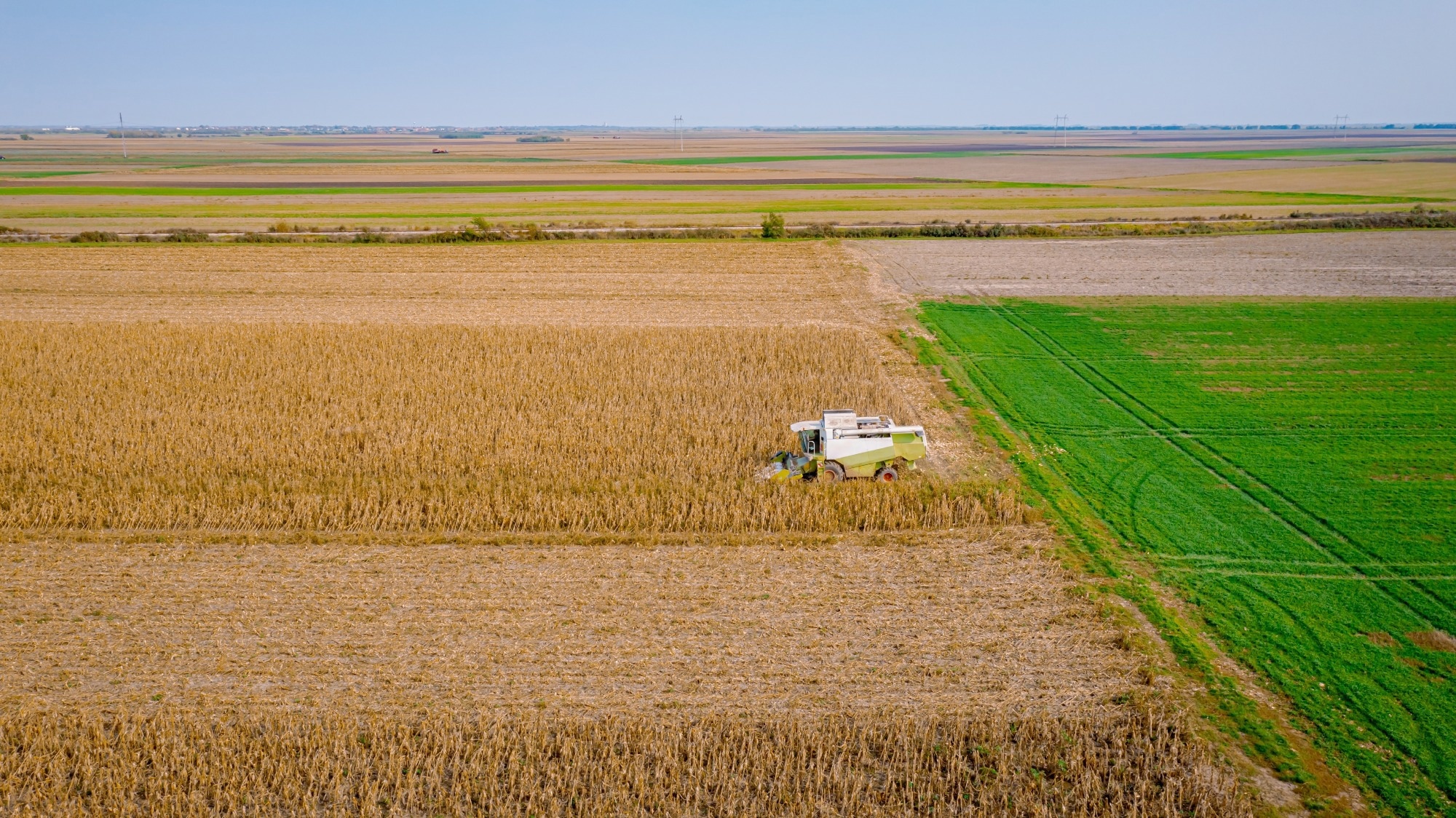
Image Credit: Roman023_photography/Shutterstock.com
Outdoor conveyor picking and crop harvesting often involve non-uniform surfaces, motion blur, and debris. How does the Bumblebee X maintain reliable depth accuracy and object recognition in such dynamic, cluttered environments?
Bumblebee X is engineered for the complexity of outdoor automation, where speed, clutter, and lighting extremes are the norm. Its dual high-resolution sensors deliver exceptional spatial accuracy, enabling precise object recognition even on irregular or partially occluded surfaces.
Combined with HDR imaging, Bumblebee X captures detail in both bright sunlight and deep shadows, ensuring consistent performance in high-contrast environments such as crop rows or conveyor belts under variable lighting conditions.
To handle motion, global shutter sensors minimize distortion and blurring, preserving clarity for fast-moving objects. Advanced stereo algorithms are tuned for texture-rich, non-uniform scenes, producing accurate depth maps even in debris-filled settings. For compute-limited platforms, onboard depth processing provides real-time 3D data without overloading the GPU, while calibration retention ensures long-term accuracy despite vibration and temperature shifts.
With these capabilities, Bumblebee X empowers autonomous systems to operate reliably and efficiently in the most dynamic outdoor conditions.
In off-road robotics and mining, latency and robustness are critical. How does the 5GigE interface and real-time data processing pipeline of the Bumblebee X support rapid decision-making in these time-sensitive operations?
You are absolutely right. In off-road robotics and mining, latency and robustness are critical because every second counts in terms of safety and productivity. Bumblebee X is designed for these high-stakes environments. Its 5GigE interface delivers high-bandwidth stereo data with ultra-low latency, while onboard depth processing converts images into actionable 3D data in real time, reducing GPU load and enabling split-second decisions for obstacle avoidance and route adjustments.
We had a case study with a customer in the Mining industry. They use Bumblebee X in autonomous haulage for mining, leveraging its rugged IP67 design, low latency, and flexible stereo pipeline to optimize routes under harsh conditions. The result is faster decision-making, improved safety, and greater operational efficiency, proving Bumblebee X sets the standard for high-performing vision in mining automation.
Can you discuss how the Bumblebee X integrates with navigation and localization systems in outdoor platforms such as road inspection robots or autonomous ground vehicles?
Bumblebee X integrates seamlessly with navigation and localization systems by delivering dense stereo point clouds with precise timestamp and frame ID synchronization, ensuring accurate alignment with other sensors like IMUs or GPS. This synchronization is critical for SLAM and sensor fusion, enabling reliable mapping and positioning even in GPS-denied environments.
Combined with its extended working distance for large-area mapping and real-time onboard depth processing to keep updates flowing without taxing compute resources, Bumblebee X provides navigation stacks with timely, accurate, and rich 3D data for smooth path planning, obstacle avoidance, and road inspection. It does more than integrate, it assures every frame is perfectly aligned for precision autonomy.
LiDAR and time-of-flight sensors are powerful, but they come with trade-offs, especially for outdoor robotics. They require active illumination, which can struggle in bright sunlight or reflective environments, and they often need to be paired with 2D cameras to add color and context to point clouds. That means extra hardware, sensor fusion, and post-processing, which increases cost, complexity, and power consumption.
Bumblebee X takes a different approach. Its passive stereo vision delivers dense, color-rich depth data in a single system, eliminating the need for additional cameras or complex fusion pipelines. With dual 3MP global-shutter sensors, it provides high-resolution, accurate depth maps without interference from external light sources. Its extended working distance bridges the gap between traditional stereo and LiDAR, making it ideal for mid-range perception tasks like obstacle detection and terrain mapping.
Add to that onboard depth processing for real-time performance, IP67 ruggedness for harsh environments, and significantly lower cost and power draw compared to LiDAR, and Bumblebee X becomes a compelling alternative for outdoor platforms that prioritize accuracy, efficiency, and simplicity.
Looking forward, how is Teledyne positioning Bumblebee X to evolve alongside trends in outdoor robotics?
Teledyne is positioning Bumblebee X as a key enabler for the next wave of outdoor robotics innovation, with a focus on intelligence, scalability, and resilience. As the industry shifts toward longer-range perception, simpler system architectures, and lower total cost of ownership, Bumblebee X stands out with its extended working distance, calibration stability, and IP67-rated durability.
Instead of relying on active sensors, Bumblebee X delivers high-quality, mid-range depth and dense stereo data suitable for applications that have traditionally depended on LiDAR, while avoiding the cost, power consumption, and integration complexity associated with active systems. Our roadmap ensures Bumblebee X evolves as a scalable, AI-ready vision platform that enables robots to operate more confidently and effectively in any outdoor environment.
About the Interviewee
Freya Ma is a seasoned professional with an MBA and a background in Automation Engineering, specializing in machine vision and industrial automation. Her expertise in depth sensing and advanced sensor technologies, particularly 3D vision (stereo, time-of-flight, and LiDAR), enables her to design and deploy cutting-edge vision systems for robotics and automated solutions across diverse industrial applications.

This information has been sourced, reviewed, and adapted from materials provided by Teledyne FLIR IIS.
For more information on this source, please visit Teledyne FLIR IIS.
Disclaimer: The views expressed here are those of the interviewee and do not necessarily represent the views of AZoM.com Limited (T/A) AZoNetwork, the owner and operator of this website. This disclaimer forms part of the Terms and Conditions of use of this website.