A lightweight AI-controlled prosthetic hand combines soft robotics, tendon-inspired mechanics, and passive grip features to deliver stable object handling without complex sensors.
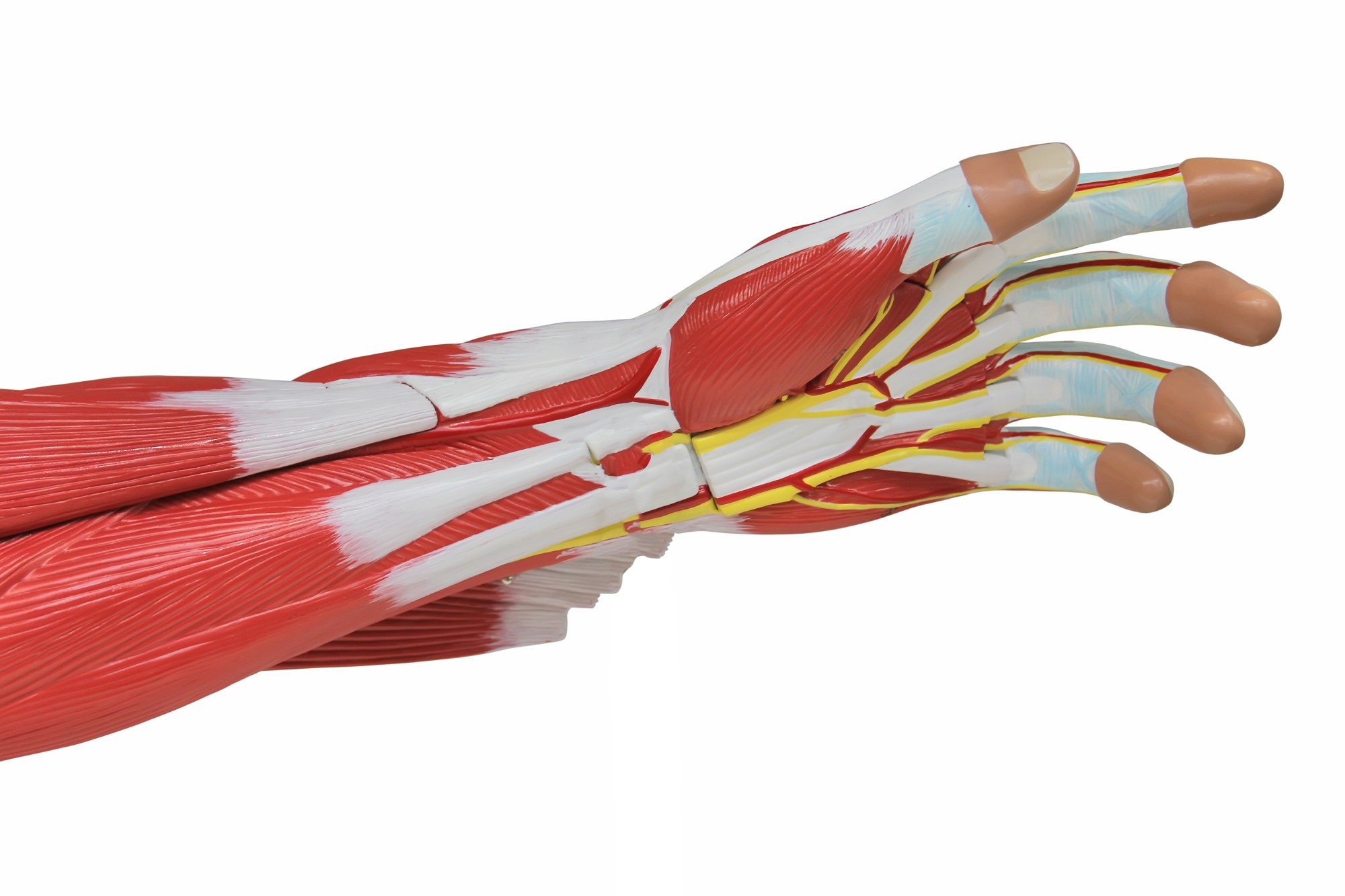
Study: Hand Prosthesis with Soft Robotics Technology and Artificial Intelligence for Fine Motor Control. Image Credit: Vladislav Gajic/Shutterstock.com
In a study published in Sensors, researchers presented a soft robotic hand prosthesis designed to mimic natural muscle and tendon behavior.
The system uses vacuum reinforcement and textured fingertips to improve grip, while myoelectric signals from an armband control movement. A lightweight neural network processes commands for open-hand and pinch motions. Testing showed 80 % grasping effectiveness, suggesting a low-cost and functional option for fine motor assistance.
Background
The development of hand prostheses plays an important role in restoring autonomy for individuals with upper limb impairments. Although rigid prostheses are widely available, replicating natural, adaptive movement with lightweight and comfortable devices remains difficult. Soft robotics offers a promising alternative by using compliant materials that enable safer and more flexible interaction with objects.
However, existing approaches still present practical limitations.
Pneumatically actuated systems can provide soft and adaptive motion but often require bulky hardware that reduces portability. Meanwhile, monolithic or tendon-driven electric designs can face durability challenges or introduce complex control requirements. Myoelectric control remains one of the most practical interfaces for prosthetic devices, yet achieving accurate, low-latency gesture recognition on resource-constrained hardware continues to be a significant challenge.
Against this backdrop, the researchers proposed a soft, tendon-driven prosthetic hand designed to simplify both the mechanical and control architecture.
The system incorporates vacuum-based reinforcement and textured fingertips to enhance passive grip stability, reducing the need for complex sensing systems. At the same time, a lightweight neural network enables real-time myoelectric control of open and pinch movements on a low-power microcontroller. The following section outlines how this integrated design was developed.
System Design and Methodology
Based on this objective, the study developed a soft robotic hand prosthesis designed to assist with fine motor tasks like the tripod pinch grip. The mechanical design was created using computer-aided design (CAD) software, with finger proportions based on anthropometric data derived from DIN 33402 standards and adjusted using measurements from a real hand to better reflect regional user morphology.
Inspired by the human muscle–tendon system, the prosthesis uses a tendon-driven mechanism for smooth, biomimetic motion. To improve grip without complex electronics, the fingertips feature textured surfaces and internal cavities that allow for passive deformation, conforming to an object's shape and enabling passive mechanical adaptation to object geometry. The thumb is positioned with a 38.5-degree angle to enable effective interaction with the index and middle fingers.
The prototype was manufactured using three-dimensional (3D) printing with different materials, namely a flexible thermoplastic polyurethane (TPU) filament for the joints and a soft resin for the fingertips to mimic human skin.
Finite element analysis was performed to evaluate structural limits under extreme and service load conditions, confirming the fingers could withstand expected operational loads without damage. A high-torque servo motor was selected to drive the fingers, providing enough force to manipulate lightweight objects, with a battery life estimated at 3.5 to 4 hours.
For control, the system uses a myoelectric armband that captures muscle signals and sends them wirelessly to a microcontroller. These signals are digitally filtered, and key features are extracted to form an eight-dimensional data point.
This data is fed into a compact, fully connected neural network trained to classify four hand gestures: open hand, tripod pinch, fist, and pointing. Only the open and pinch commands trigger movement, while the other gestures improve the model's overall accuracy. A state-machine controller manages the sequence of motions, ensuring safe and stable operation by maintaining the last valid grip if a signal is unclear.
This integrated approach aims to create a functional, intuitive, and robust prosthesis for daily use.
Experimental Results and Performance Evaluation
To evaluate the system, the authors conducted controlled experiments with ten healthy, right-handed volunteers. Myoelectric signals were acquired using an armband as users performed four gestures: open hand, tripod pinch, point, and fist.
Analysis of different sampling windows revealed a trade-off between signal stability and response speed. A 50 millisecond (ms) window was selected as it balanced reliable classification with low latency. Significant inter-user variability in electromyography (EMG) patterns was observed, confirming the need for user-specific classification models.
Individual neural networks were trained for each participant, achieving a mean accuracy of 87.94 %. Extended functional tests, including response time, grasping experiments, and sustained grip evaluations, were conducted primarily with one participant whose EMG signals demonstrated exceptional stability.
Response times for gesture transitions averaged 1.05 seconds, ranging from 0.49 to 2.00 seconds. Sustained grasp experiments showed the prosthesis could maintain a tripod pinch for an average of 17.92 seconds before muscle fatigue affected control.
Grip tests using three everyday objects (a marker, lipstick, and eraser) were performed over 20 trials each. The prosthesis successfully grasped and held objects for over 12 seconds in approximately 80 % of attempts.
The discussion emphasized that effective performance was achieved without complex sensors or algorithms, relying instead on passive mechanical features like textured fingertips and a compact neural network on a low-power microcontroller.
The design prioritized simplicity, regional anthropometric adaptation, and usability in resource-constrained contexts, though gripping force is ultimately limited by actuator torque rather than structural capacity, resulting in an effective tripod pinch force of approximately 3.8–4.2 newtons during experiments.
Conclusion
In conclusion, the study successfully developed and validated a soft robotic hand prosthesis that balances functionality, simplicity, and affordability for fine motor assistance.
By combining a tendon-driven, biomimetic design with passive grip features like textured fingertips, the system achieves stable grasping without complex sensors. A lightweight neural network on a low-power microcontroller enables reliable, real-time myoelectric control, demonstrated by an 80 % success rate in grasping everyday objects.
While gripping force is actuator-limited, the prototype offers an accessible, user-adaptive solution for resource-constrained settings. The reported experiments represent an engineering feasibility validation using healthy volunteers rather than clinical testing with amputee users. Future work will focus on adding thumb degrees of freedom to expand functionality and support a broader range of grasp patterns.
Journal Reference
Chaucala-Gualotuña, M., De la Cruz-Guevara, D., Tobar-Quevedo, J., & Alban-Escobar, M. (2026). Hand Prosthesis with Soft Robotics Technology and Artificial Intelligence for Fine Motor Control. Sensors, 26(5), 1423. DOI:10.3390/s26051423. https://www.mdpi.com/1424-8220/26/5/1423
Disclaimer: The views expressed here are those of the author expressed in their private capacity and do not necessarily represent the views of AZoM.com Limited T/A AZoNetwork the owner and operator of this website. This disclaimer forms part of the Terms and conditions of use of this website.