New findings from NASA’s Curiosity rover challenge assumptions about when Mars dried out - and suggest subsurface water may have endured far later than expected.
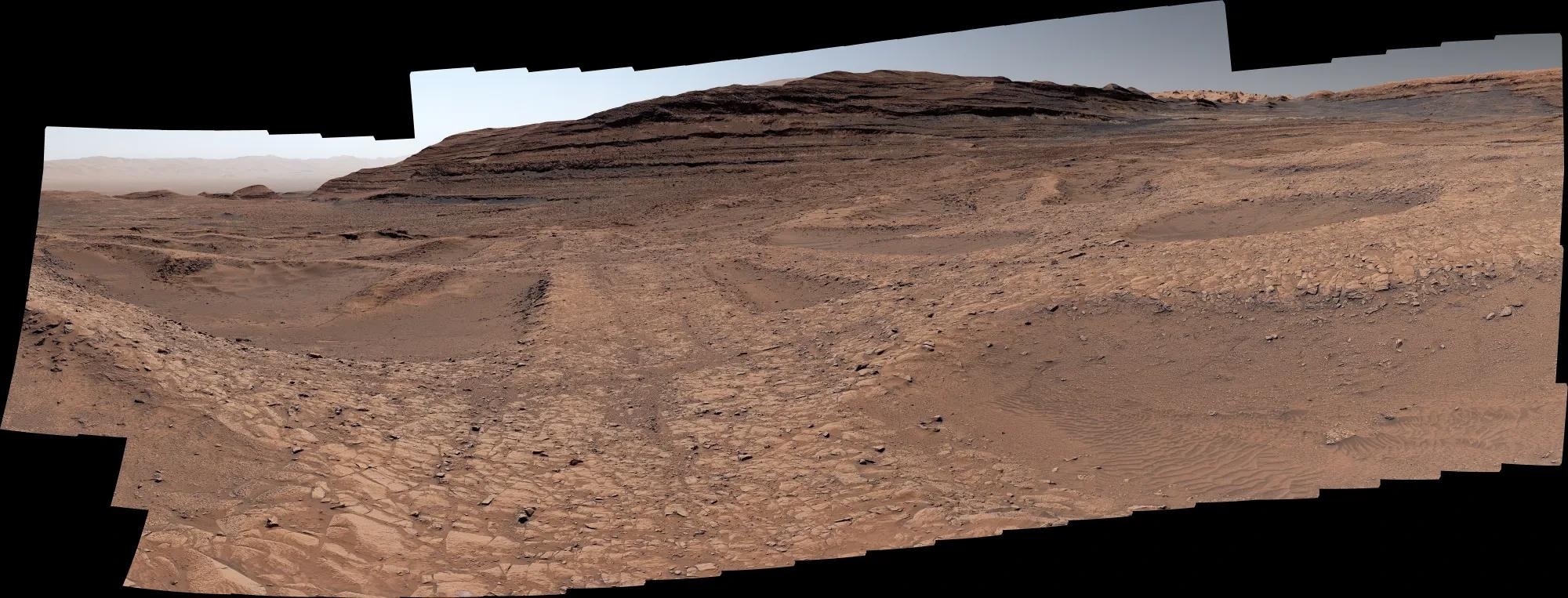
NASA’s Curiosity Mars rover captured this panorama of boxwork formations - the low ridges seen here with hollows in between them - using its Mastcam on Sept. 26, 2025. Image Credit: NASA/JPL-Caltech/MSSS
NASA’s Curiosity Mars rover has been exploring extensive boxwork formations on Mount Sharp that tower one to two meters high and stretch for miles across the landscape. These intricate structures suggest that groundwater may have endured on Mars well after surface water vanished.
Through detailed rock analysis and careful navigation across demanding terrain, the rover has uncovered signs that conditions potentially capable of supporting microbial life may have existed billions of years after Mars became a surface desert.
Background
Since landing in Gale Crater, NASA’s Curiosity rover has steadily climbed Mount Sharp, examining rock layers that record Mars’ shift from a once-wet world to the arid planet we see today. In late 2025, the rover reached a region marked by striking boxwork formations, features that resemble giant spiderwebs when viewed from orbit.
Scientists have long theorized that these formations developed when ancient groundwater flowed through fractures in the bedrock. As mineral-rich water moved through the cracks, it deposited materials that hardened certain sections. Over billions of years, wind erosion stripped away the surrounding rock, leaving behind a raised lattice of ridges. Until now, however, orbital imagery alone could not confirm this explanation.
The mission also faced two major challenges: navigating terrain where ridge tops were barely wider than the rover itself, and conducting precise scientific analysis to determine what these formations reveal about Mars’ watery past.
Navigating the Spiderwebs
The boxwork region presented some of the most complex terrain Curiosity has encountered in its thirteen-year mission. Engineers had to develop new strategies to guide the nearly one-ton rover safely across narrow ridges and sandy hollows.
Ashley Stroupe, an operations systems engineer at NASA Jet Propulsion Laboratory, explained that the ridge tops often served as natural pathways, almost like highways for the rover. However, moving between ridges required descending into soft, sandy depressions where wheel traction became a serious concern.
To manage these risks, the team carefully mapped routes designed to balance safety with scientific return.
Their planning paid off, as Curiosity successfully completed the first close-up investigation of formations that had puzzled scientists since their discovery in orbital images.
Earlier observations had revealed dark lines cutting across the boxwork networks. Researchers suspected these lines marked central fractures where groundwater once seeped through cracks in the bedrock. Curiosity’s high-resolution imaging confirmed that these features are indeed fractures, strengthening the case for past groundwater flow.
Even more intriguing was the discovery of abundant mineral nodules. Instead of clustering near the central fractures as scientists expected, the nodules were spread along ridge walls and within the hollows between ridges. Tina Seeger of Rice University noted that while nodules typically form when mineral-rich water precipitates minerals inside rock pores, their unusual distribution here points to a more complex geological history.
“Seeing boxwork this far up the mountain suggests the groundwater table had to be pretty high,” Seeger explained, indicating that subsurface water systems may have extended higher into Mount Sharp than previously inferred.
Chemical Evidence and Implications for Ancient Martian Life
Beyond visual observations, Curiosity’s onboard laboratory has played a critical role in analyzing the boxwork region. The rover’s drill, mounted on its robotic arm, collected four rock samples from carefully selected locations: a ridgetop, bedrock within a hollow, a transitional zone, and a particularly promising site chosen for deeper investigation.
These samples were analyzed using X-ray diffraction and high-temperature oven techniques, revealing distinct mineral compositions.
Ridgetop samples contained clay minerals, which typically form in neutral-to-alkaline water conditions considered favorable for life. In contrast, samples from the hollows contained carbonate minerals, which precipitate when water interacts with carbon dioxide under specific chemical conditions. This variation suggests multiple water-related episodes unfolding under different chemical environments over extended periods.
For the most recent sample, the team employed a specialized “wet chemistry” technique reserved for especially compelling targets. This method involves adding chemical reagents to powdered rock before heating it, allowing scientists to detect organic compounds that might otherwise go unnoticed. While such carbon-based molecules do not prove life existed, they are essential ingredients for biological processes and offer valuable insight into Mars’ prebiotic chemistry.
The fact that these formations lie within a sulfate-rich layer of Mount Sharp adds another layer of significance. This layer formed during a time when Mars was shifting from a wetter climate to the arid world it is today. Evidence of persistent groundwater within this layer suggests that liquid water endured later into that transition than previously thought, raising important questions about how long habitable environments may have lasted beneath the surface.
Conclusion
By navigating some of the most challenging terrain of its mission and conducting detailed geological and chemical analyses, Curiosity has deepened our understanding of Mars’ hydrological history.
The findings indicate that groundwater systems may have remained active long after surface water disappeared. Distinct mineral patterns, fracture networks, and the potential preservation of organic compounds together suggest that habitable conditions could have persisted longer than earlier estimates indicated.
As Curiosity continues its ascent through Mount Sharp’s sulfate-rich layers, scientists will build on these results to refine models of Mars’ climate evolution and assess how long the planet may have supported environments suitable for life.
Disclaimer: The views expressed here are those of the author expressed in their private capacity and do not necessarily represent the views of AZoM.com Limited T/A AZoNetwork the owner and operator of this website. This disclaimer forms part of the Terms and conditions of use of this website.