In a series of advanced field campaigns, engineers at NASA’s Jet Propulsion Laboratory (JPL) are flight-testing cutting-edge drone software in California’s deserts to prepare future rotorcraft for Mars. The goal? To build a system capable of autonomous flight over featureless terrain like sand dunes, a known challenge for the Ingenuity Mars Helicopter during its final missions.
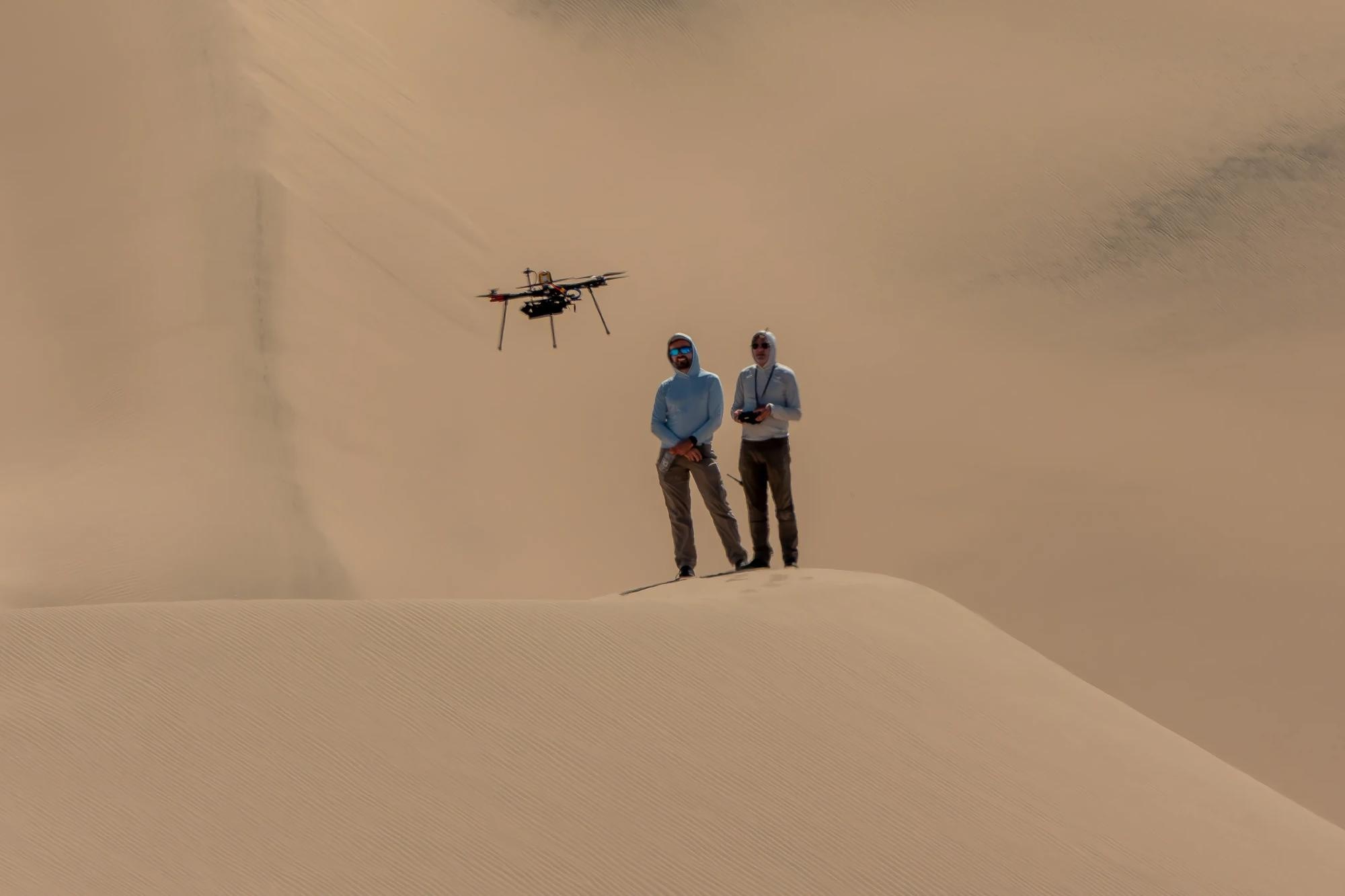
Researchers from NASA’s Jet Propulsion Laboratory in Southern California monitor a research drone in the Dumont Dunes area of the Mojave Desert in September as part of a test campaign to develop navigation software to guide future rotorcraft on Mars. Image Credit: NASA/JPL-Caltech
This work, focused on a navigation framework called Extended Robust Aerial Autonomy, is part of a broader set of 25 projects funded by NASA’s Mars Exploration Program. It aims to develop robotic scouts that can operate with far greater independence across the Red Planet’s diverse and often difficult landscapes, potentially in support of future human missions.
Learning from Ingenuity
NASA’s Ingenuity Mars Helicopter, which completed an impressive 72 flights, proved that powered, controlled flight is possible in the thin Martian atmosphere. But Ingenuity also revealed a major limitation: its navigation relied on visually tracking textures and features on the ground. When flying over uniform areas like flat plains or sand dunes, terrain lacking distinct landmarks, its systems struggled. These conditions complicated several of its final flights, making it clear that future rotorcraft would need more robust navigation tools.
To solve this, researchers can't afford to wait until they’re on Mars. They must test solutions here on Earth, in environments that mirror Martian challenges.
For decades, NASA has used Earth-based analogs, extreme landscapes that simulate Mars, like California’s Death Valley National Park, which has served as a testbed since the Viking era in the 1970s.
Pushing Autonomy Beyond Ingenuity
The goal of the new desert flight tests is to validate software that can guide rotorcraft across the kinds of terrain that stymied Ingenuity. The centerpiece of this work is Extended Robust Aerial Autonomy, an upgraded navigation system designed to handle low-texture environments, such as sand dunes, smooth rock surfaces, and other featureless areas that are both common and scientifically important on Mars.
As JPL researchers explain, Ingenuity’s visual navigation system worked well on textured terrain, but lost reliability when the ground lacked distinguishable features. The new software is intended to overcome that shortfall, allowing future Mars helicopters to travel safely and confidently, no matter what lies below.
Testing at Death Valley and Dumont Dunes
To turn this software into a mission-ready system, the JPL team headed to two of California’s most Mars-like landscapes: Death Valley National Park and Dumont Dunes in the Mojave Desert.
In late April and again in early September, the team conducted flights at Death Valley’s Mars Hill and Mesquite Flat Sand Dunes, operating under just the third research drone license ever granted for the park. Engineers worked in scorching heat, often above 113 °F (45 °C), running tests from beneath a simple canopy and monitoring flight data on laptops.
These sessions provided immediate feedback. For example, they helped identify which camera filters allowed the drones to track the ground more effectively in changing light. They also demonstrated how the new software could manage landings in rocky terrain - an essential ability for Martian missions.
For tests targeting truly featureless landscapes, the team turned to Dumont Dunes, which had previously served as a test site for the Curiosity rover in 2012. The sweeping, textureless dunes made it the ideal setting to evaluate how well the software handled navigation in the absence of visual landmarks, directly addressing the challenges Ingenuity faced in its final flights.
Part of a Larger Strategy
Extended Robust Aerial Autonomy is one piece of a broader push by NASA to expand Mars mobility. Other recent projects include:
- LASSIE-M: A robot dog designed to adapt to complex terrain using real-time data.
- MERF (Mars Electric Reusable Flyer): A winged drone concept that offers longer range than rotorcraft.
Together, these efforts reflect NASA’s commitment to developing a flexible suite of technologies for exploring Mars - whether by air, land, or beyond.
Looking Ahead
The drone tests in California’s deserts mark an essential step in the ongoing evolution of planetary exploration. By proactively addressing the limitations exposed by Ingenuity and refining next-generation software in Earth's most Mars-like environments, NASA engineers are helping to establish more capable, autonomous aerial scouts.
The Extended Robust Aerial Autonomy system is a remarkable strategic advancement. It opens the door to exploring regions of Mars that were once off-limits and fits into a growing toolkit of innovative solutions that will shape the future of Mars exploration.
Disclaimer: The views expressed here are those of the author expressed in their private capacity and do not necessarily represent the views of AZoM.com Limited T/A AZoNetwork the owner and operator of this website. This disclaimer forms part of the Terms and conditions of use of this website.