Reviewed by Frances BriggsJan 12 2026Reviewed
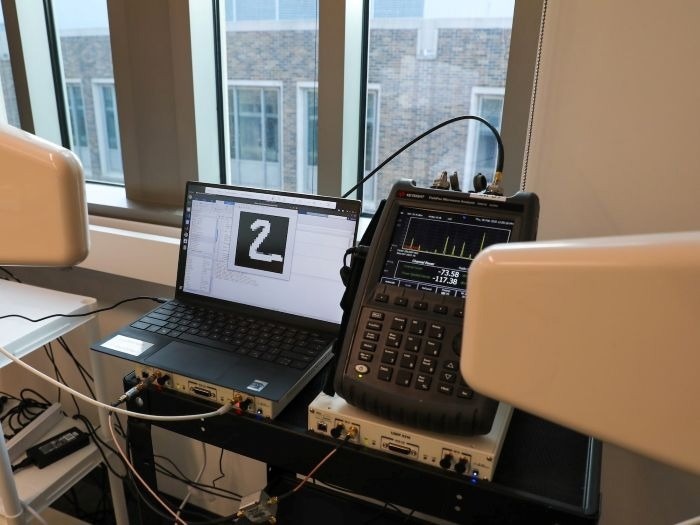 Testing in Chen’s lab at Duke shows an AI model that can identify thousands of images transmitted wirelessly with high accuracy in the blink of an eye. Image Credit: Duke Pratt School of Engineering
Duke University researchers are investigating the new solution, known as Wireless Smart Edge networks (WISE). The study was conducted in collaboration with MIT Research Laboratory of Electronics. It was published in Science Advances.
As drones scan forests, robots manage warehouses, and sensors monitor city streets, more of the world's decision-making is taking place autonomously at the edge - on small devices that collect data at the endpoints of much bigger networks.
But making the transition to edge computing is tricky. Artificial intelligence (AI) models become larger and more intelligent every day, but the technology within these devices remains small.
Engineers typically have two options, neither of which is desirable. Storing a whole AI model on the device requires substantial memory, data movement, and computing power, which can deplete batteries. Offloading the model to the cloud eliminates these hardware limits, but the back-and-forth increases latency, consumes energy, and poses security issues.
The research team has demonstrated that massive AI model weights can be cleverly integrated into radio waves transmitted over the air between devices and adjacent base stations, creating a route to energy-efficient edge AI without the usual trade-offs in energy, speed, or size.
Delivering an AI Model Over the Air Using Radio Waves
The program is based on a concept known as in-physics analog computing.
Binary coding is used in traditional digital computing. Devices conduct lengthy math operations by converting input into ones and zeros and transferring those bits into a digital processor. Even something as basic as using fingerprints to unlock a phone sets off a quick series of calculations. For micro and nanoscale battery-operated devices, it is reliable but inefficient.
Computing in physics operates differently. Instead of transferring ones and zeros from an edge device to a remote processor, part of the math is completed by the way radio waves naturally behave.
In WISE, a base station sends a radio frequency (RF) signal that encodes the model's weight values - numbers needed to finish those calculations, while storing the whole AI model. A nearby device's radio hardware combines the broadcast signal with its own input data when the signal reaches it.
This allows the device to naturally do computing in the RF or analog domain. A passive frequency mixer, for instance, "approximates" the multiplication of two time-domain radio frequency signals. Without the need for a digital processor, that analog in-physics mixing process - which occurs directly at RF - performs a crucial step in the majority of deep learning models.
“We’re taking advantage of computations that common, miniaturized electronics already gives us. Instead of running every step of the model on a chip designed for digital computing, the radio waves themselves help carry information in a way optimized for the computation,” said Chen.
The device bypasses the significant memory and energy requirements that now restrict edge AI since it does not save the whole model or run it digitally.
These findings open a new direction, in which future networks may distribute intelligence by blending communication and computation to enable energy-efficient edge AI at massive scale.
Tingjun Chen, Assistant Professor, Electrical and Computer Engineering, Duke Pratt School of Engineering
Lead author of the study, Zhihui Gao, a PhD candidate in Chen's group, believes the concept may be useful for a variety of devices. Traffic sensors, cameras, and drones all continually provide data, but they are unable to run the sophisticated models that would aid in their interpretation.
Technology is moving toward smaller devices that can do more than ever before. In order to achieve that, we need new improvements in edge computing. With WISE, we have shown how devices can run on powerful AI without relying on heavy chips or distant servers.
Zhihui Gao, Study Lead Author and PhD Student, Duke Pratt School of Engineering
Gao points out that WISE's capacity to leverage pre-existing infrastructure is another benefit. With very minor modifications, base stations that are already configured for 5G, upcoming 6G, or WiFi routers might be enhanced to transmit these AI models. Furthermore, the hardware required to carry out the in-physics calculation is already present in common wireless devices, such as frequency mixers.
“We’re not adding exotic components or creating entirely new hardware. We’re reusing features that are widely deployed and don’t consume extra energy,” added Gao.
In experiments, WISE used more than an order of magnitude less energy than state-of-the-art digital processors while achieving approximately 96% image classification accuracy.
The Future of WISE and Physics Computing
WISE is still in its infancy, despite its potential. Longer-range testing would need better transmission or integration with next-generation wireless equipment, although the current prototype operates over short distances. Furthermore, even if the method is adaptable, broadcasting several AI models at once would need either more spectrum bandwidth or effective multiplexing of the time-frequency-space resources.
However, the researchers believe such applications have a wide range of possibilities. One base station may assist traffic cameras in coordinating junction signals or support a swarm of drones in a search and rescue operation.
“This is the next step in wireless technologies becoming as powerful as wired ones. Beyond delivering data and information, these findings open a new direction, in which future networks may distribute intelligence by blending communication and computation to enable energy-efficient edge AI at massive scale,” concluded Chen.
Journal Reference:
Gao, Z., et al. (2026) Disaggregated machine learning via in-physics computing at radio frequency. Science Advances. DOI: 10.1126/sciadv.adz0817. https://www.science.org/doi/10.1126/sciadv.adz0817.