A quadruped robot has learned to walk on slippery, uneven terrain entirely through simulation, with no human-coded gaits or manual tuning.
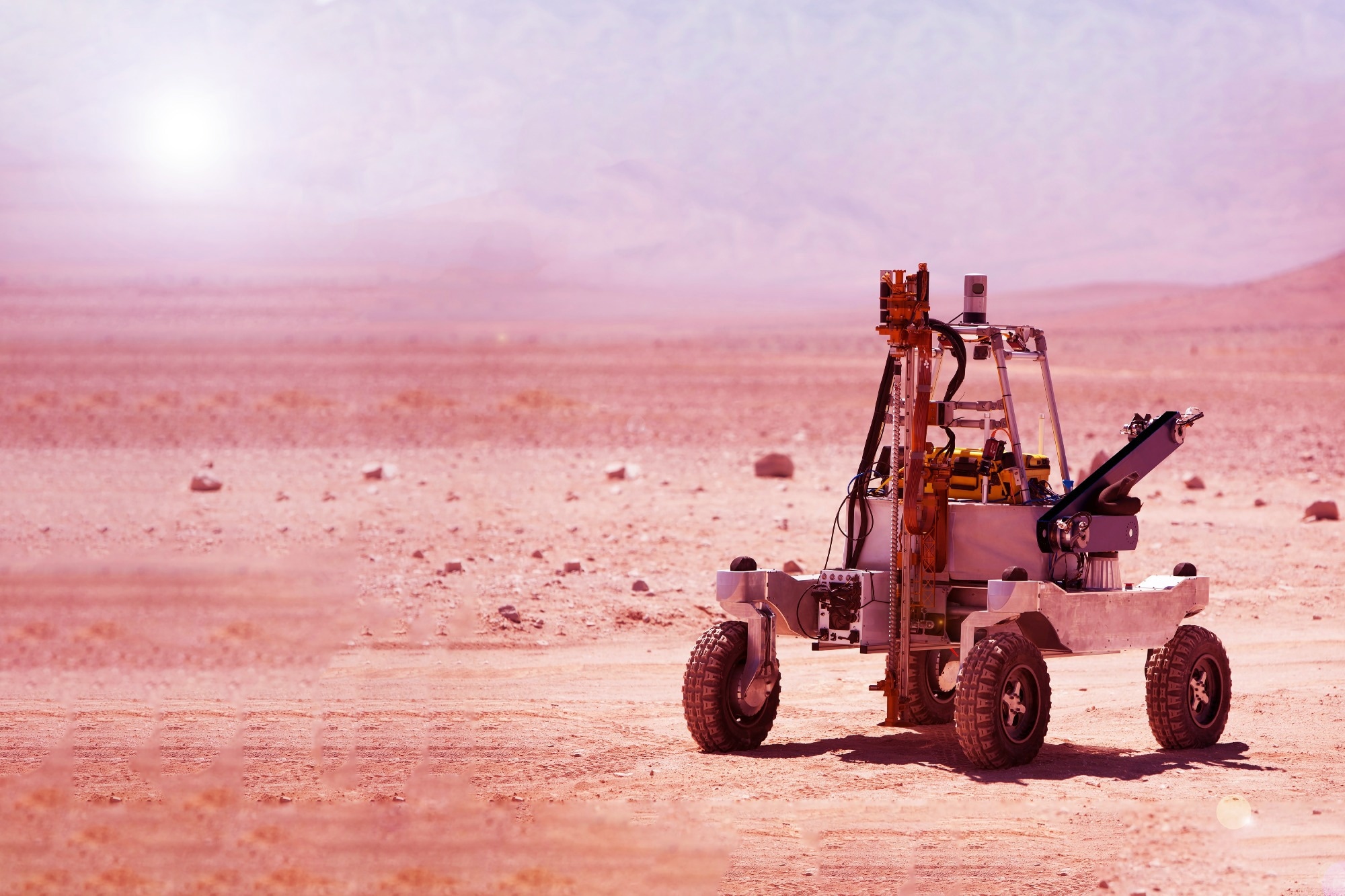
Study: Adaptive motion planning for legged robots in unstructured terrain using deep reinforcement learning. Image Credit: Artsiom P/Shutterstock.com
In a study published in Scientific Reports, researchers introduced a deep reinforcement learning (DRL) system that trains robots to walk stably and adaptively across unpredictable terrain without any human intervention.
Background
Quadruped robots hold strong promise for navigating complex, real-world environments such as disaster zones or rugged outdoor landscapes. But traditional control methods often fall short in these scenarios. They rely heavily on precise models and fail to adapt when conditions change unpredictably.
Deep reinforcement learning (DRL) offers a more flexible alternative. However, it’s often plagued by unstable training and poor generalization, especially when facing unfamiliar terrain.
This study tackles those issues head-on.
The researchers introduced a robust DRL framework featuring a structured curriculum that progressively increases terrain complexity. Starting with flat ground and advancing to slopes, rough surfaces, and low-friction patches, the robot learns to walk in a way that is both stable and energy-efficient, without pre-programmed behaviors. This approach enables smooth adaptation to entirely new and challenging terrains.
System Architecture and Learning Framework
The robot is modeled as a 12-degree-of-freedom system with articulated legs, using a hierarchical control structure. A high-level neural network policy operates at 10 Hz, generating target joint commands. These are executed by a low-level proportional-derivative (PD) controller at 100 Hz for precise motion tracking.
Its perception system combines proprioceptive data (joint positions, body orientation, velocities) with exteroceptive input from a simulated depth camera. This camera provides a local terrain heightmap and estimates of slope and friction, allowing the robot to “feel” and “see” its environment.
Training used the proximal policy optimization (PPO) algorithm. A carefully designed reward function balanced multiple goals: forward velocity, body stability, energy efficiency, smooth motion, and minimal foot slippage.
A key part of the framework was its four-stage curriculum learning process. Rather than dropping the robot into complex environments from the start, the system began with simple, flat terrain.
As the robot mastered basic locomotion, the environment gradually became more difficult - with inclines, uneven ground, low-friction surfaces, and simulated sensor noise introduced in stages. This structured exposure allowed the policy to build a foundation before tackling more demanding conditions.
The result was a controller that could adapt on the fly to unseen and unpredictable environments.
Experimental Setup and Results
The team trained and tested the system in the Webots simulator using procedurally generated terrain types: flat, sloped, rough, low-friction, and mixed.
Performance metrics showed consistently strong results across all terrain types. The learned policy achieved:
- Forward velocity of 0.79–0.9 m/second
- Low energy consumption
- Minimal foot slippage
- Fall rates ranging from 0 % (flat ground) to 12 % (low-friction terrain)
The policy also generalized well to unseen surfaces and performed reliably even with added sensor noise. Impressively, it achieved a 94.6 % success rate in Webots and a 91.2 % success rate in the PyBullet simulator (without retraining), demonstrating strong cross-simulator generalization.
Ablation studies validated the contribution of each system component.
Curriculum learning in particular proved critical. For instance, a baseline model trained without curriculum learning had an 18 % fall rate and higher energy usage. In contrast, the full method brought fall rates down to 5 % and slippage to just 4.2 %.
Analysis and Discussion
The study highlights three major contributors to the system’s success:
- Progressive training through a curriculum learning strategy
- Terrain-aware sensing, combining proprioceptive and exteroceptive data
- Multi-objective reward shaping, which encouraged balanced, natural locomotion
Interestingly, the robot developed several emergent behaviors during training, such as lateral weight shifts on slopes, stride adjustments on rough terrain, and cautious stepping on slippery surfaces. These weren’t explicitly programmed, but naturally arose from the learning process.
Despite these advances, the researchers acknowledge limitations. Chief among them is the sim-to-real gap. While the robot performs well in simulation, deploying the system in the real world introduces challenges like hardware dynamics, imperfect sensor data, and unpredictable environments. Future work will need to explore strategies such as:
- Domain randomization
- Residual learning
- Real-world sensing integration (e.g., LIDAR, RGB-D cameras)
- Hybrid control systems that blend learning with traditional reliability-focused approaches
The simulation environment itself also has limits. Terrain features like slope and friction were procedurally modeled, but real-world variables like soft ground, sensor calibration issues, or dynamic obstacles weren’t included.
Conclusion
This study presents a significant step forward in adaptive locomotion for legged robots. By combining deep reinforcement learning, curriculum-based training, and terrain-aware sensing, the researchers developed a system that learns to walk across complex terrain entirely in simulation with strong generalization and no manual intervention.
While challenges remain in translating these results to the real world, the framework lays a solid foundation for future work. Applications in disaster response, autonomous exploration, and rugged terrain navigation are well within reach.
Journal Reference
uddin, M. S. (2026). Adaptive motion planning for legged robots in unstructured terrain using deep reinforcement learning. Scientific Reports. DOI:10.1038/s41598-025-34956-7 https://www.nature.com/articles/s41598-025-34956-7
Disclaimer: The views expressed here are those of the author expressed in their private capacity and do not necessarily represent the views of AZoM.com Limited T/A AZoNetwork the owner and operator of this website. This disclaimer forms part of the Terms and conditions of use of this website.