A team of researchers from the Computational Robot Design and Fabrication Lab at EPFL has developed a robotic hand that exceeds the boundaries of human dexterity through a dual-thumbed, reversible-palm configuration that is capable of detaching from its robotic ‘arm’ to access and grasp various objects. The study was published in Nature Communications.
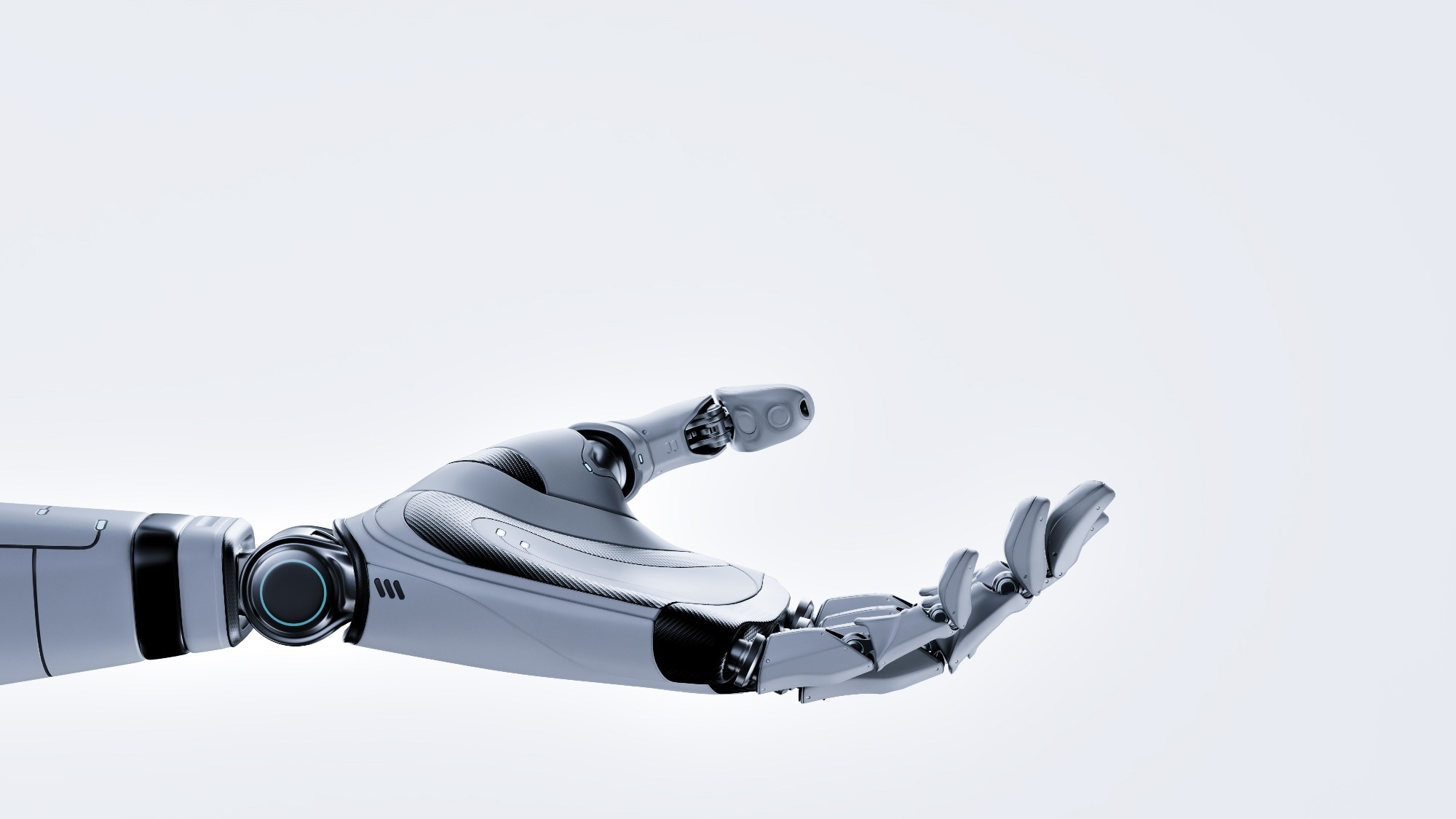
Image Credit: 3Dsss/Shutterstock.com
Human hands, characterized by their opposable thumbs, numerous joints, and gripping skin, are frequently regarded as the epitome of dexterity, inspiring the design of many robotic hands. However, shaped by the gradual process of evolution, human hands are not fully optimized, with significant limitations such as the singular, asymmetrical thumbs and their connection to arms that possess restricted mobility.
We can easily see the limitations of the human hand when attempting to reach objects underneath furniture or behind shelves, or performing simultaneous tasks like holding a bottle while picking up a chip can. Likewise, accessing objects positioned behind the hand while keeping the grip stable can be extremely challenging, requiring awkward wrist contortions or body repositioning.
Aude Billard, Head, Learning Algorithms and Systems Laboratory (LASA), School of Engineering, EPFL
A team consisting of Billard, LASA researcher Xiao Gao, along with Kai Junge and Josie Hughes from the Computational Robot Design and Fabrication Lab, has developed a robotic hand that addresses these challenges. This device, capable of accommodating up to six identical silicone-tipped fingers, resolves the issue of human asymmetry by enabling any combination of fingers to create opposing pairs in a thumb-like pinch.
The ‘back’ and ‘palm’ of the robotic hand can be interchanged due to its reversible design. The hand is capable of detaching from its robotic arm and can ‘crawl’ in a spider-like manner to grasp and transport objects that are beyond the reach of the arm.
Our device reliably and seamlessly performs ‘loco manipulation’ – stationary manipulation combined with autonomous mobility – which we believe has great potential for industrial, service, and exploratory robotics.
Aude Billard, Head, Learning Algorithms and Systems Laboratory (LASA), School of Engineering, EPFL
Human Applications – and Beyond
Although the robotic hand resembles an object from a futuristic science fiction film, the researchers assert that they were inspired by nature.
“Many organisms have evolved versatile limbs that seamlessly switch between different functionalities like grasping and locomotion. For example, the octopus uses its flexible arms both to crawl across the seafloor and open shells, while in the insect world, the praying mantis use specialized limbs for locomotion and prey capture,” said Billard.
The EPFL robot is capable of crawling while securely grasping several objects, keeping them either under its 'palm', on its 'back', or in both locations. With its five fingers, the device can imitate the majority of conventional human grips. When it is fitted with more than five fingers, it can independently perform tasks that typically necessitate the use of two human hands – for instance, unscrewing the cap from a large bottle or driving a screw into a piece of wood using a screwdriver.
“There is no real limitation in the number of objects it can hold; if we need to hold more objects, we simply add more fingers,” said Billard.
The researchers anticipate that their groundbreaking design will find applications in practical environments that require compactness, versatility, and multi-modal interaction.
For instance, this technology may be utilized to retrieve items in restricted spaces or to enhance the capabilities of conventional industrial arms.
Although the suggested robotic hand is not anthropomorphic in nature, the researchers also believe it could be modified for use in prosthetic applications.
The symmetrical, reversible functionality is particularly valuable in scenarios where users could benefit from capabilities beyond normal human function. For example, previous studies with users of additional robotic fingers demonstrate the brain’s remarkable adaptability to integrate additional appendages, suggesting that our non-traditional configuration could even serve in specialized environments requiring augmented manipulation abilities.
Aude Billard, Head, Learning Algorithms and Systems Laboratory (LASA), School of Engineering, EPFL
Reversible, detachable robotic hand redefines dexterity
Video Credit: EPFL
Journal Reference:
Gao, X., et al. (2026) A detachable crawling robotic hand. Nature Communications. DOI: 10.1038/s41467-025-67675-8. https://www.nature.com/articles/s41467-025-67675-8.