A Caltech-led team has developed a simpler, smarter generation of microrobots, “bubble bots,” designed to deliver cancer-fighting drugs directly to tumors, offering a promising advance in precision medicine.
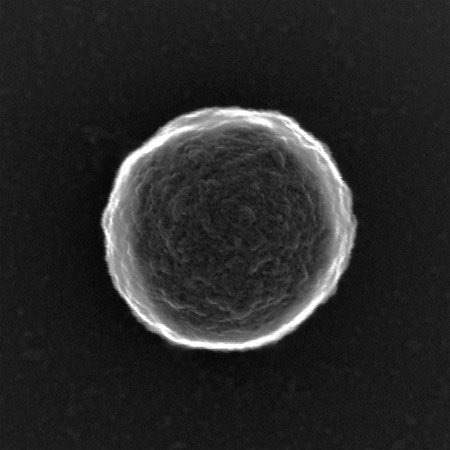 A single microbubble imaged with scanning transmission electron microscopy (STEM). Image Credit: Gao Lab/Caltech
Microrobots hold immense promise for medical applications. These tiny machines can be engineered to perform precise tasks inside the human body - detecting biomarkers, breaking down blood clots, or delivering drugs directly to tumors. However, designing microrobots that are effective, biocompatible, and affordable has been a significant hurdle.
Now, a team led by Caltech has made a major breakthrough. They've streamlined the structure and fabrication process of microrobots while enhancing their performance and adding the ability to autonomously navigate toward tumor sites.
In a study published in Nature Nanotechnology, researchers from Caltech and USC report on their “bubble bots” and their successful use in treating bladder tumors in mice.
The work builds on previous research led by Wei Gao, professor of medical engineering at Caltech and a Heritage Medical Research Institute Investigator. In earlier experiments, Gao’s team used ultrasound imaging and magnetic fields to guide 3D-printed microrobots to tumors in animal models, where the bots would degrade and release cancer-fighting drugs.
Those earlier bots were produced in cleanrooms using specialized equipment and featured a hydrogel shell (made of a jelly-like polymer) encasing a microbubble. This design enabled propulsion and provided high imaging contrast, allowing researchers to track the bots’ movement inside the body.
We thought, what if we make this even simpler, and just make the bubble itself a robot? We can make bubbles easily and already know they are very biocompatible. And if you want to burst them, you can do so immediately.
Wei Gao, Study Lead and Professor, Medical Engineering, California Institute of Technology
The team developed a straightforward method for producing these simplified bubble bots. Using an ultrasound probe, they agitated a solution containing bovine serum albumin (BSA), a common animal protein used in lab experiments, to create thousands of microbubbles coated with protein shells.
A key feature of these protein shells is the abundance of amine groups on their surface. Amine groups, made up of carbon-nitrogen bonds, are easily modified chemically.
By targeting these groups, the researchers created two versions of the microrobots, each with a different mechanism for movement control. Both versions can also be functionalized with anti-cancer drugs like doxorubicin, which bind effectively to the surface.
To power the bots, the team coated both versions with the enzyme urease. This enzyme acts like a miniature motor. It reacts with urea, an abundant waste product in the body, producing ammonia and carbon dioxide.
Since the urease isn’t evenly distributed across the bubble surface, the reaction products accumulate more on one side than the other. This chemical imbalance creates directional propulsion, pushing the microrobot forward.
In the first version, magnetic nanoparticles were added to the bubble surface, making the bots responsive to magnetic fields. Paired with ultrasound imaging (which highlights the bots’ internal microbubbles), researchers could steer them using external magnets toward specific targets inside the body.
But the team did not want to stop there.
We wanted to make the robots more intelligent.
Wei Gao, Study Lead and Professor, Medical Engineering, California Institute of Technology
Knowing that tumors and inflammation produce high concentrations of hydrogen peroxide compared to normal cells, the team decided to bind an additional enzyme called catalase to the surface of a second version of the microrobots.
Catalase drives a reaction with hydrogen peroxide, creating water and oxygen. Through what is known as chemotactic behavior, the catalase-bound bubbles automatically move toward higher concentrations of hydrogen peroxide, steering them toward tumors.
“In this case, you don't need any imaging; you don't need any external control. The robot is smart enough to find the tumor. The bubble robot's autonomous motion, together with its ability to sense the hydrogen peroxide gradient, leads to this targeting, which we call chemotactic tumor targeting,” said Wei Gao.
Once the bubble bots arrived at their target, the scientists were able to apply focused ultrasound to burst the bubbles, releasing their therapeutic cargo. That strong bursting action enhances the drug's penetration into the tumor as compared to the slowly degrading hydrogel robots previously used by the team.
When the scientists injected mice with bubble bots to deliver anti-tumor therapeutics, they observed a roughly 60 percent decrease in the weight of bladder tumors over a span of 21 days, as compared to mice given the drug alone.
This bubble robot platform is simple, but it integrates what you need for therapy: biocompatibility, controllable motion, imaging guidance, and an on-demand trigger that helps the drug penetrate deeper into the tumor. Our goal has always been to move microrobots closer to real clinical use, and this robotic design is a big step in that direction.
Songsong Tang, Study Lead Author and Postdoctoral Scholar, California Institute of Technology
Journal Reference:
Tang, S., et al. (2026) Enzymatic microbubble robots. Nature Nanotechnology. DOI: 10.1038/s41565-025-02109-6. https://www.nature.com/articles/s41565-025-02109-6