The University of Southern California Kanso Bioinspired Motion Lab uses a method from nature’s arsenal to maximize robot movement. The results were reported in PNAS.
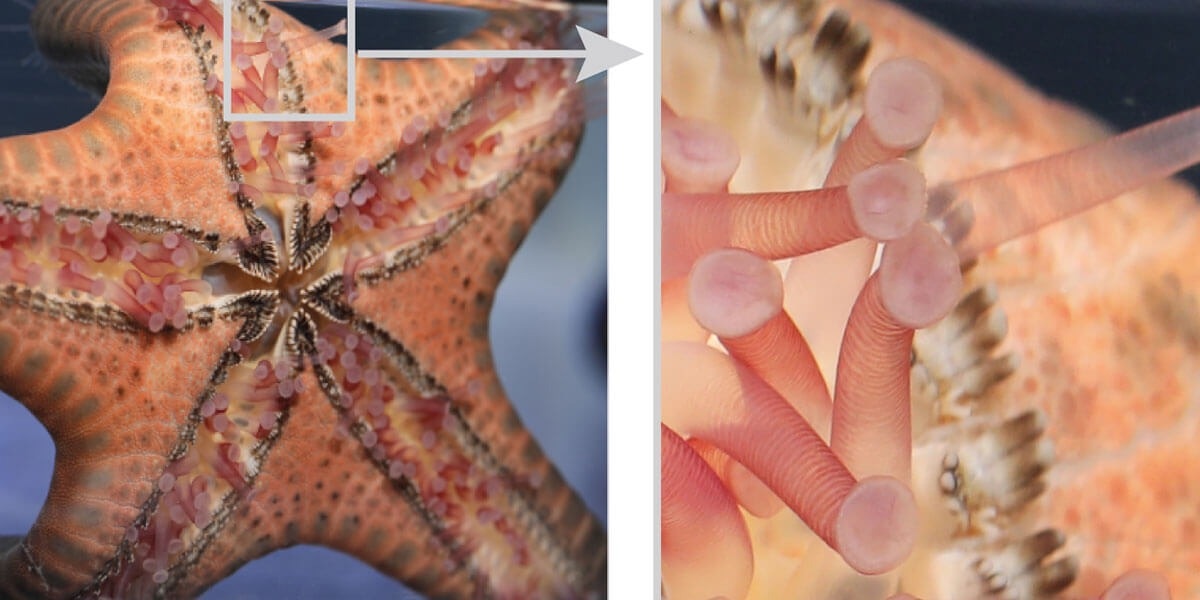 Sea star locomoting across a glass surface, picture from below, showing the attachment and detachment of tube feet. Image Credit: McHenry Lab at UC Irvine
Consider sea stars, which lack a central “brain,” yet whose movement requires the synchronization of hundreds of tiny tube feet to negotiate complicated settings.
To put it another way, it seems like every foot has an independent thought. Sea stars present an interesting phenomenon for the USC Viterbi Department of Aerospace & Mechanical Engineering's Kanso Bioinspired Motion Lab. Deciphering the flow physics of living systems is Kanso Lab's specialty, and it frequently uses these discoveries to guide advancements in robotics.
Now, researchers at USC are uncovering the secret behind this decentralized locomotion. This has the potential to completely transform autonomous robot design.
One Thought Per Foot
According to the lab's most recent PNAS study, "Tube feet dynamics drive adaptation in sea star locomotion" (January 13th, 2026), each tube foot dynamically modifies its adhesion to the surface in response to different levels of mechanical strain.
We began working on sea stars with McHenry Lab at UC Irvine, and later partnered with biologists at the University of Mons in Belgium. Together with Associate Professor Sylvain Gabriele and graduate student Amandine Deridoux at the SYMBIOSE Lab, we designed a special 3D-printed “backpack” for the sea star. By loading and unloading the backpack, we could observe and measure how each tube foot responded to the added weight.
Eva Kanso, Director, University of Southern California Kanso Bioinspired Motion Lab
What did the scientists find? When loads changed, each foot reacted independently.
From the outset, we hypothesized that sea stars rely on a hierarchical and distributed control strategy, in which each tube foot makes local decisions about when to attach and detach from the surface based on local mechanical cues, rather than being directed by a central controller.
Eva Kanso, Director, University of Southern California Kanso Bioinspired Motion Lab
The team was able to examine and measure these local reactions, thanks to the experiments.
“At USC, we developed a mathematical model showing how simple, local control rules, coupled through the mechanics of the body, can give rise to coordinated, whole-animal locomotion,” Kanso added.
No Brain, No Problem
This approach to adaptive movement based on local feedback is extremely useful for the design of soft, multi-contact robots. Potential applications on land, underwater, and even on other planets include decentralized locomotion systems for robots crossing uneven, vertical, and upside-down terrain - situations that impede regular communication from a central “mission control” or human decision-maker. Is there no brain? This is not an issue.
Kanso noted, “We also conducted experiments in which we turned the sea star upside-down – the morphology of the tube feet allows the sea star to continue to move. Just imagine if you were doing a handstand. Your nervous system would immediately let you know that you were in a position opposed to gravity. But a sea star has no such collective recognition.”
Robustness Through Redundancy
Instead, the sea star is armed with local information, as each tube foot experiences gravity differently. Coordinated movement occurs because the feet are mechanically connected to the body; when one foot pushes, it impacts the other feet. As a result, local failures do not always halt the entire system, providing for increased robustness and resilience.
That is a huge advantage for autonomous robots navigating severe settings, which are prone to flipping, losing or gaining load, or becoming detached from the primary communication source. While fast-moving animals (ranging from insects to gymnasts) rely on “central pattern generators” – specialized neural circuits in the brainstem that create rhythmic motor patterns – slow-moving sea stars are designed to respond dynamically to environmental changes.
So, it turns out there are certain advantages to being brainless. Whether negotiating tidal pressures, currents, or variable terrain roughness, sea stars adapt and move with the flow.
USC Kanso Bioinspired Motion Lab Sea Stars Experiment
Video Credit: University of Southern California Viterbi School of Engineering
Journal Reference:
Deridoux, A., et.al. (2026) Tube feet dynamics drive adaptation in sea star locomotion. PNAS. DOI: 10.1073/pnas.2509681123. https://www.pnas.org/doi/abs/10.1073/pnas.2509681123.