 By Soham NandiReviewed by Louis CastelApr 7 2026
Researchers have unveiled sub-micrometer nanorobots that use light for both propulsion and control, offering a novel approach to microscale cleaning and manipulation in biological environments. In an article published in Nature, the team introduced nanorobots powered by a plasmonic directional antenna, which harnesses photon recoil for propulsion alongside polarization-based control. These nanorobots can reach speeds of up to 50 micrometers per second (μm/s), with their motion constrained perpendicular to linear polarization. When exposed to circular polarization, they can be steered with a high degree of precision. In addition to their mobility, the nanorobots are capable of capturing, transporting, and releasing bacteria, enabling them to function as light-driven robotic cleaners with strong potential for a range of biological applications.
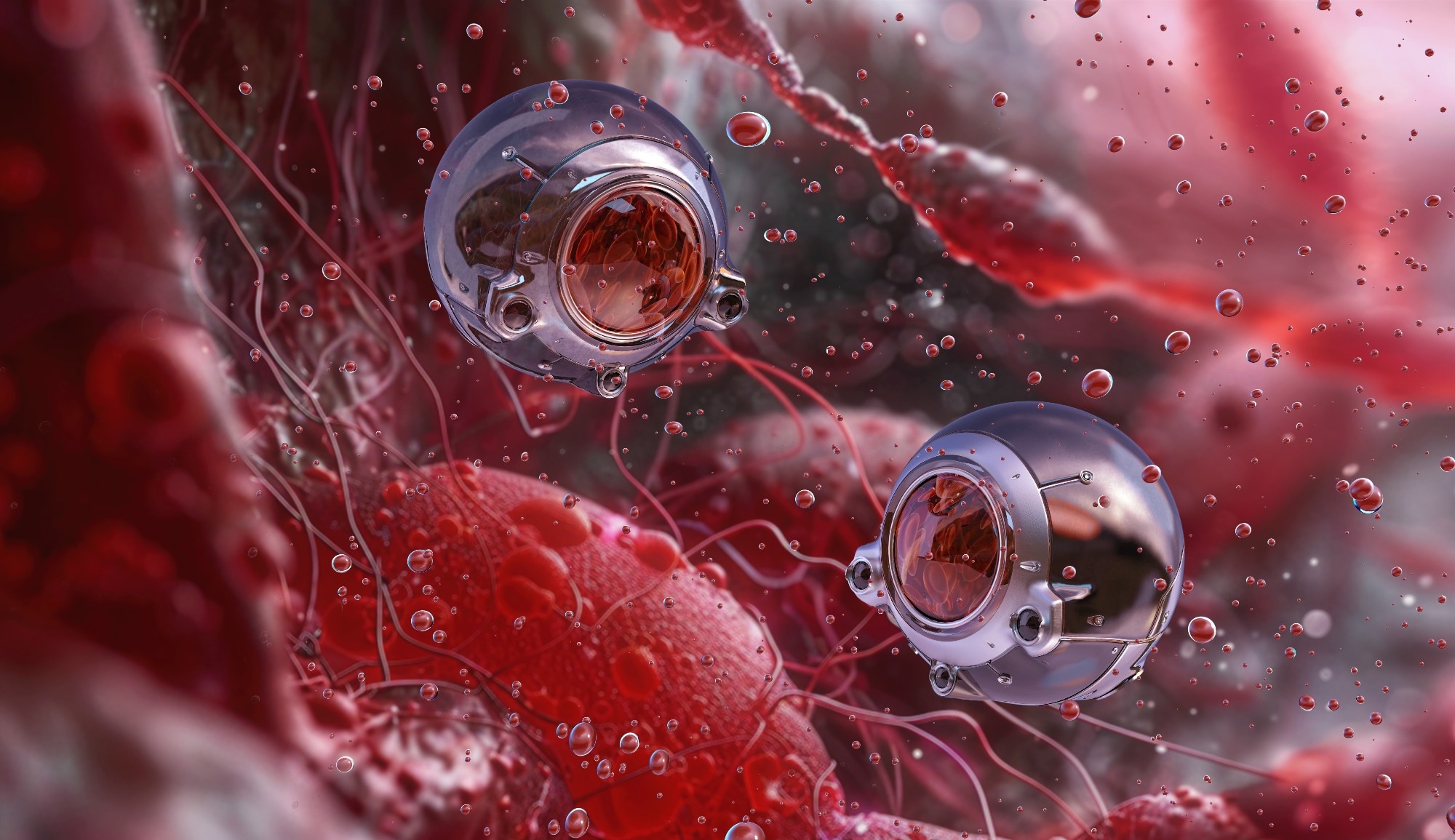
Image: Corona Borealis Studio/Shutterstock.com
Background
The manipulation of micro- and nanoscale objects using light typically relies on beam steering or tight focusing, which increases system complexity and risks photodamage. Previous work demonstrated light-driven microdrones with full two-dimensional (2D) control via multiple laser fields, but this approach sacrifices miniaturization and efficiency. Other methods, such as plasmonic dimers or metasurface-covered "metavehicles," achieved propulsion or self-correcting torque but faced limitations, either lacking simultaneous rotational and translational control or being too large for further miniaturization due to periodic structure requirements.
To address these gaps, this paper introduced sub-micrometer nanorobots (below 1 μm) using single plasmonic motors that combine unidirectional scattering for thrust and self-correcting torque to suppress Brownian rotation. This design enables precise steering, complex trajectory execution, and biological tasks like bacterial capture and transport.
Fabrication, Simulation, and Optical Methods
The fabrication of micro- and nanorobots begins with synthesizing monocrystalline gold platelets on indium tin oxide (ITO)-coated glass. A 50-nanometer (nm) thick platelet is selected, and plasmonic motors are carved using helium-focused-ion-beam milling. A hydrogen silsesquioxane (HSQ) layer forms the robot body via electron beam lithography. Robots are released by etching the ITO layer and sealed in a liquid cell, with bacterial suspensions added for experiments.
Numerical simulations using COMSOL Multiphysics optimize optical force and torque. The electromagnetic module calculates forces via Maxwell’s Stress Tensor under plane wave excitation. Heat transfer and laminar flow simulations model the liquid cell environment with boundary conditions set at 20 degrees Celsius (°C).
The optical setup uses a 980 nm continuous-wave laser diode with two electro-optic modulators to control power and polarization, switching between horizontal and vertical linear states. The laser is loosely focused through a 20× objective onto a piezo-mounted sample. Imaging is performed with a 100× oil immersion lens and a complementary metal-oxide semiconductor (CMOS) camera at 30 frames per second (fps).
For biological assays, Escherichia coli (E. coli) and Staphylococcus carnosus (S.carnosus) are cultured overnight in tryptic soy broth at 37°C, washed, and diluted 1:5000 in Milli-Q water before use.
Robot Steering and Bacterial Trapping
The researchers developed self-orienting micro- and nanorobots powered by plasmonic gold nanorod structures embedded in silica discs. The microrobot uses separate dimer antennas for propulsion and orientation locking. When exposed to linearly polarized light, the propulsion dimers generate directional thrust through asymmetric scattering, while the orientation-locking dimers produce a restoring torque that keeps the robot aligned with the polarization direction. This self-correcting mechanism allows the microrobot to follow precise rectangular trajectories by switching between horizontal and vertical polarization. Brief pulses of circularly polarized light at corners ensure deterministic turning. The robot achieves velocities up to 30 μm/s, with speed increasing linearly with laser intensity.
The team then miniaturized the design further, creating a nanorobot under 1 μm in diameter (920 nm) with a mass of just 0.26 picograms. Despite its smaller size, the nanorobot preserves orientation-locking capability and reaches even higher peak velocities of 50 μm/s. Using programmed polarization sequences, the nanorobot can trace complex patterns, including the letters "EP5" and spiral rectangular paths, functioning as a precise nanoscanner.
For biological applications, both robots were tested with mixtures of E. coli and S. carnosus bacteria. The plasmonic structures generate mild local heating (less than 10 kelvin (K) temperature increase), creating thermophoretic forces that attract and trap bacteria around the robots without causing harm. Robots can capture, transport, assemble dense bacterial clusters, and release them simply by turning off the laser. This assembly process is fully reversible. Remarkably, even when carrying bacterial loads hundreds of times heavier than themselves, the robots remain maneuverable and maintain orientation control, successfully transporting bacteria along complex trajectories like "5" and "6" shapes.
Robotic Cleaners and Future Perspectives
The researchers demonstrate that their micro- and nanorobots can function as efficient biological cleaners. By integrating stage movement to extend the operational range beyond the laser spot, a nanorobot collects bacteria from the solution and disposes of them at designated locations, significantly improving cleaning efficiency. A microrobot similarly gathers bacteria from varying heights within the suspension using thermophoretic forces. Compared to conventional optical tweezers, this approach uses two orders of magnitude lower laser intensity, causes minimal temperature increase (below 10 K), and enables high-throughput assembly of multiple bacteria simultaneously rather than single-particle trapping.
The robots maintain excellent maneuverability even when carrying bacterial loads hundreds of times their own weight. Future work may enable collective operation of multiple robots using spatial light modulators, supporting applications in bioengineering, drug delivery, and nanoscale sensing.
Conclusion
In conclusion, this work demonstrates a breakthrough in nanorobotics by introducing sub-micrometer robots driven by a single unfocused laser beam. By combining asymmetric light scattering for thrust with passive orientation-locking from linear polarization, the design achieves high-speed propulsion (up to 50 μm/s) and precise 2D steering without complex beam steering or tight focusing. The robots can capture, transport, and release multiple bacteria simultaneously using mild thermophoretic forces that avoid photodamage. Remarkably, they remain fully maneuverable even when carrying bacterial loads hundreds of times their own weight. This versatile platform opens new possibilities for biological cleaning, targeted drug delivery, and localized sensing at the nanoscale.
Download the PDF of this page here
Journal Reference
Qin, J., Büchner, C., Wu, X., & Hecht, B. (2026). A nanoscale robotic cleaner. Nature Communications, 17(1). DOI:10.1038/s41467-026-70685-9
https://www.nature.com/articles/s41467-026-70685-9
Disclaimer: The views expressed here are those of the author expressed in their private capacity and do not necessarily represent the views of AZoM.com Limited T/A AZoNetwork the owner and operator of this website. This disclaimer forms part of the Terms and conditions of use of this website.