SMU researchers created an electromagnetic coil system that can control microrobots without requiring continuous visual tracking of their position - a significant advancement that could enable microrobots to operate inside the body, within industrial pipes and other places that aren’t always visible with a camera.
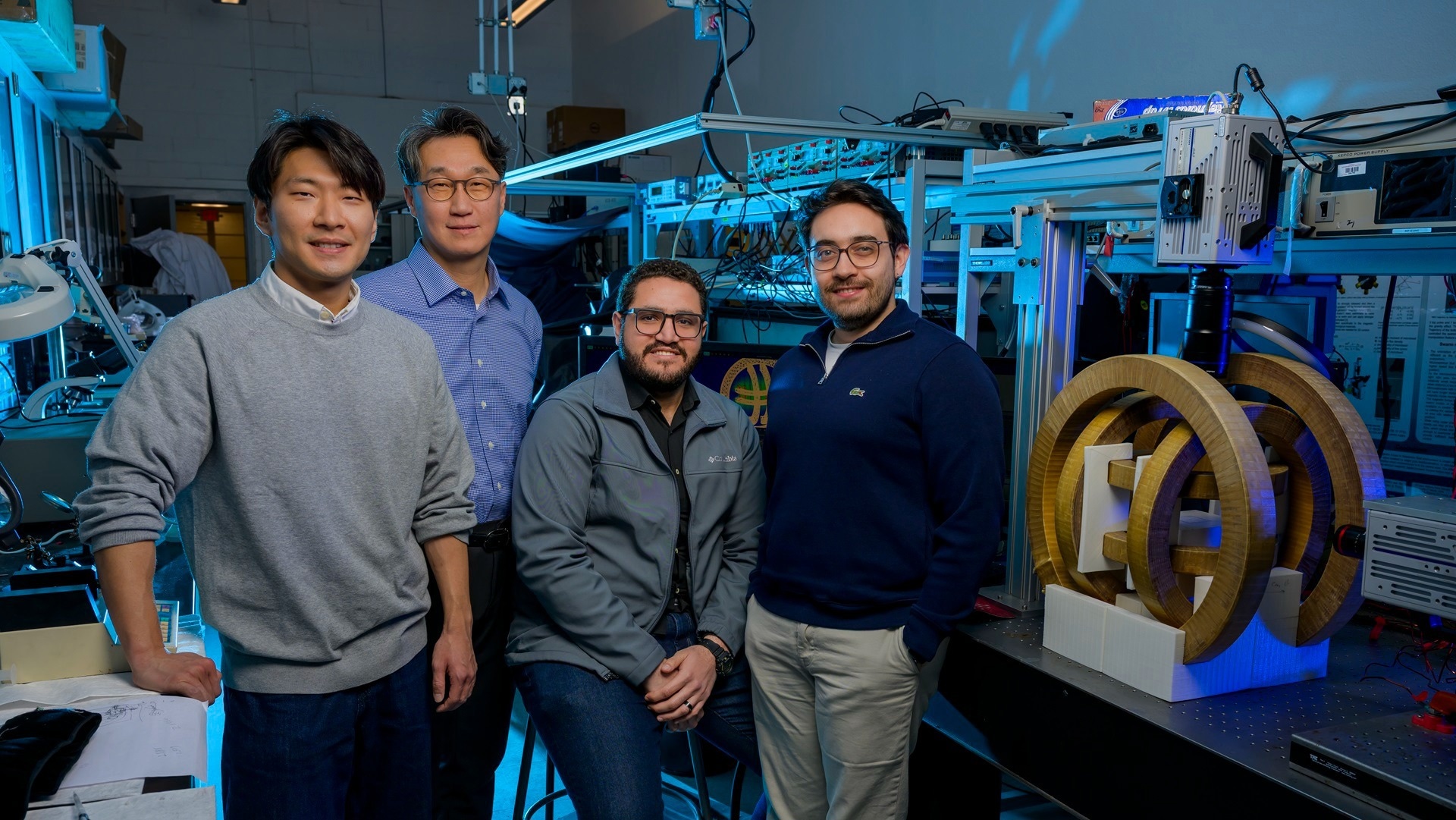 SMU researchers developed an electromagnetic coil system that controls microrobots without continuous visual tracking. This breakthrough could allow microrobots to operate inside the body, in industrial pipes, and in other hard-to-see environments. Image Credit: SMU
“In real-world settings, imaging methods can be complex, slow, expensive, or unreliable,” said lead inventor Sangwon Lee, a postdoctoral researcher at the BAST Lab at SMU. “By reducing or eliminating the need for position tracking, the system can be simpler, more robust, and more practical for those hard-to-see environments, while still providing controlled motion.”
The instrument works by creating a uniform magnetic field gradient that applies consistent force to microrobots regardless of their location within the workspace, eliminating the need for constant position updates that have long been an obstacle for microrobot control systems, explained co-inventor MinJun Kim. Kim is the Robert C. Womack Chair Professor in the Lyle School of Engineering at SMU and principal investigator of the BAST Lab.
He said this advance is particularly significant for biomedical applications, where microrobots, or tiny robots, could potentially deliver drugs to precise locations, perform minimally invasive procedures, or conduct diagnostics in areas of the body difficult to access with traditional instruments.
SMU Ph.D. student and research assistant Muhammad I. Azeez and Yasin Cagatay Duygu, who received a Ph.D. from SMU in 2026, also helped build the device, known as a triaxial Helmholtz coil instrument.
Guiding Microrobots Without Cameras
Think of a gradient of magnetic field like a slope: a steeper slope creates a stronger “pull” or "magnetic force" on the microrobot. In many existing coil systems, that slope isn’t the same everywhere - it changes depending on where the microrobot happens to be, Lee said. That means knowing the microrobot’s exact position is necessary, in order to apply the right magnetic force and get it to move to the precise position.
The new system creates a more uniform slope throughout the workspace, allowing microrobots to experience consistent magnetic forces regardless of position. As a result, the system no longer needs to constantly track the microrobot's location and make adjustments.
To generate magnetic fields in three dimensions, the researchers used six separate coils, arranged in three pairs (one pair per axis: X, Y, and Z).
This instrument was then calibrated using a triaxial magnetometer - a device that measures magnetic fields in all three directions - to make sure the system created exactly the intended magnetic fields.
To determine the correct current for each coil, researchers used a smart-solving strategy called Tikhonov regularization. This helped avoid mistakes caused by small coil misalignment and singularity issues of the Helmholtz-coil system, Kim said.
Finally, to test how well the instrument worked, they used a computer simulation tool called a COMSOL to predict how the magnetic field behaved inside the system. The results matched real-life tests with 99 % accuracy, the researchers reported in a study published in the journal IEEE Access.
With the coil system validated, the research team is now exploring techniques for estimating microrobot position using sensors other than cameras.
This material is based upon work supported by the National Science Foundation under Award No. 2518336.
Any opinions, findings and conclusions or recommendations expressed in the material are those of the authors and do not necessarily reflect the views of the National Science Foundation.