Text mining of public discourse reveals how care robots contribute to health, labor, economic, and innovation domains. This analysis highlights their broader role in transforming healthcare systems beyond functional support.
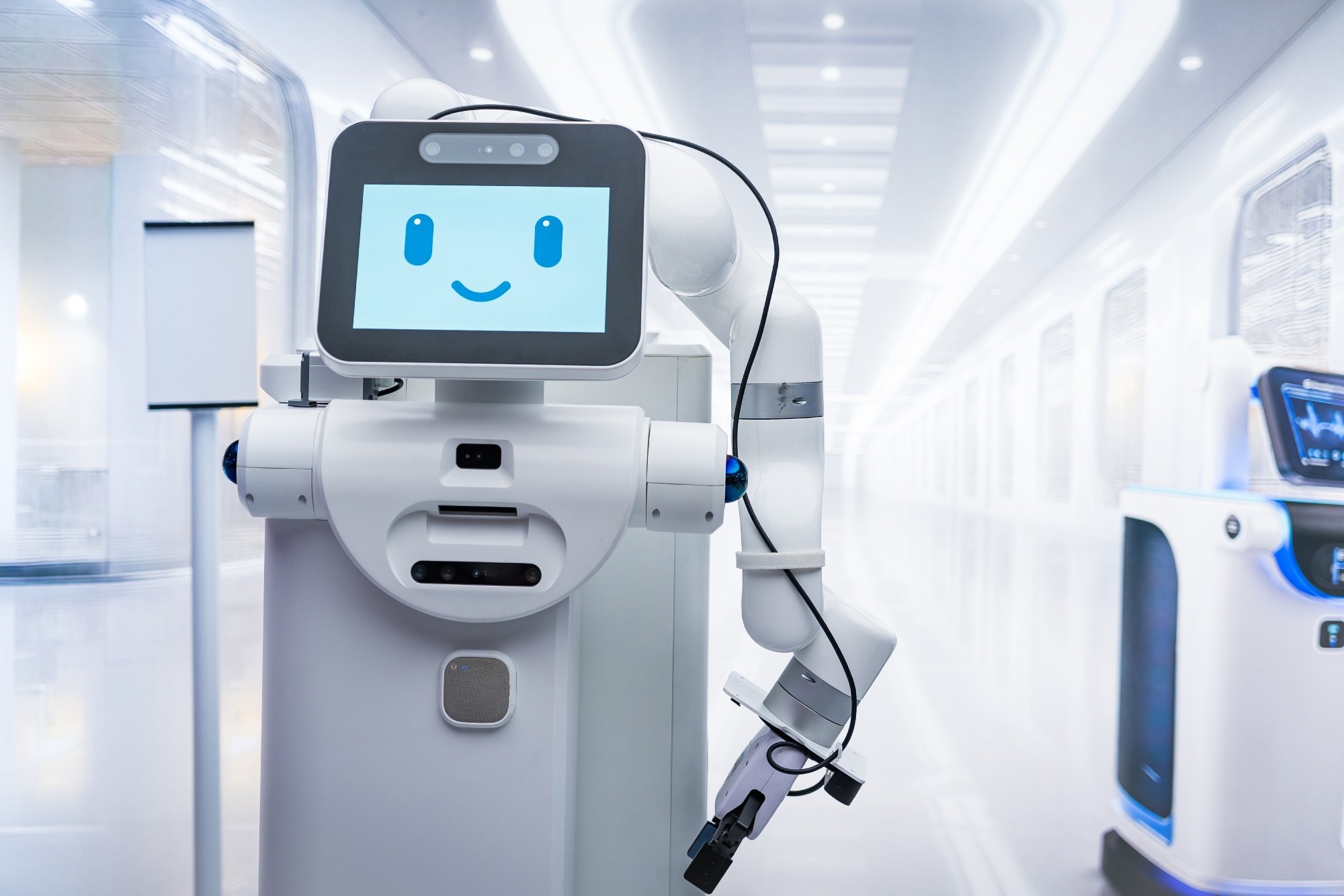 Study: Exploring the Social Value of Care Robots: Text Mining and Semantic Network Analysis. Image Credit: davide bonaldo/Shutterstock
In an article published in the journal Asian Nursing Research, researchers explored public discourse on care robots in South Korea (2021–2023) using big data text mining, topic modeling, and semantic network analysis. They identified four social value domains (health, labor, economy, and innovation), showing that care robots can address broader social challenges beyond functional support. However, current discussions are provider-driven, highlighting the need for more public engagement and user-centered approaches in nursing care.
Identifying Social Value Through Public Discourse
The global rise in disability and aging populations has increased care demands, while healthcare faces staff shortages and burnout, creating a care crisis. Care robots offer a promising solution, functioning as assistive or social assistive devices that enhance efficiency and emotional support.
However, previous research has focused narrowly on technical features or perceived effectiveness, failing to identify the social value of care robots, such as their potential to transform social structures and generate sustainable outcomes.
To address this gap, this paper analyzed public discourse from Korean online platforms using text mining, topic modeling, and semantic network analysis. It identifies four social value domains (health, labor, economy, innovation), providing foundational data for strategic care robot implementation.
Data Collection, Refinement, and Analytical Procedures
This study employed an exploratory design using text mining and semantic network analysis to examine public discourse on care robots and identify their potential social values. Data were collected from major Korean portal sites (Naver, Google, Daum) and social media (Facebook) covering January 1, 2021, to December 31, 2023.
Using TEXTOM with "care robot" as the keyword, 21,216 documents (blogs, news, café posts, comments) totaling 11.51 megabytes (MB) were collected. After removing advertisements and duplicates, 8,671 cases remained. Data preprocessing involved removing single-syllable and non-informative terms, then unifying synonyms.
Frequency analysis using term frequency-inverse document frequency (TF-IDF) identified the top 100 keywords, visualized in a word cloud. Topic modeling using the latent Dirichlet allocation (LDA) model in the machine learning for language toolkit (MALLET) determined four optimal topics based on coherence scores and semantic interpretability. To minimize subjectivity, researchers examined both keyword composition and representative texts when labeling topics.
Semantic network analysis using UCINET 6.0 and NetDraw visualized keyword relationships. From 9,724 extracted keywords, core keywords were selected using Sun Cheong-nan's formula, yielding approximately 100 keywords for analysis. Degree centrality measured keyword influence, while CONCOR analysis identified clusters within the text. A dendrogram determined cluster classification criteria.
Finally, an analytic framework based on thematic integration systematically mapped semantic clusters to social value domains (health, labor, economy, innovation) by considering keyword centrality, thematic similarity, and conceptual alignment with established social value literature.
Frequency Trends, Thematic Topics, and Network Clusters
The study analyzed 21,216 documents related to care robots from Korean portals and social media. Frequency analysis revealed two notable data peaks coinciding with government announcements on advanced industry promotion and robotics vision strategies.
Download the PDF of this page here
From 29,614 initial keywords, preprocessing yielded 9,724 unique terms. High-frequency keywords included "robot," "older adult," and "service," while TF-IDF analysis highlighted "companion robot" and "artificial intelligence" as contextually important.
Topic modeling identified four distinct themes involving companion robots that help bridge care gaps for socially isolated older adults with dementia through home-based support, care robots that contribute to economic growth through market expansion and investment, care robots that support human caregiving across sectors such as childcare, education, and disability welfare, and government-led efforts to expand social care by integrating robots into healthcare systems.
Semantic network analysis of 100 core keywords (from 9,724) revealed eight clusters with a network density of 0.998. Key clusters included health care support for vulnerable populations, companion robots for emotional bonds, community-based dementia care, changes in future care work, urban welfare system innovation, home-based care models, economic value creation through wearable technology, and industrial innovation through platform technology.
By integrating topic modeling and semantic network results using an analytic framework, four social value domains were identified: health value (supporting vulnerable populations), economic value (market expansion and investment), labor value (complementing human caregiving), and innovation value (policy-driven system transformation and service development).
From Functional Tools to Social Transformation
This study identified four social values of care robots through public discourse analysis. Health value relates to improving quality of life, autonomy, and dignity, particularly for vulnerable groups such as older adults. Care robots enable nurses to focus on human-centered care by handling repetitive tasks.
Economic value stems from reduced healthcare costs through optimized workflows, fall prevention, and addressing regional care disparities. Labor value involves reducing caregiver burden, improving working conditions, and lowering nurse turnover rates, though ethical concerns about accessibility and depersonalization remain.
According to Locsin's theory, technology enhances rather than diminishes human care. Innovative value drives technological advancement, supports "aging in place" through community-based care, and enables data-driven nursing practices.
Limitations include excluding 2020 COVID-19 data, visual platforms such as Instagram, and microblogging sites, which may limit generalizability. Future research should incorporate user-generated content and qualitative methods to capture patients' and caregivers' lived experiences.
Journal Reference
Shin Y.S., Jang H.-Y., Kim J.-A & Kang M.-S., Exploring the Social Value of Care Robots: Text Mining and Semantic Network Analysis, Asian Nursing Research, DOI:10.1016/j.anr.2026.04.002, https://www.sciencedirect.com/science/article/pii/S1976131726000344
Disclaimer: The views expressed here are those of the author expressed in their private capacity and do not necessarily represent the views of AZoM.com Limited T/A AZoNetwork the owner and operator of this website. This disclaimer forms part of the Terms and conditions of use of this website.