Nitinol-based smart implants monitor fracture healing and apply controlled stimulation. AI-driven sensing enables real-time tracking, improving recovery outcomes and reducing reliance on X-ray imaging.
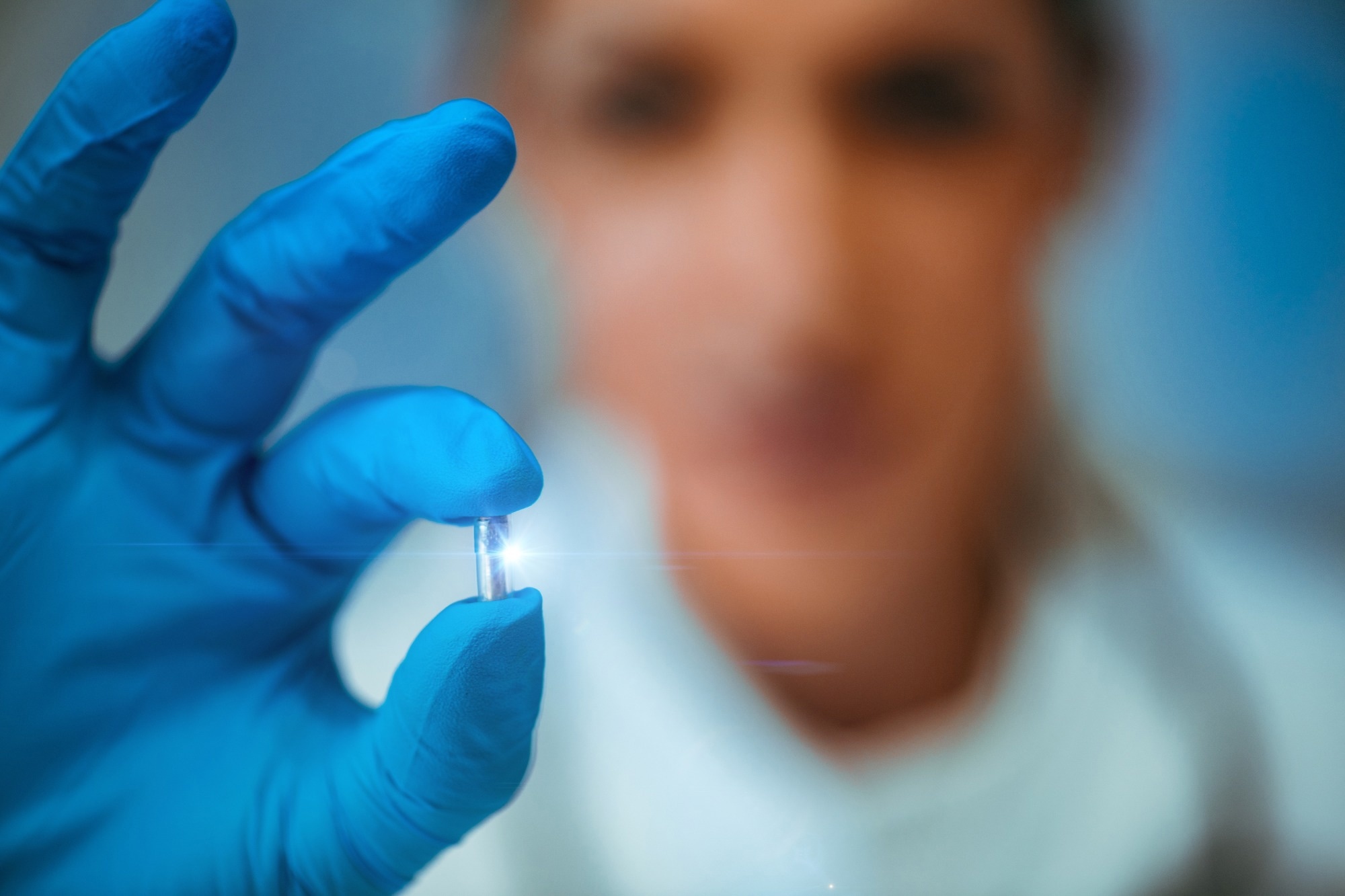 Study: Smart implants at Hannover Messe: How robotic micro-actuators are enhancing bone healing. Image Credit: Microgen/Shutterstock
In an article published by the Universität des Saarlandes, authors discussed a development in orthopedic medicine, smart implants capable of monitoring and supporting bone fracture healing. The interdisciplinary team of researchers, combining engineering, medical science, and computer science, developed prototype implants integrating shape-memory micro-actuators made from nickel-titanium alloy (nitinol).
These actuators offer inherent self-sensing capabilities, allowing continuous in vivo monitoring of fracture stiffness and tissue regeneration without X-rays. Furthermore, the implants can mechanically stimulate the fracture gap through controlled micro-movements, accelerating healing.
Addressing Gaps in Early Fracture Healing Assessment
Fracture healing is a complex biological process that typically takes several weeks before clinicians can assess its success using X-ray imaging. During this critical initial period, the healing process remains largely unmonitored, leaving patients and doctors unaware of potential complications such as delayed unions or non-unions.
If a fracture fails to heal properly, secondary interventions like bone grafts or surgical revisions become necessary, increasing patient suffering and healthcare costs. Recognizing this gap, a team at Saarland University, led by medical scientist Professor Bergita Ganse, launched the ‘Smart Implants’ project, funded by the Werner Siemens Foundation. The project aims to revolutionize fracture management by creating customized implants that continuously track healing dynamics.
Professor Paul Motzki’s engineering group contributes expertise in smart material systems, specifically shape-memory alloys. Their goal is to develop implants that not only stabilize a fracture but also adapt their mechanical properties over time and actively promote bone formation via micromechanical stimulation.
How Smart Implants Monitor and Adapt to Fracture Healing
At the core of this innovation lies the ability to continuously sense mechanical changes at the fracture site. As new bone tissue forms, the stiffness across the fracture gap increases. The smart implant detects this progression by measuring minute movements at the fracture edges, translating biological healing into quantifiable data. Professor Paul Motzki explains that this measurement data reveals not only healthy healing patterns but also harmful behaviors, such as when a patient places excessive weight on an injured leg. Consequently, the system can establish individual load limits, enhancing patient safety during recovery.
Beyond passive monitoring, the implant actively adapts its mechanical properties. Early in the healing process, when bone fragments require rigid stabilization, the implant stiffens to provide firm support. As healing advances, it switches to a more compliant mode, allowing controlled mobility that encourages natural tissue development. This adaptability is achieved through patented mechanisms controlling robotic micro-actuators. The implant can execute small movements ranging from gentle contractions to rapid vibrations, with stroke lengths of approximately 100 to 500 micrometres.
According to Professor Bergita Ganse, these tiny oscillating motions are often sufficient to initiate and accelerate tissue growth processes. By mechanically stimulating the fracture edges, the implant mimics natural biomechanical cues that promote regeneration, potentially shortening recovery times and reducing the need for follow-up surgeries.
Download the PDF of this page here
Shape-Memory Alloys for Implant Motion and Monitoring
The technological heart of the smart implant is bundles of ultrafine nickel-titanium wires, or nitinol, an alloy renowned for its shape-memory properties. Nitinol exists in two crystal phases with different lengths. When an electric current heats the wires, the alloy transitions from one phase to the other, causing the wires to contract and generate motion. Upon cooling, the wires return to their starting position.
Professor Motzki notes that nitinol possesses the highest energy density of any known drive mechanism, allowing substantial tensile forces within very small spaces. To enable rapid movements and high-frequency oscillations, researchers use wire bundles that maximize surface area for faster cooling rates.
Furthermore, nitinol offers inherent self-sensing capabilities, as its electrical resistance changes as the wire deforms. Each mechanical deformation corresponds to a specific resistance value, allowing the implant to “feel” its own position and movement. The researchers leverage this property by training neural networks on large datasets of resistance measurements. These artificial intelligence (AI) models can accurately calculate positional information even in the presence of disruptive factors like temperature fluctuations or electromagnetic interference.
Professor Motzki emphasizes that AI-assisted monitoring enables medical teams to assess whether fracture-site stiffness increases over time without exposing patients to X-ray radiation. The same data enables precise control of the wire bundles, allowing engineers to program specific movement sequences or hold the wires at any chosen position.
In future clinical use, data from the implant will be transmitted wirelessly to a smartphone, enabling remote monitoring and control. The team is now working on further miniaturization, supported by the Horizon Europe programme.
From Stabilization to Adaptive Support in Orthopedic Implants
The smart implant technology developed at Saarland University bridges the critical monitoring gap in fracture healing, replacing weeks of uncertainty with continuous, data-driven assessments. By combining nitinol-based micro-actuators, self-sensing capabilities, and AI-assisted interpretation, these implants can not only track but also actively enhance bone regeneration through controlled mechanical stimulation.
As the research progresses toward miniaturization and wireless clinical use, the potential to reduce X-ray exposure, shorten recovery times, and prevent non-unions becomes increasingly tangible. This interdisciplinary innovation promises to transform orthopedic care from passive stabilization to intelligent, adaptive healing support.
Journal Reference
Universität des Saarlandes. (2026). Smart implants at Hannover Messe: How robotic micro-actuators are enhancing bone healing. Uni-Saarland.de. https://www.uni-saarland.de/en/news/smart-implants-hannover-messe-2026-45445.html
Disclaimer: The views expressed here are those of the author expressed in their private capacity and do not necessarily represent the views of AZoM.com Limited T/A AZoNetwork the owner and operator of this website. This disclaimer forms part of the Terms and conditions of use of this website.