Artificial intelligence (AI) is transforming the management of modern data centers by improving efficiency, automating routine operations, and reducing downtime. AI is becoming crucial for monitoring server performance, optimizing cooling systems, and enhancing security. While human oversight is still required to operate an entire data center facility, AI capabilities continue to expand rapidly. This article explores the rapidly expanding capabilities of AI in managing data centers.1-4
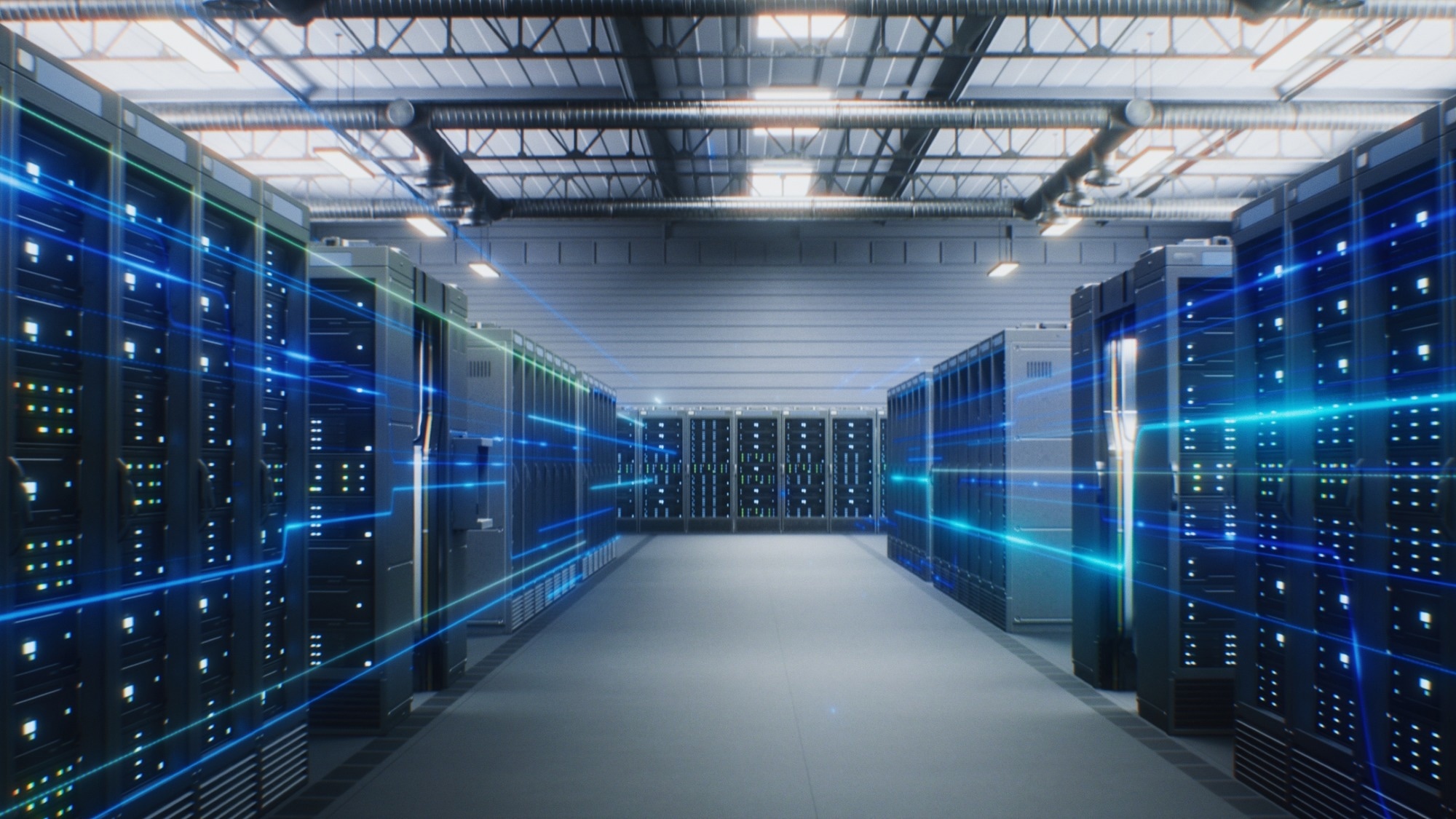 Image Credit: Frame Stock Footage/Shutterstock
AI-powered systems predict computational requirements with 95% accuracy by simultaneously analyzing historical usage patterns across several applications.1
Computing resources are dynamically adjusted by these systems in real time, leading to an average 30–40% reduction in over-provisioning compared to traditional threshold-based allocation techniques and a 15–22% reduction in operational costs within the first year.1
Contemporary AI-based resource management solutions incorporate deep reinforcement learning to continuously enhance predictive capabilities through iterative interactions with the data center environment. This continuous learning is critical in environments with variable workloads as it enables AI to maintain optimal performance without requiring manual intervention.1
In the domain of workload management and orchestration, machine learning (ML) algorithms currently distribute computing tasks intelligently throughout available resources depending on multidimensional optimization criteria.1
These algorithms balance factors like application dependencies, thermal constraints, energy consumption, and processing requirements. Intelligent orchestration has led to an average 37% reduction in application response times and a 25–30% reduction in server idle time, reducing inefficiencies associated with manual processes in large-scale operations.1
Predictive Maintenance and Network Traffic Optimization
Existing AI systems analyze up to 500 unique parameters from every infrastructure component to identify potential failures up to 2 weeks before they can be detected through traditional monitoring. This predictive capability in maintenance leads to a 73% decrease in unplanned downtime and a reduction in maintenance costs in mature implementations.1,2
Over 85% of potential equipment failures are currently addressed during scheduled maintenance periods rather than through emergency interventions, resulting in approximately $100,000–$150,000 in savings for every 1% increase in uptime in medium-sized data center operations.1
AI also enabled advances in network traffic optimization. Systems employing reinforcement learning and graph neural networks dynamically reconfigure network paths, reducing latency by 42–58% for time-sensitive applications.1
By continuously analyzing traffic patterns across several network connections, these systems identify congestion points an average of 30 seconds before they start to affect performance. Network traffic is preemptively rerouted to preserve optimal throughput.1
Power Management for Energy Efficiency
Energy efficiency has become a major issue in modern data centers, as power-related expenses account for 40–60% of overall operational costs. Conventional cooling methods, such as air conditioning, incur high operational costs and excessive energy consumption.1
AI-based cooling systems decrease energy consumption by 20–35% compared to traditional approaches, with DeepMind realizing a 40% reduction in cooling energy needs across its data centers. AI fine-tunes cooling zones within a facility by directing cooling resources to zones with the highest demand while preserving energy in less critical zones.1
Hundreds of sensors are deployed by these systems throughout facilities to monitor equipment thermal signatures, airflow, humidity, and temperature in real time, processing more than 21 million data points per day to identify optimization opportunities that would otherwise go undetected.1
AI cooling management also encompasses comprehensive environmental management. ML algorithms anticipate cooling requirements 24–72 hours in advance by integrating predictive weather analysis with internal thermal mapping, automatically adjusting cooling infrastructure to optimize efficiency while maintaining thermal compliance.1
During high-demand periods, this predictive capability allows data centers to curtail peak power consumption by 18–27% and reduce utility costs, which can exceed $1.5 million yearly for large-scale operations, reducing energy wastage.1
AI systems significantly impact server power management by optimizing resources and dynamically allocating workloads, reducing energy consumption by 29–45% through intelligent consolidation.1
By implementing these technologies, improvements of 0.15–0.25 points in Power Usage Effectiveness (PUE) can be achieved without major hardware modifications, resulting in substantial operational savings for enterprise-scale deployments.1
Renewable Energy Integration
The integration of AI and renewable energy management is a major step towards increasing the sustainability of data centers. AI-based systems can reduce data centers' carbon footprint by optimizing cooling operations to align with the availability of wind and solar energy.1,3
Saving this for later? Download a PDF here.
ML algorithms optimize the utilization of renewable energy by analyzing grid carbon intensity, workload flexibility, and generation patterns to schedule energy-intensive operations during periods when maximum renewable energy is available.1,3
With intelligent orchestration, data centers with on-site renewable generation can increase renewable energy use by 35–50%, reducing energy costs and carbon emissions. AI systems coordinate with grid operators at centers without on-site generation to shift workloads to periods of high renewable penetration.1
This leads to a 20–30% reduction in effective carbon intensity and also a major decrease in energy expenses through time-of-use optimization. By integrating renewable energy, implementing dynamic temperature control, and leveraging predictive analytics, data centers can ensure both sustainability and energy efficiency.1
Cybersecurity Enhancement and Anomaly Detection
In data center security, anomaly detection is crucial because malicious activities such as data breaches and intrusions disrupt operations. Clustering and deep learning algorithms could identify unusual patterns in data center system behavior and traffic.2
Deep learning models are effective for real-time anomaly detection in data center network traffic. Studies have shown that AI models detect security threats 35% faster than conventional signature-based systems and with greater accuracy. This capability improves data center cybersecurity by identifying previously unseen threats in real time.2
Similarly, a hybrid AI model integrating ML and statistical analysis can identify anomalies in hardware performance data, achieving a 20% improvement in detection accuracy over traditional methods. This approach improves the overall resilience of data centers against internal system failures and external cyberattacks.2
While AI-driven anomaly detection systems surpass conventional methods in detecting known and unknown threats, improving system security and reducing response times, challenges remain in ensuring that AI models handle the huge data volumes of large-scale data centers and in dealing with false positives.2
New Developments
A paper recently published in IEEE Intelligent Systems proposed and developed a novel Physical AI (PhyAI) framework to advance data center operations and management. The framework leveraged advanced industrial technologies coupled with in-house research and development to enhance data center efficiency.4
It consisted of three core modules: an industry-grade simulation engine for accurate data center operation modeling; an AI engine based on NVIDIA PhysicsNemo for training and evaluating physics-informed machine learning (PIML) models; and a digital twin platform built on NVIDIA Omniverse to support a five-tier digital twin architecture.4
The proposed system provided an adaptable and scalable solution for digitalizing, optimizing, and automating future data center operations through real-time digital twins.4
To validate its effectiveness, the study developed a surrogate model to predict the thermal and airflow profiles of a large-scale data center in real time. The model surpassed conventional computational fluid dynamics/heat transfer simulations by achieving a median absolute temperature prediction error of only 0.18 °C.4
The physics-informed model achieved results comparable to the high-fidelity physical simulator while delivering 105× acceleration and inferring the high-dimensional velocity and temperature fields in real time. Thus, the findings showed that the proposed PhyAI framework could pave the way for several research directions to advance PhyAI in future data center operations.4
AI’s Rapidly Expanding Role
AI can independently handle multiple aspects of data center operations, including resource allocation, cooling optimization, predictive maintenance, energy management, and security monitoring.
However, fully autonomous data centers are yet to become a reality, as human supervision remains necessary for strategic decisions, maintenance, and complex problem-solving. Future advances may enable AI to operate data centers with minimal human intervention.
References and Further Reading
- Patel, P. D. (2025). Artificial Intelligence in Datacenters: Optimizing Performance, Power, and Thermal Management. Journal of Computer Science and Technology Studies, 7(4), 952-963. DOI: 10.32996/jcsts.2025.7.4.109, https://al-kindipublishers.org/index.php/jcsts/article/view/9671
- Ademilua, D. A. (2025). Intelligent data centers: leveraging AI and automation for process optimization and operational efficiency. International Journal of Advanced Trends in Computer Science and Engineering, 14(2). DOI: 10.30534/ijatcse/2025/071422025, https://www.warse.org/IJATCSE/static/pdf/file/ijatcse071422025.pdf
- Nash, K. (2024). Transforming Data Centers: How AI Revolutionizes Energy Efficiency in Cooling. https://www.researchgate.net/publication/404815145_Transforming_Data_Centers_How_AIRevolutionizes_Energy_Efficiency_in_Cooling
- Cao, Z., Li, M., Ling, F., Jia, J., Wen, Y., Yin, J., & See, S. (2026). Transforming future data center operations and management via physical AI. IEEE Intelligent Systems, 41, 3, 91-100. DOI: 10.1109/MIS.2026.3668406, https://ieeexplore.ieee.org/abstract/document/11414252
Disclaimer: The views expressed here are those of the author expressed in their private capacity and do not necessarily represent the views of AZoM.com Limited T/A AZoNetwork the owner and operator of this website. This disclaimer forms part of the Terms and conditions of use of this website.