Hospitals around the world are running short of hands. Nurses walk long corridors to fetch supplies, physicians spend hours on documentation, and vacancies stay open for months. AI-powered robots have arrived with a clear promise to absorb repetitive labor so that clinical staff can spend more of their shift beside patients.
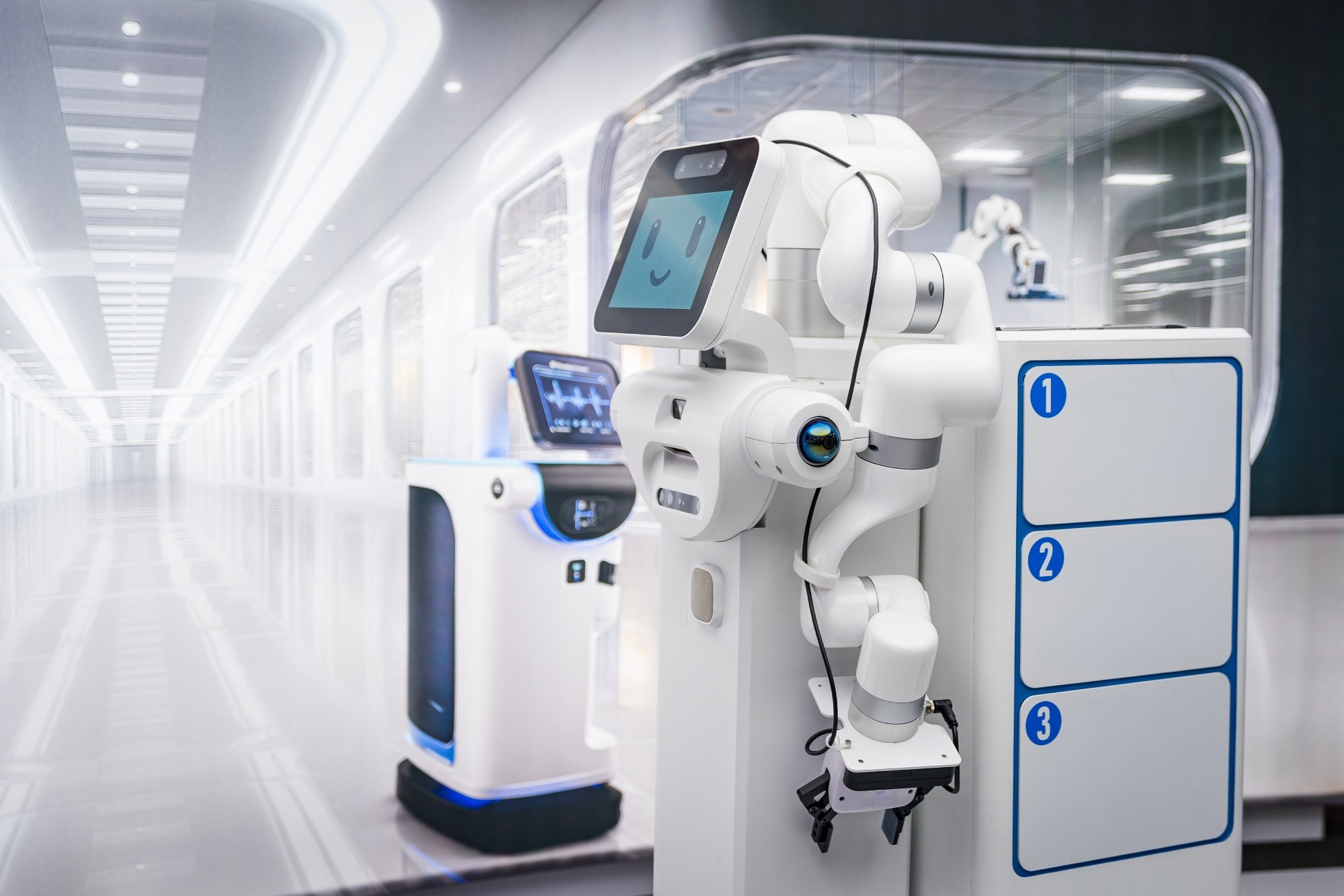 Image Credit: davide bonaldo/Shutterstock
Whether those machines can solve healthcare's biggest workforce challenges deserves a careful answer grounded in measurement rather than marketing. Hospital trials, research, and surveys from medical associations show measurable improvements in narrow logistical tasks. However, there are stubborn limits in every activity that requires clinical judgment, physical touch, and patient trust.1,2
The Size of the Gap
The World Health Organization counts a global stock of more than 70 million health workers and a shortage that fell from 15.4 million in 2020 to 14.7 million in 2023. Projections now place the 2030 shortfall at 11.1 million, concentrated in the African and Eastern Mediterranean regions.1
Wealthier systems face their own arithmetic. The OECD projects a deficit of about 3 million health workers across member countries, with population aging and chronic disease driving demand faster than training pipelines can respond. Emotional exhaustion among health workers rose from 36% before the pandemic to 63% during it.3
Retention explains much of the pressure. Shift work, ergonomic strain, emotional labor, and administrative documentation push experienced clinicians toward the exit, and each departure removes expertise that took years to build. Any technology aimed at the workforce problem has to make the job itself more sustainable.4
What These Robots Actually Handle?
Hospital robots are divided into recognizable families. Service robots move medicine, meals, blood samples, and linen. Telepresence units carry video consultations between wards. Clinical and rehabilitation systems support sterility, diagnostics, and physical therapy, while surgical platforms, such as the da Vinci system, extend a surgeon's precision via a console.2
A two-phase study published in the Journal of Nursing Management screened 15,125 records and included 199 publications describing nursing robots for general adult wards. Researchers also catalogued 26 nursing functions. Transfer assistance appeared in 34.17% of reports, medication and other item delivery in 22.61%, and automated ward rounds in 9.05%.5
Among the robots identified, 71.9% sat in the design phase, 12.6% were under testing, and 15.6% had reached application. About 85.9% performed a single function, which means a ward wanting broad coverage would need to buy, maintain, and coordinate several distinct machines.5
Counting the Hours Saved
The same research team observed 7,073 inpatients across 72 wards in six tertiary hospitals, timing care activities down to the second. Direct nursing averaged 2.32 hours per patient every 24 hours. Fully deploying the catalogued robots could cover 62.37% of that per-capita workload.5
That headline figure carries an important qualifier. It models a hospital where every identified robot works reliably at once, including prototypes and patented designs that no ward has purchased. The realistic near-term figure sits far lower, shaped by procurement budgets, elevator access, floor layouts, and maintenance contracts.5
Intensive care research points toward a similar pattern of partial relief. Automated documentation reduces administrative load and adds flexibility when notes get written. Similarly, continuous monitoring allows a nurse to step away from the bedside without missing a deterioration, freeing attention for problems that require a human decision.4
Where the Evidence Cools
A seven-month interventional study in a German nuclear medicine unit tested a delivery robot combined with a staff communication app. Nurses were observed across six shifts at nine time points, and researchers tracked walking distances, stress scores, and radiation exposure throughout the deployment period.6
Results proved sober. The combined technology had no direct effect on stress levels or total walking distances, showing only a gradual shift toward shorter trips as staff became accustomed to the system. Perceived stress tracked the number of walking trips and the frequency of interruptions rather than the distance covered.6
Saving this for later? Download a PDF here.
Organizational friction compounds the problem. Across 40 studies of hospital employees, 14 reported insufficient knowledge, awareness, and support around robots, and 11 reported skepticism strong enough to limit use. Lack of scheduled practice time was the most frequently mentioned concern, linked with unsuccessful integration and degraded care.2
Trust Determines Uptake
Professional bodies hold a measured position. Among 18 medical associations surveyed by the OECD, 72% judged the benefits of health AI greater than its risks, while 94% voiced ethical concerns. Every association agreed that physicians need more education before implementing these tools in clinical practice.3
The primary concern among providers is about the processes rather than employment itself. Many providers express significant worry that systems are being developed and implemented without their input. In fact, 74% of the surveyed associations identified data accessibility and operational infrastructure as major barriers to the responsible adoption of these systems within their health networks. Involving clinicians early in the development process can help shape what gets built.3
Autonomy sits at the center of that concern. Intensive care staff described local decision-making authority as a strength. It allows units to absorb sudden changes in patient volume and equipment failure. Heavy AI-driven standardization can make workflows rigid and erode the judgment that keeps critical care resilient.4
Making Deployment Work
Successful programs treat robots as one component of a larger work system. Task allocation deserves deliberate thought, with partial automation for diagnostic support and prescribing decisions, higher automation for continuous monitoring and routine documentation, and full human control preserved wherever patients interact directly with the people caring for them.4
Practical conditions matter as much as engineering quality. Protected training hours, visible management backing, and extra support for older staff members turn a purchased machine into a used one. Colleagues demonstrating the technology during shifts proved more persuasive than formal introductions in several of the hospitals reviewed.3
Geography raises a harder equity question. Nearly all robot research comes from high-income countries, while the projected 2030 shortfall is concentrated in low- and middle-income regions with thinner capital budgets and technical support networks. The places with the deepest staffing gaps stand furthest from these solutions.3
A Grounded Answer
AI-powered robots address specific challenges in the healthcare workforce. They move supplies, watch monitors, draft notes, and lift patients, returning fragments of time to people whose expertise lies elsewhere. Those fragments accumulate into something meaningful when hospitals redesign schedules and roles around them.5
Solving the shortage requires the slower work of expanding training capacity, paying fairly, legislating safe staffing ratios, and distributing clinicians toward the regions where they are most needed. Robots play a supportive role in this effort by making demanding jobs more manageable and helping to retain skilled professionals in the field for longer. While their contribution is meaningful, it is just one part of a broader solution.1
References and Further Reading
- Health and care workforce Global strategy on human resources for health: workforce 2030. (2024). World Health Organization. https://apps.who.int/gb/ebwha/pdf_files/EB156/B156_15-en.pdf
- Rasmussen, M. K. et al. (2024). New colleague or gimmick hurdle? A user-centric scoping review of the barriers and facilitators of robots in hospitals. PLOS Digital Health. DOI:10.1371/journal.pdig.0000660. https://journals.plos.org/digitalhealth/article?id=10.1371/journal.pdig.0000660
- Artificial Intelligence and the Health Workforce: Perspectives from Medical Associations on AI in Health. (2024). OECD Artificial Intelligence Papers. https://www.oecd.org/content/dam/oecd/en/publications/reports/2024/11/artificial-intelligence-and-the-health-workforce_c8e4433d/9a31d8af-en.pdf
- Bienefeld, N. et al. (2025). AI Interventions to Alleviate Healthcare Shortages and Enhance Work Conditions in Critical Care: Qualitative Analysis. Journal of Medical Internet Research, 27, e50852. DOI:10.2196/50852. https://www.jmir.org/2025/1/e50852
- Song, Y. et al. (2025). Nursing Robots Can Reduce Nursing Workload in General Adult Wards: A Two-Phase Study. Journal of Nursing Management, 9096837. DOI:10.1155/jonm/9096837. https://onlinelibrary.wiley.com/doi/10.1155/jonm/9096837
- Warmbein, A. et al. (2025). First Integration of a Service Robot and a Communication Application into a Nursing Isolation Setting – An Observational Study Evaluating Walking Distances, Stress and Radiation Doses. Int J of Soc Robotics 17, 1809–1820. DOI:10.1007/s12369-025-01215-8. https://link.springer.com/article/10.1007/s12369-025-01215-8
Disclaimer: The views expressed here are those of the author expressed in their private capacity and do not necessarily represent the views of AZoM.com Limited T/A AZoNetwork the owner and operator of this website. This disclaimer forms part of the Terms and conditions of use of this website.