Vision-guided robots are transforming automated food inspection by integrating advanced imaging systems with robotics to improve accuracy, speed, and consistency. Unlike conventional inspection methods, these robots perform inspection in real time while reducing human error.
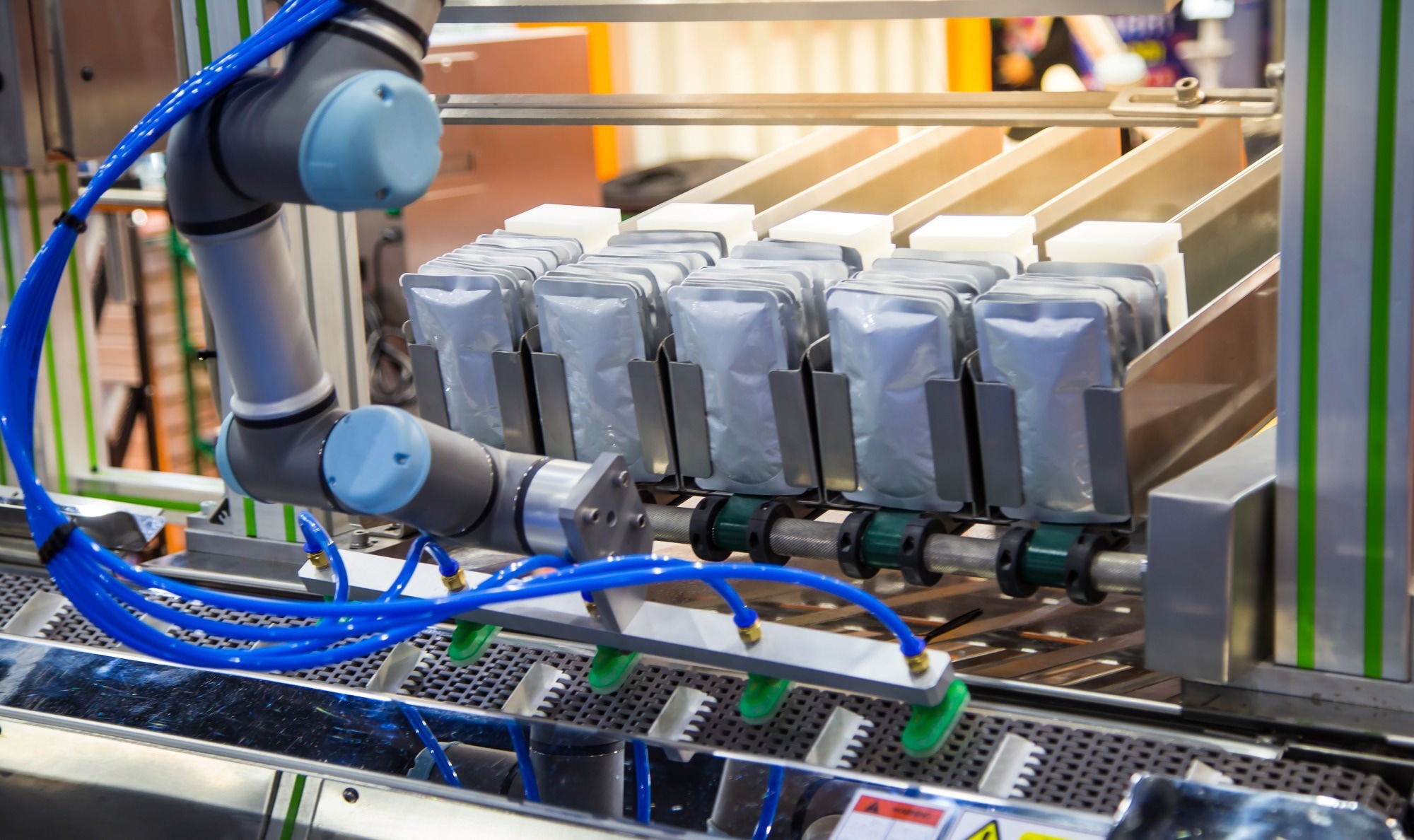 Image Credit: Itsanan/Shutterstock
Vision-guided Robots in Food Manufacturing
In food manufacturing, robots are used in several processes with prominent applications including harvest controlling and cutting, food processing and extraction, food loading/unloading and packaging, food retail operations, and food warehouse operations.1
Quality grading is crucial in food manufacturing, enabling price determination, waste reduction, and better client allocation. Robots are well-suited to the food industry, where a high level of repetition, consistency, and speed is required.2,3
They typically outperform humans in terms of accuracy and efficiency. Recently, robots with verbal command understanding, multitasking, and intelligent vision have been developed. Vision technologies can discern the orientation and location data of individual food items.2,3
Robotic systems can use this data to manipulate products based on operation type, food characteristics, and existing end-effector capabilities, thereby enabling the selection of an effective automation framework. Effective automation of robotic processes relies on the suitability of the end-effector for the process and product. Although robots are versatile, the end-effector must be customized to maximize performance.3
Additionally, handling objects with transient and unpredictable physical properties can benefit from learning-based optimizations, such as machine learning or reinforcement learning, rather than traditional heuristics.3
Fish Grading and Packaging
While automated fish grading and packaging is crucial in the seafood industry, fish grading remains underexplored in previous research. Several existing vision systems depend on conventional handcrafted methods.3
Unlike deep learning methods, traditional approaches require ad hoc parameter tuning because they are task specific. This leads to generalization bottlenecks owing to limited robustness to illumination changes. In a study published in IEEE/CAA Journal of Automatica Sinica, researchers presented a novel proof-of-concept robotic vision system for size-based automatic fish grading and packaging.3
The proposed system classified frozen fish steaks into two size grades and localized them on a conveyor belt for robotic pick-and-place through a specialized end-effector. Researchers acquired and annotated a dataset of fish steaks moving on a conveyor belt.3
The grading task consisted of a standalone vision system. At the same time, the packaging task also required the vision system to determine the identity and three-dimensional (3D) location of fish steaks that will be handled.3
Additionally, the packaging task required a robotic system that receives coordinates from the vision module and proceeds with the pick-and-place operation for steak packaging.3
Functioning of the Robotic Vision System
Initially, depth and red-green-blue (RGB) images of the fish steaks were captured and aligned, followed by manual annotation of the RGB images by segmenting the fish steaks using the computer vision annotation tool.3
An instance segmentation model was trained on annotated data and used to infer fish segments from RGB images. Researchers used the depth image to measure steak size, grade steaks (A or B), and determine 3D coordinates for each segmented fish steak.3
The information obtained in the previous step was transmitted to the robotic system via a Transmission Control Protocol socket. Upon receiving the information, the pick-and-place handling operation was executed by the robotic system.3
Results showed that the proposed system achieved 87.6% grading accuracy and 87% robotic packaging rate, demonstrating the potential of the novel robotic vision system for automated food quality inspection and handling. The system can be implemented at a cost of $1,200, assuming an 87% success rate.3
Vision-guided Robot for Food Product Inspection
In a study published in the 2023 International Conference on IoT, Communication and Automation Technology (ICICAT), a mobile robot with visual guidance was proposed to improve product search in malls and supermarkets.4
The robot identifies product availability, locates items, and verifies that products are correctly placed on shelves, reducing manual effort and improving efficiency in retail operations. A mobile robot derived from TIAGO – Mobile Robot was introduced to perform these actions efficiently. It was cost-effective and decreased complexity levels for easy handling.4
A camera sensor was mounted on the head-mounted part of the robot, while the light detection and ranging (LiDAR) sensor was mounted at the robot base. The vision-guided inspection robot scans products on the shelves and informs the person at the counter whether each product is in its correct position or on the correct shelf.4
In this way, the robot assists in sorting products for placement in their designated locations based on their barcode numbers. The ‘you only look once’ version 8 (YOLO v8) algorithm, which runs on the camera sensor, performs the inspection of food products and articles.4
Download the PDF of this page here
After inspecting and recording the food articles and packets, it confirms whether the proposed item is placed in its correct position. Then, the system selects the best possible path to its destination by mapping the mall area with sensors and creating a graphical user interface to control the robot's navigation.4
The robot localizes, plans, and maps its path through the environment by collecting required information from the camera and LiDAR mounted on the robot on the ROS platform, using a suitable simultaneous localization and mapping (SLAM) algorithm.4
AI-assisted Vision-guided Robots
While vision-guided robotic systems are effective in food and beverage packaging and manufacturing under controlled conditions, they struggle with anomalies in product size, shape, appearance, presentation, and texture.5
AI-assisted vision-guided robots could effectively deal with the variability found in food products. AI can recognize irregular shapes, varying sizes, and deformities while handling fresh produce. It improves inspection capabilities by detecting spoilage/allergens not visible to human inspectors and assessing fat content in chicken breasts.5
The Way Forward
In conclusion, vision-guided robots play a pivotal role in advancing food inspection and manufacturing by improving accuracy, adaptability, and efficiency. Future AI-powered systems will integrate improved sensors and robotics to manage complex food variations while reducing waste and ensuring safety. Continued innovation and research will enable the widespread adoption of intelligent robotic inspection solutions across the food industry.
References and Further Reading
- Barasa, S., Etene, Y. (2023). Robotics in food manufacturing industry in the Industry 4.0 era. International Journal of Computer Science and Mobile Computing, 12(8), 72-77. DOI: 10.47760/ijcsmc.2023.v12i08.009, https://www.academia.edu/105617544/Robotics_in_Food_Manufacturing_Industry_in_the_Industry_4_0_Era
- Hwa, L. S., & Chuan, L. T. (2024). A Brief Review of Artificial Intelligence Robotic in Food Industry. Procedia Computer Science, 232, 1694-1700. DOI:10.1016/j.procs.2024.01.167, https://www.sciencedirect.com/science/article/pii/S1877050924001686
- Mekhalfi, M. L. et al. (2026). Vision-Guided Robotic System for Automatic Fish Quality Grading and Packaging. IEEE/CAA Journal of Automatica Sinica, 13(4), 983-985. DOI: 10.1109/JAS.2025.125801, https://ieeexplore.ieee.org/abstract/document/11503194
- Natarajan, A., Pramod, S., & Megalingam, R. K. (2023). Vision-guided robot for product inspection. 2023 International Conference on IoT, Communication and Automation Technology (ICICAT), 1-6. DOI: 10.1109/ICICAT57735.2023.10263666, https://ieeexplore.ieee.org/abstract/document/10263666
- Harvey, A. (2025) AI Assists Vision-Guided Robots in Food and Beverage Inspection [Online] Available at https://www.photonics.com/Articles/AI-Assists-Vision-Guided-Robots-in-Food-and/a70561 (Accessed on 04 August 2026)
Disclaimer: The views expressed here are those of the author expressed in their private capacity and do not necessarily represent the views of AZoM.com Limited T/A AZoNetwork the owner and operator of this website. This disclaimer forms part of the Terms and conditions of use of this website.