Reviewed by Frances BriggsDec 3 2025Reviewed
A new carbon-based thin film promises cooler, faster, and far more efficient AI hardware by eliminating charge buildup and cutting energy waste inside integrated circuits.
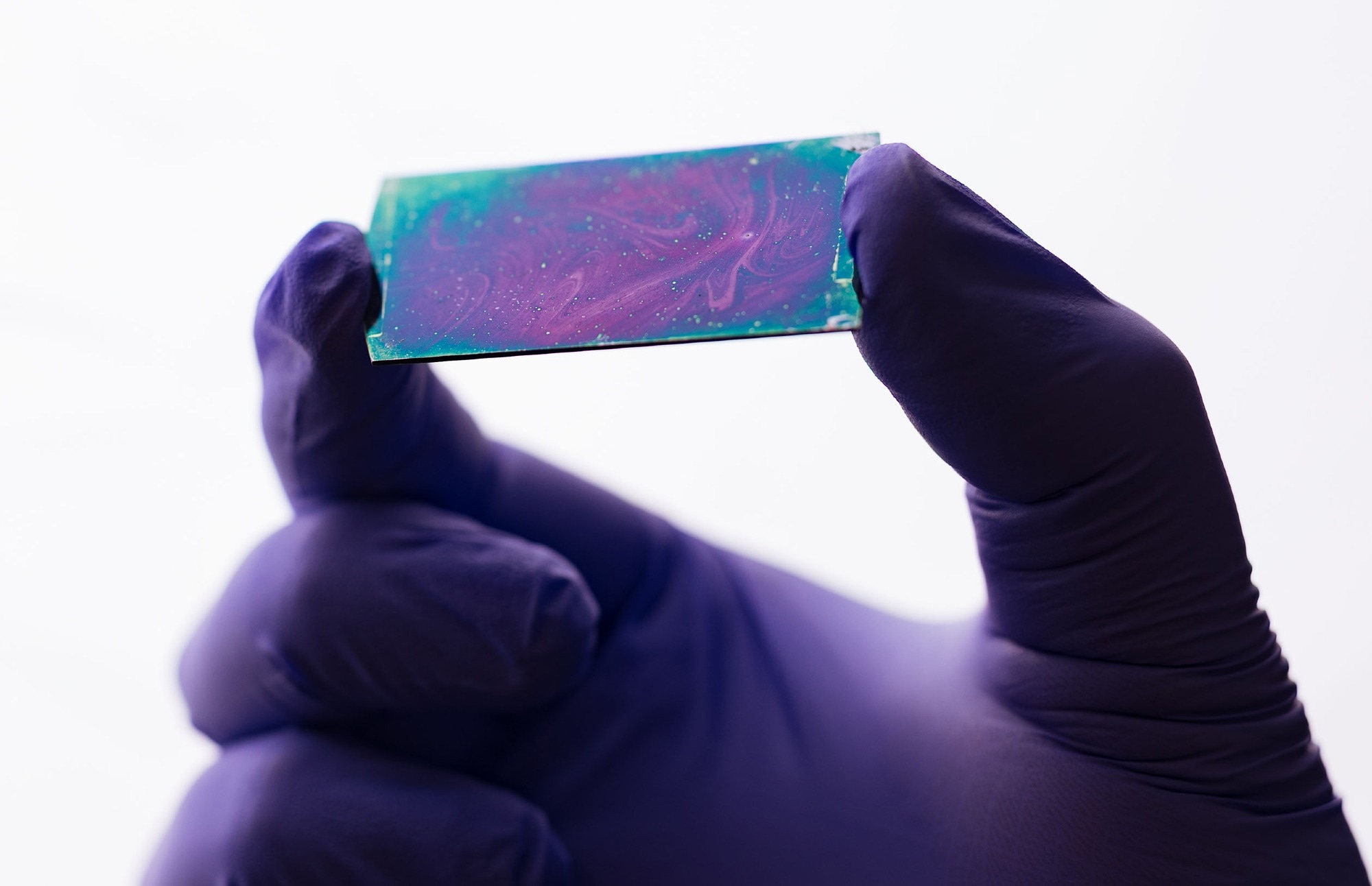 This is the two-dimensional thin film electric insulator designed in a University of Houston lab to make AI faster and reduce power consumption. Image Credit: University of Houston
Engineers at the University of Houston have designed an innovative thin-film material which could transform AI by substantially increasing device speed and drastically reducing energy usage. This innovation directly tackles the immense power and energy requirements inherent in AI technologies.
The study was published in ACS Nano.
The report reveals a specialized two-dimensional (2D) thin film dielectric that functions as an electrical insulator. Its primary role is to supersede conventional, heat-producing elements within integrated circuit chips.
Importantly, the material doesn't retain electrical charge, and so mitigates the substantial energy expenditure and thermal output associated with the high-performance computing essential for AI applications today.
AI has made our energy needs explode.
Many AI data centers employ vast cooling systems that consume large amounts of electricity to keep the thousands of servers with integrated circuit chips running optimally at low temperatures to maintain high data processing speed, have shorter response time, and extend chip lifetime.
Alamgir Karim, Dow Chair and Welch Foundation Professor, William A. Brookshire Department of Chemical and Biomolecular Engineering, University of Houston
The Solution: “Low-K” Electronic Material
Karim and former doctoral student Maninderjeet Singh developed dielectric films using Nobel Prize-winning metal-organic framework materials. Their new material aims to control power consumption and enhance performance.
These next-generation materials are expected to boost the performance of AI and conventional electronics devices significantly.
Maninderjeet Singh, Postdoctoral Researcher, Columbia University
Dielectrics vary in their characteristics. High-permittivity (high-k) materials, for example, store more electrical energy but also dissipate more heat than low-k materials.
Consequently, Karim's work centered on low-k materials, specifically lightweight covalent organic frameworks composed of light elements such as carbon, which enhance signal speed and minimize delays.
“Low-k materials are base insulators that support integrated circuit conductors carrying high-speed and high-frequency electrical signals with low power consumption (for example, high-efficiency because chips can run cooler and faster!) and also low interference (signal cross-talk),” said Karim.
The new material, developed by the team, consists of carbon and other light elements, forming covalently bonded sheetlike films with highly porous crystalline structures. Subsequently, the team, alongside Saurabh Tiwary, investigated its electronic properties for next-generation low-k device applications.
Incorporation of low-k materials into integrated circuit devices has the tremendous potential to greatly lower power consumption by the booming AI data centers growth.
We discovered that the 2D sheets had an ultralow dielectric constant and ultrahigh electrical breakdown strength needed for high-voltage operation for high power devices, with good thermal stability even at elevated device operating temperatures.
Maninderjeet Singh and Alamgir Karim
Shaffer and Schroeder created the films through synthetic interfacial polymerization. This method involves dissolving molecules in two immiscible liquids, leading to the stitching of molecular building blocks to form strong, crystalline layered sheets. The technique itself was discovered by 2025 Chemistry Nobel Prize winners.
Journal Reference
Singh, M. et al. (2025). Two-Dimensional Covalent Organic Framework Films for High Dielectric Strength Electrically and Thermo-Mechanically Stable Low Permittivity Dielectrics. DOI: 10.1021/acsnano.5c11582.