 By Soham NandiReviewed by Frances BriggsDec 17 2025
MIT engineers reveal an insect-scale flying robot that can perform rapid, agile maneuvers - matching key aspects of insect flight - by using a neural-network controller distilled from a robust control framework.
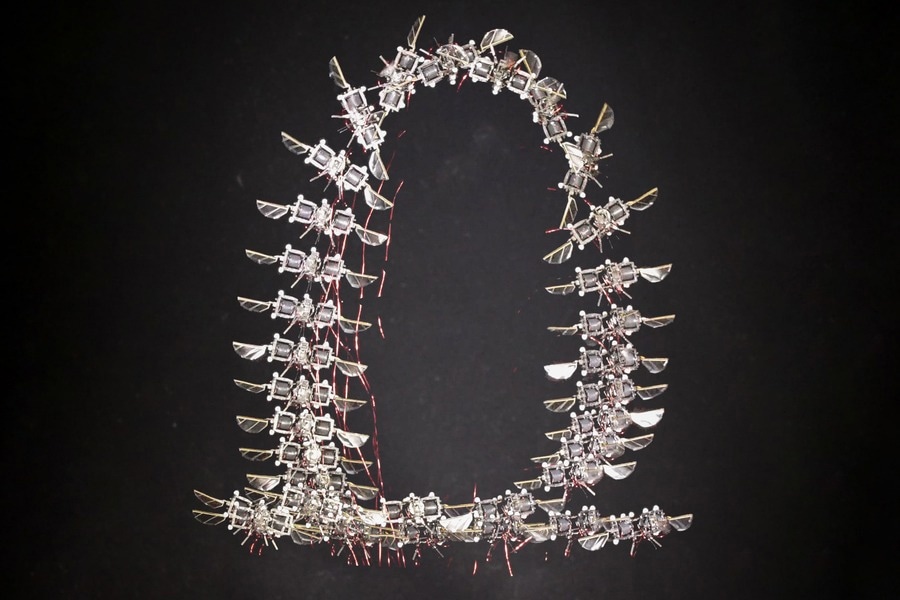
Study: Aerobatic maneuvers in insect-scale flapping-wing aerial robots via deep-learned robust tube model predictive control. Image Credit: Soft and Micro Robotics Laboratory/MIT
Researchers at the Massachusetts Institute of Technology have shown that a flapping-wing robot weighing just 750 milligrams can fly faster and more aggressively than any previous insect-scale robot, executing sharp turns, resisting strong wind gusts, and performing repeated mid-air somersaults with precision.
The work, published in Science Advances, addresses a significant challenge in micro-robotics: How to achieve the speed, acceleration, and disturbance resistance seen in real insects, despite severe limits on sensing, computation, and actuation at tiny scales?
Insects rely on erratic, high-speed maneuvers, known as body saccades and flips, to navigate cluttered environments, evade predators, and maintain stable vision. Replicating these behaviors in robots is complicated.
Previously developed insect-scale flying robots could hover and follow smooth paths, but were typically limited to speeds of less than 40 centimeters per second and modest accelerations. Small errors in modeling, fabrication tolerances, or air flow often caused aggressive maneuvers to fail.
Get all the details: Grab your PDF here!
Two-Stage Control for Strength and Efficiency
The MIT team tackled this problem with a two-stage control approach that combines robustness with computational efficiency.
First, they designed a robust tube nonlinear model predictive controller (RTMPC). This controller plans aggressive flight trajectories, such as sharp turns or flips, while explicitly accounting for uncertainty, actuator limits, and external disturbances.
Around each planned trajectory, the controller constructs a mathematically verified “tube” of safe states, ensuring the robot remains controllable even when conditions deviate from expectations.
Because this controller is too computationally expensive to run directly on the robot at high speed, it is used as an expert system. In the second stage, the researchers train a neural network policy through imitation learning, using data generated within the verified safety tube.
The result is a lightweight controller that runs fast enough for real-time flight while retaining the robustness of the expert planner.
Record Performance at an Insect Scale
In flight experiments, the robot reached a maximum speed of 197 centimeters per second and a peak acceleration of 11.7 meters per second squared, presenting improvements of 447 % and 255 %, respectively, over prior insect-scale systems.
The robotic insect maintained accurate tracking while flying through wind gusts of 160 centimeters per second and continued operating despite a 33 % error in thrust calibration, conditions that would destabilize most micro-robots.
The most demanding test involved aerobatic body flips.
Using the new controller, the robot completed 10 consecutive somersaults in 11 seconds, staying within a few centimeters of its planned trajectory even when its power tether briefly tangled mid-flight.
A built-in safety monitor continuously checked whether the robot’s state remained inside the verified tube and could switch to a stabilizing backup controller if necessary.
Experimental Limits and What May Come Next
All experiments relied on offboard computation, external motion-capture sensing, and tethered power, reflecting current constraints at the insect scale.
However, the researchers showed that the neural-network controller can be substantially reduced in size, trading some precision for large savings in computation.
Their analysis suggests that future versions of the controller could run on milligram-scale microcontrollers, opening the door to onboard autonomy once lightweight sensors are integrated.
By combining fast soft actuators with a control design that balances robustness and efficiency, the study closes much of the performance gap between robotic insects and their biological counterparts.
The work shows that advanced control architectures, not just improved hardware, are central to achieving agile flight at extreme scales.
The results suggest that future insect-scale robots could navigate tight, cluttered spaces where larger flying machines cannot operate, with potential applications ranging from environmental monitoring to search-and-rescue operations in confined environments.
Reference
Hsiao, Y.-H., Tagliabue, A., Matteson, O., Kim, S., Zhao, T., How, J. P., & Chen, Y. (2025). Aerobatic maneuvers in insect-scale flapping-wing aerial robots via deep-learned robust tube model predictive control. Science Advances, 11(49). DOI:10.1126/sciadv.aea8716
https://www.science.org/doi/10.1126/sciadv.aea8716
Disclaimer: The views expressed here are those of the author expressed in their private capacity and do not necessarily represent the views of AZoM.com Limited T/A AZoNetwork the owner and operator of this website. This disclaimer forms part of the Terms and conditions of use of this website.