A collaborative research team from the Korea Advanced Institute of Science and Technology (KAIST) and the Unmanned Exploration Laboratory (UEL) has developed an innovative wheel that can effectively navigate the Moon's most challenging terrains, including steep lunar pits and lava tubes. The study introduces a unique "origami-inspired" deployable airless wheel that can greatly increase its diameter to overcome obstacles that would hinder conventional rovers. The study was published in Science Robotics.
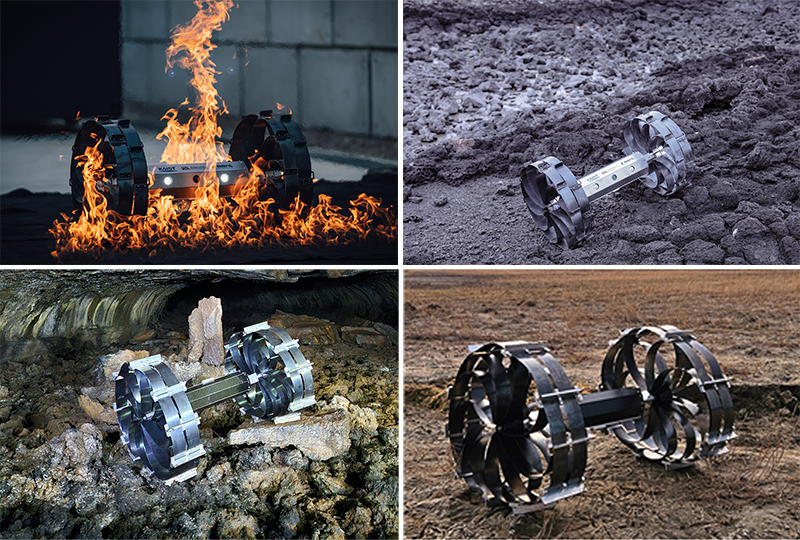 Driving performance field tests were conducted in various environments, such as artificial lunar soil, extreme temperatures, mud, and rocky terrain. Image Credit: KAIST
The Challenge: Small Rovers vs. Big Obstacles
Lunar lava tubes and pits represent excellent candidates for future human habitats due to their natural protection against cosmic radiation and extreme temperature variations; however, accessing these locations poses significant risks. Utilizing a swarm of small, autonomous rovers can serve as an effective approach to reduce the dangers associated with relying on a single large rover. This method guarantees mission continuity through redundancy; even if some units encounter failures, the remaining rovers are capable of completing the exploration.
Small rovers are confronted with a fundamental physical limitation: their small wheel size greatly limits their capacity to navigate steep and rugged terrains, such as the entrances to lunar pits. Although variable-diameter wheels could theoretically address this issue by providing enhanced traversability as needed, developing such a system for the Moon has proven to be a considerable challenge.
The design of a lightweight, transformable wheel that can endure the harsh lunar conditions – particularly the abrasive dust and the vacuum that leads to the fusion of metal components (known as "cold welding") – has continued to be a major engineering obstacle.
A Transformable Wheel for Extreme Environments
The research team, led by Professor Dae-Young Lee from KAIST’s Department of Aerospace Engineering, has developed an innovative type of compliant wheel that eliminates the need for complex mechanical joints. By integrating the structural concepts of the "Da Vinci bridge" with origami design principles, the team has engineered a wheel that leverages the flexibility of its materials to adapt.
This wheel can expand from a compact 230 mm to a diameter of 500 mm, enabling compact rovers to maintain a low profile during transport while still being capable of overcoming significant obstacles once deployed. Importantly, by employing a specialized elastic metal frame and fabric tensioners in place of conventional hinges, the design guarantees dependable performance in the extreme conditions of the lunar environment, effectively mitigating the risks of cold welding and mechanical failure due to fine dust.
The team conducted thorough testing of the wheel’s performance using artificial lunar soil (simulants). The wheel exhibited exceptional traction on loose slopes and demonstrated its structural integrity by enduring a drop impact equivalent to a fall of 100 m in lunar gravity.
Scientific and Engineering Significance
The project united specialists from prominent Korean space institutions to assess the technology's capabilities. Professor Lee pointed out that the wheel serves as a practical and dependable solution for traversing the Moon's most challenging terrains, expressing hope that this innovative technology would establish the team as frontrunners in upcoming lunar missions, despite ongoing issues related to communication and power.
From a scientific standpoint, Dr. Chae Kyung Sim, Head of the Planetary Science Group at KASI (Korea Astronomy and Space Science Institute), highlighted the importance of lunar pits as "natural geological heritages," indicating that this research significantly reduces the technical obstacles to accessing these locations and brings actual exploration missions closer to fruition.
Dr. Jongtae Jang, Principal Researcher at Korea Aerospace Research Institute (KARI), emphasized the engineering precision involved in the design, clarifying that the wheel was carefully optimized and validated through mathematical thermal models to withstand the Moon’s extreme temperature variations of 300 º.
Journal Reference:
Lee, S., et al. (2025) Soft deployable airless wheel for lunar lava tube intact exploration. Science Robotics. DOI: 10.1126/scirobotics.adx2549. https://www.science.org/doi/10.1126/scirobotics.adx2549