Researchers from Stevens Institute of Technology developed an AI-based model to rapidly assess the toxicity of hundreds of unregulated disinfection byproducts (DBPs) formed during drinking water treatment. Their findings were published in the journal Environmental Science & Technology Letters.
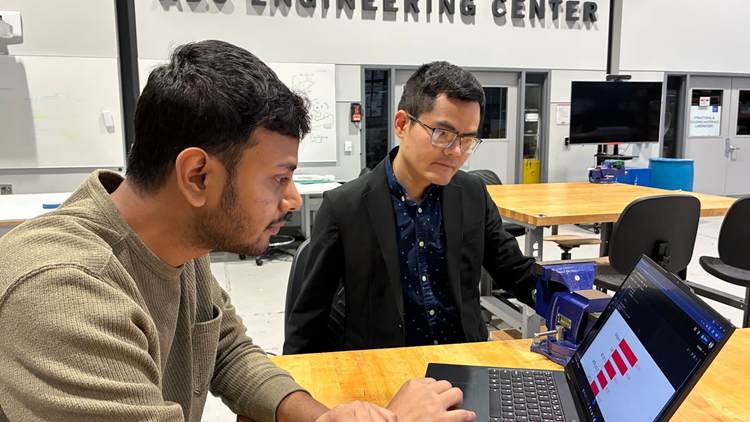 Tao Ye and Rabbi Sikder are discussing their research. Image Credit: Stevens Institute of Technology
Disinfecting drinking water prevents the spread of deadly waterborne diseases by eliminating infectious agents such as bacteria, viruses, and parasites. Even water that looks clear can harbor pathogens capable of causing severe or life-threatening illness, particularly in children, the elderly, and those with weakened immune systems, if it is not disinfected.
Before water disinfection was implemented, outbreaks of diseases such as cholera, typhoid, and dysentery frequently caused widespread deaths, devastating cities, and even entire countries. Ensuring safe drinking water through disinfection stands as one of the greatest public health achievements in human history.
Disinfectants commonly added to water, including chlorine and chloramine, also interact with organic matter – the small amounts of dissolved organic carbon naturally found in water from sources such as rivers, lakes, and aquifers. These reactions produce byproducts that can pose risks to human health.
Some of these disinfection byproducts, known as DBPs, have been associated with certain cancers and reproductive problems. For instance, DBPs such as trihalomethanes and haloacetic acids have been linked to higher risks of bladder cancer and impaired fetal development.
The Environmental Protection Agency sets safety standards for some of these byproducts in drinking water, but not for all, says Tao Ye, Assistant Professor at Stevens Institute of Technology, who applies AI to environmental data to study the complex interactions among different chemical compounds.
There are 11 such byproducts regulated by the EPA. However, so far, research has identified several hundred more, which we don’t know much about – and they may be more toxic than the ones that are regulated.
Tao Ye, Assistant Professor, Stevens Institute of Technology
While it is important to understand how the chemistry of these compounds can affect human health, evaluating them under laboratory conditions is difficult.
“Traditional toxicity testing in the lab is often time-consuming, labor-intensive, and expensive, which limits how many disinfection byproducts can be evaluated,” Ye states.
That’s where AI can make a difference, he notes.
AI and machine learning are fundamentally transforming this process by enabling rapid, scalable toxicity screening, allowing us to assess hundreds of compounds that would otherwise be impractical to test experimentally.
Tao Ye, Assistant Professor, Stevens Institute of Technology
To accelerate DBP research, Ye, along with his PhD student Rabbi Sikder and collaborator Peng Gao from Harvard T.H. Chan School of Public Health, developed an AI model to evaluate disinfectant byproducts and their toxicity.
First, the researchers reviewed scientific studies to collect toxicity data from experimental tests on more than 200 chemicals. They then trained the AI model using this data to predict the potential toxicity of additional chemicals.
We used the laboratory testing data reported in previous literature. We collected those chemical names, their chemical structures, along with experimental exposure conditions and their corresponding toxicity values. We found toxicity values for 227 known chemicals and used them to build a machine learning predictive model to predict the toxicity for the unknown ones.
Rabbi Sikder, PhD Student, Stevens Institute of Technology
The model predicted the toxicity of 1,163 byproducts from the disinfection process. It also revealed that the potential toxicity of some byproducts was 2 to 10 times higher than that of certain chemicals regulated by the EPA, Sikder says.
Does that indicate that tap water is not safe to drink? “Not at all,” Ye details.
An ordinary glass of tap water will never contain all of these harmful byproducts at once. The total number refers to compounds that could theoretically form, depending on the organic matter in the water and the chemicals used for treatment. Ye emphasizes that water composition and treatment chemicals vary in different parts of the world.
“What we are doing here is our due diligence to see what else may need to be regulated, depending on what’s in the water and what you use to clean it,” he adds. “All in all, our tap water is safe to drink, and our research intends to make it even safer.”
Sikder adds that with the AI model now developed and accessible, other researchers can use it to gain deeper insights into the chemistry of DBPs.
For those still concerned, Ye offers guidance on removing disinfectant byproducts from tap water.
“As researchers, we are always trying to do two things – advance the science and inform the public. The first thing in this case is understanding the mechanisms behind the formation of toxic compounds. And the second one is how to reduce these chemicals in our tap water, which you can do in two different ways. You can filter the water with various widely available household filters. Or you can boil it because when you boil it, these chemicals evaporate. Both methods are easy to do at home,” Ye says.
Journal Reference:
Sikder, R., et al. (2026). Multi-Endpoint Semisupervised Learning Identifies High-Priority Unregulated Disinfection Byproducts. Environmental Science & Technology Letters. DOI: 10.1021/acs.estlett.5c01145. https://pubs.acs.org/doi/10.1021/acs.estlett.5c01145.