Husker researchers at the University of Nebraska are making strides in the development of a novel synthetic material that mimics biological muscle, a breakthrough that may pave the way for soft robotics, prosthetic devices, and sophisticated human-machine interfaces. The study was published in the journal Advanced Functional Materials.
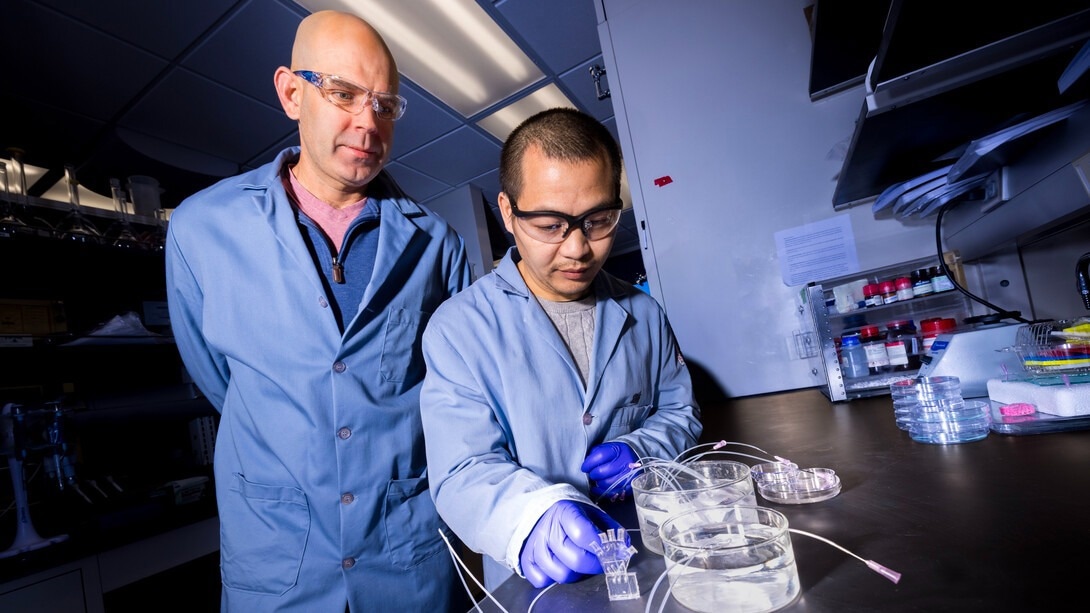 Stephen Morin (left), associate professor of chemistry, and Nengiian Huang, a graduate student in chemistry, are working together on research to develop a new synthetic material that behaves like biological muscle. Image Credit: Jordan Opp | University Communication and Marketing
Their findings revealed a hydrogel-based actuator system that integrates movement, control, and fuel supply on a single integrated platform.
Stephen Morin, an associate professor of chemistry at the University of Nebraska-Lincoln, described biological muscle as one of nature's miracles. It can create significant force, move swiftly, and adapt to a variety of jobs. It is particularly exceptional in terms of energy usage flexibility, as it can draw on sugars, fats, and other chemical resources and convert them into useful energy precisely when and where they are required to move muscles.
One of material science's Holy Grail goals is to create a synthetic muscle.
Artificial muscle has been an elusive target. I'm not going to say that we’ve done that because I don’t think that we have yet, but we’ve demonstrated in this current work two really big principles that work toward the target of some sort of synthetic artificial muscle, ad those are microstructure and chemical control.
Stephen Morin, Associate Professor, Chemistry, Center for Materials and Nanoscience, University of Nebraska
Hydrogels, which are adaptable, water-absorbing polymer networks, have shown considerable promise in soft actuators, but their performance has been hampered by sluggish response times and the requirement to operate completely submerged in water.
Morin and his colleagues have been developing a novel sort of hydrogel-based soft actuator that combines tiny hydrogel units called microgels with an internal microfluidic "circulatory system" that mimics blood vessels. This method results in an actuator that can respond quickly to chemical or thermal stimuli while working in non-aqueous conditions.
The goal is to create a system with the same speed and versatility as biological muscle, allowing for precise control and practical soft-robotic capabilities like microgripping and multi-actuator “hands” with programmable movements.
Traditional robotic components such as stiff motors, cables, and batteries will continue to be used, but Morin believes that this soft, flexible, and water-based synthetic muscle will be more suited to circumstances in which robots interact intimately with humans or delicate surroundings.
Future versions may take on fiber-like or tubular structures more akin to genuine muscle fibers, which might help scale up the technology for practical application, Morin added.
The Army Research Office funded the study.
Journal Reference:
Huang, N., et al. (2026) Controlled Movement of Soft Actuators using Multi-Responsive Microgel Arrays and Microcirculatory Systems. Advanced Functional Materials. DOI: 10.1002/adfm.202521444. https://advanced.onlinelibrary.wiley.com/doi/10.1002/adfm.202521444