NASA’s Perseverance rover has successfully executed two Mars drives using routes generated by generative AI, marking the first time AI-planned waypoints were tested on another world.
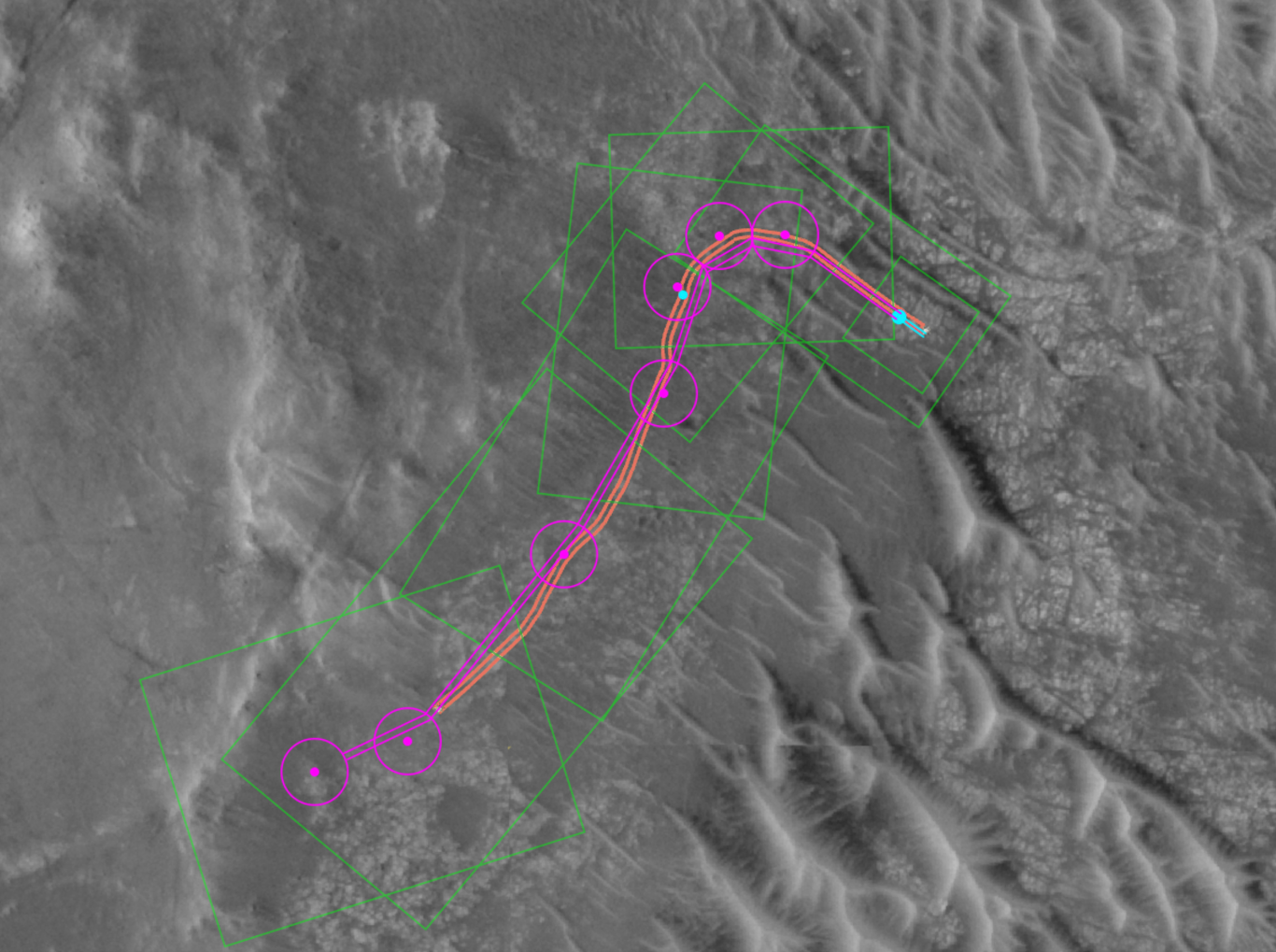
This annotated image from NASA’s HiRISE (High Resolution Imaging Science Experiment) camera aboard the agency’s Mars Reconnaissance Orbiter image depicts the AI-planned route and the actual route taken by NASA’s Perseverance Mars rover during its 807-foot (246-meter) drive on Dec. 10, 2025, the 1,709th Martian day, or sol, of the mission. Image Credit: NASA/JPL-Caltech/UofA
NASA's Perseverance rover has successfully completed the first-ever drives on another world using routes planned primarily with generative artificial intelligence (AI). In a landmark demonstration on December 8th and 10th, 2025, the rover navigated almost 1500 feet of Martian terrain using waypoints generated by an AI model.
This demonstration, led by Jet Propulsion Laboratory (JPL) in collaboration with Anthropic, marks a significant step toward greater autonomy in space exploration, with the potential to enhance mission efficiency, safety, and scientific return as spacecraft venture further into the solar system.
Background
For nearly three decades, rovers on Mars have been driven by teams of human planners on Earth.
These experts analyze terrain data from orbital images and onboard cameras to chart safe paths, breaking them down into discrete waypoints, fixed locations where the rover receives new instructions. This method is necessary due to the immense distance between Earth and Mars, which creates communication delays of up to 22 minutes, making real-time joystick control impossible.
While effective, this process is labor-intensive and limits a rover's speed across complex landscapes.
The introduction of advanced AI marks a turning point.
By using vision-language models to interpret the same high-resolution imagery and terrain data used by humans, mission teams aim to automate key elements of navigation, namely perceiving hazards, localizing the rover, and planning an optimal path.
This demonstration with Perseverance sought to show that generative AI could support this critical, complex decision-making task when operating within carefully defined mission constraints on another planet.
The AI Demonstration and How it Worked
The demonstration took place on the 1707th and 1709th Martian days (sols) of the Perseverance mission. For these drives, the traditional manual planning process was augmented by generative AI.
The team at JPL’s Rover Operations Center, in collaboration with Anthropic, used the company’s Claude AI models to analyze the mission’s vast dataset. This included high-resolution imagery from the High Resolution Imaging Science Experiment (HiRISE) camera aboard the Mars Reconnaissance Orbiter and detailed digital elevation models showing terrain slope.
The AI was tasked with identifying key features, ranging from bedrock and outcrops to hazardous boulder fields and sand ripples, and then generating a continuous navigation path complete with specific waypoints inside predefined “keep-in zones” established by mission planners.
The resulting AI-planned route for the December 10th drive, depicted in magenta on orbital maps, shows a 807-foot (246-meter) journey along the rim of Jezero Crater. The close alignment between this AI plan (magenta lines) and the rover’s actual driven path (orange lines) confirmed the technology’s precision in generating viable waypoints for real mission conditions.
Crucially, the AI operated within defined "keep-in zones" (marked by pale green boxes), areas where the rover's autonomous software is permitted to navigate.
To ensure absolute safety, engineers ran the AI-generated commands through a "digital twin," a virtual replica of the rover at JPL. This process verified over 500,000 telemetry variables, confirming the instructions were fully compatible with the rover’s flight software before they were transmitted across 140 million miles of space via NASA’s Deep Space Network.
Implications and the Future of Autonomous Exploration
This successful test is a step toward a new era of interplanetary robotics. As Vandi Verma, a JPL space roboticist on the Perseverance team, noted, generative AI shows great promise in streamlining the pillars of autonomous navigation.
By handling these core tasks, AI can dramatically reduce operator workload, enabling mission teams to focus on higher-level science strategy and analysis. In the near term, this technology could allow rovers to execute longer, kilometer-scale drives in a single command cycle, while still relying on rigorous human validation, significantly accelerating exploration campaigns and increasing the area accessible for scientific study.
Looking further ahead, the implications are profound for future missions to the Moon, Mars, and beyond.
As distances from Earth increase, so do communication delays, making real-time human oversight impractical. Intelligent, edge-computing systems onboard spacecraft will become essential. As Matt Wallace of JPL’s Exploration Systems Office envisions, imagine fleets of rovers, helicopters, and drones equipped with AI trained on the collective wisdom of NASA’s engineers and scientists. These systems could independently navigate treacherous terrain, perform complex tasks, and even scour thousands of images to flag intriguing geological features for scientists back on Earth.
Conclusion
In conclusion, the successful integration of generative AI into Perseverance’s route planning marks an important and carefully controlled moment in space exploration.
By demonstrating that AI-generated waypoints can be safely executed on the challenging Martian landscape under tightly constrained and well-validated conditions, NASA has unlocked a powerful new tool for robotic explorers. This advancement promises to make future missions more efficient, resilient, and scientifically productive by delegating portions of complex route planning to onboard intelligence.
As we set our sights on returning humans to the Moon and embarking on crewed missions to Mars, the autonomous capabilities demonstrated by Perseverance will be critical. This is not just about driving a rover. It’s about pioneering the intelligent systems that will serve as our eyes, hands, and scouts throughout the solar system.
Disclaimer: The views expressed here are those of the author expressed in their private capacity and do not necessarily represent the views of AZoM.com Limited T/A AZoNetwork the owner and operator of this website. This disclaimer forms part of the Terms and conditions of use of this website.