*Important notice: This news reports on an unedited version of the paper which has been accepted. and is awaiting final editing. Scientific Reports sometimes publishes preliminary scientific reports that are not fully edited and, therefore, should not be regarded as conclusive or treated as established information.
An advanced VSLAM framework integrates optical flow, LiDAR, and optimization algorithms to enhance obstacle avoidance. It improves navigation accuracy, reduces path conflicts, and boosts efficiency in complex indoor logistics environments.
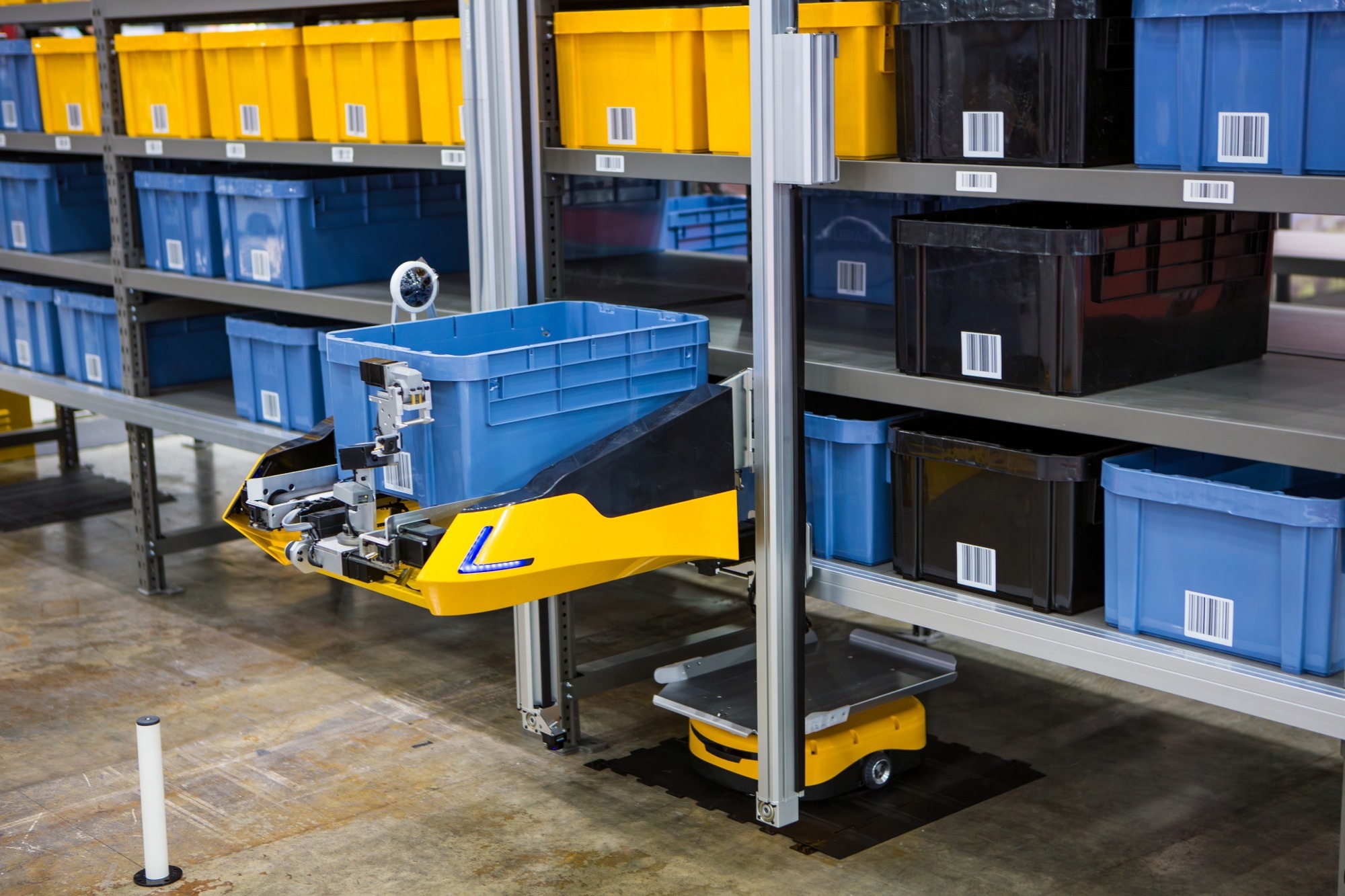 Study: Visual obstacle avoidance technology of VSLAM indoor intelligent logistics robot combining optical flow and feature extraction. Image Credit: Itsanan/Shutterstock
In an article published in the journal Nature, researchers presented a visual obstacle avoidance (OA) framework for indoor intelligent logistics robots operating in complex dynamic environments. By integrating optical flow and feature extraction techniques with multi-sensor fusion from depth cameras and laser radars, the research enhances environmental perception.
A refined Pelican optimization algorithm (POA), incorporating chaotic mapping and firefly disturbance strategies, enables optimal multi-robot path planning, achieving high OA success rates and improved collaborative efficiency.
Limitations and Proposed Enhancements
Indoor logistics robots are increasingly deployed in warehouse sorting and material handling, where autonomous OA is critical to operational efficiency and safety. Visual synchronous localization and mapping (VSLAM) has emerged as a promising approach, integrating environmental perception with path planning. However, existing methods face notable limitations.
Traditional Lucas-Kanade (LK) optical flow algorithms fail under rapid camera motion due to the constant-brightness assumption; multi-robot path-planning algorithms suffer from slow convergence and susceptibility to local optima; and existing approaches inadequately account for the relationship between obstacle boundaries and robot size.
To address these gaps, this study optimizes the LK algorithm using multi-scale pyramids, fuses multi-sensor mapping for improved perception accuracy, and refines swarm intelligence optimization through an enhanced POA, collectively improving OA safety and multi-robot collaborative planning.
Multi-Module System Design for Indoor Logistics Robots
The proposed framework is structured around three integrated modules targeting perception, mapping, and navigation for indoor logistics robots. The perception module enhances the traditional LK optical flow algorithm by incorporating a multi-scale pyramid structure, enabling reliable feature tracking in large-displacement scenarios caused by rapid camera motion.
A six-parameter affine transformation model is additionally introduced to correct image distortions, while Shi-Tomasi corner detection is employed to extract stable feature points, improving robustness under varying lighting and noise conditions.
The mapping and positioning module fuses data from a red, green, blue-depth (RGB-D) camera and a two-dimensional (2D) light detection and ranging (LiDAR) sensor through the real-time appearance-based mapping (RTAB-MAP) framework. This fusion pipeline performs filtering, point cloud splicing, and image registration, followed by Bayesian filtering and visual bag-of-words-based loop detection. Graph optimization corrects odometric drift, ultimately generating a high-resolution 2D occupancy grid map for downstream navigation.
The navigation and planning module employs an improved model predictive control (MPC) algorithm for local OA trajectory planning. A kinematic model of the differential-drive robot is linearized via Taylor expansion and discretized into a state-space form. The MPC objective function balances trajectory tracking accuracy, motion smoothness, and obstacle avoidance through a proportional distance penalty function. A three-tier zone classification strategy (safe, relative collision, and emergency) governs avoidance behavior, with an expansion radius of 0.5 meters (m) ensuring physical safety margins.
For multi-robot global path planning, the problem is modeled as a multi-traveling salesman problem (MTSP). The traditional POA is enhanced through logistic chaotic mapping initialization, which promotes uniform population distribution, and a firefly perturbation strategy, which prevents premature convergence to local optima. Together, these improvements enable faster convergence and higher-quality solutions for coordinating multiple robots across complex logistics environments.
Download the PDF of this page here
Performance Validation in Static and Dynamic Environments
Simulation experiments on the Ubuntu 20.04 platform with a robot operating system (ROS) confirmed the effectiveness of the proposed framework across multiple evaluation dimensions. In static environments, the improved MPC algorithm consistently maintained a minimum robot-to-obstacle distance of 0.5 m or more across three OA scenarios, improving the average OA safety distance by over 60% compared to traditional MPC, which failed due to delayed path adjustments.
In dynamic environments, the robot demonstrated smooth, responsive trajectories when encountering moving obstacles and pedestrians, with real-world testing confirming an OA success rate of 98.6%, an average avoidance time of 1.5 seconds, and a total path length of 12.5 m, all of which are superior to existing methods.
Multi-sensor fusion comparisons showed the proposed RTAB-MAP-based approach achieved a map intersection over union (IoU) of 0.93 and an absolute trajectory error (ATE) of 0.041m, outperforming standalone RGB-D and LiDAR configurations, with a near-perfect loop closure detection rate of 99.1%. VSLAM benchmarking against ORB-SLAM3, direct sparse odometry (DSO), and dynamic scenes (DynaSLAM) revealed that the proposed method achieved the lowest tracking loss rate (3.5%) and competitive ATE (0.026m) at a processing time of 25.8 milliseconds per frame.
The improved POA outperformed particle swarm optimization (PSO), whale optimization algorithm (WOA), grey wolf optimizer (GWO), and traditional POA in both unimodal and multi-modal test functions, converging faster and with greater stability. In complex warehouse scenarios involving high-density crowds, low-light conditions, and up to 40 collaborative robots, the method maintained OA success rates above 88.9% and consistently produced the fewest path conflicts.
Final Insights and Future Scope
In conclusion, this study presented a comprehensive VSLAM-based obstacle-avoidance framework for indoor logistics robots that addresses key limitations in dynamic perception, sensor fusion, and multi-robot coordination. By enhancing the LK optical flow algorithm with multi-scale pyramids, integrating RGB-D and LiDAR data via RTAB-MAP, and refining the POA with chaotic initialization and firefly perturbation, the proposed system achieves high OA success rates, robust dynamic response, and efficient collaborative path planning. Future work should focus on extreme lighting robustness, real-time multi-sensor optimization, and deep learning-based environmental perception.
Journal Reference
Li, J. (2026). Visual obstacle avoidance technology of VSLAM indoor intelligent logistics robot combining optical flow and feature extraction. Scientific Reports. DOI:10.1038/s41598-026-47723-z, https://www.nature.com/articles/s41598-026-47723-z
Disclaimer: The views expressed here are those of the author expressed in their private capacity and do not necessarily represent the views of AZoM.com Limited T/A AZoNetwork the owner and operator of this website. This disclaimer forms part of the Terms and conditions of use of this website.