A new study suggests that something as simple as projecting a visual drop zone on the ground could make people trust delivery drones far more and feel safer interacting with them.
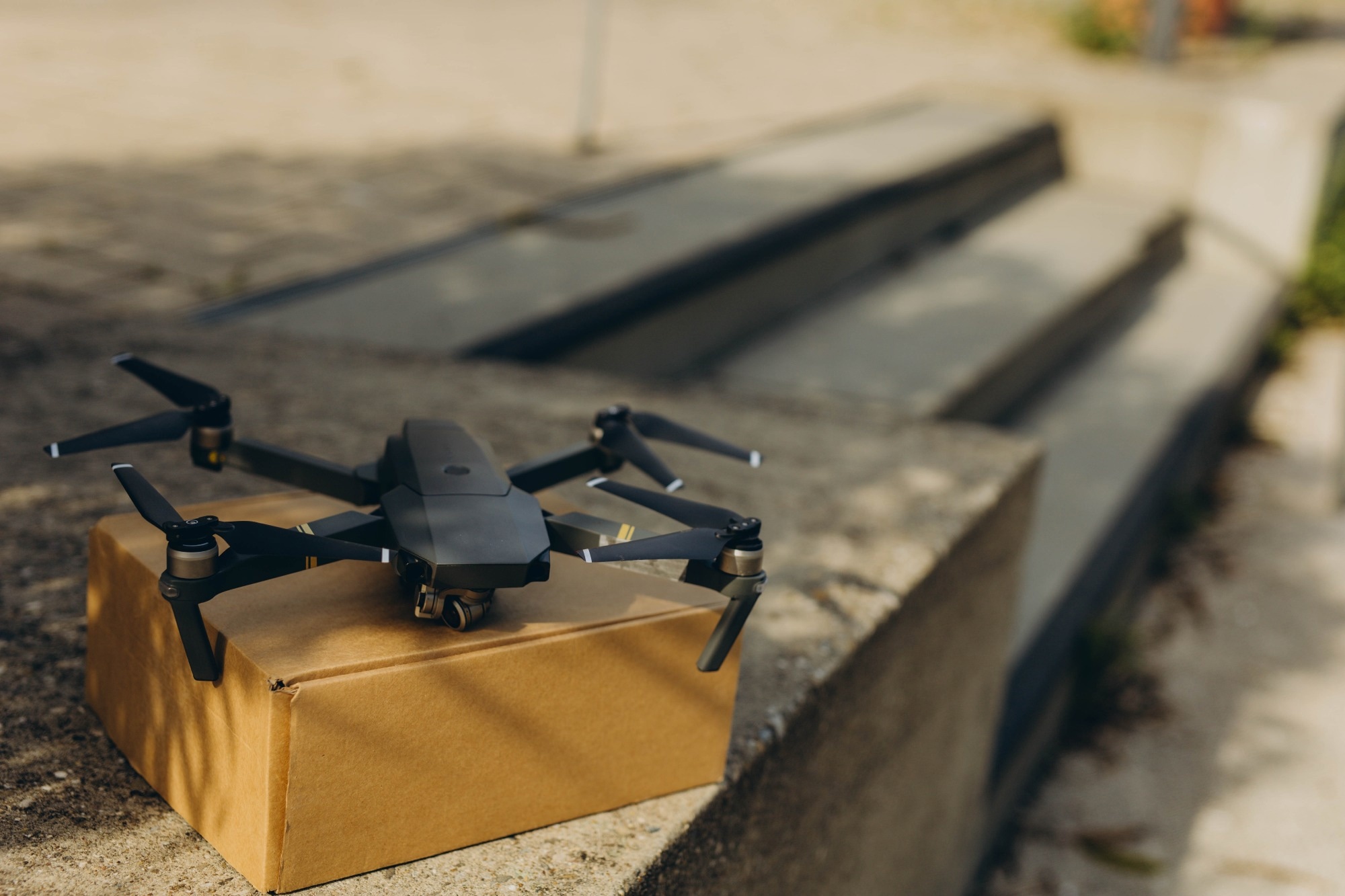
Study: Delivery from the sky: investigating visual cues to communicate robot intentions in simulated public spaces. Image Credit: Kateryna Mukhina/Shutterstock.com
In a study published in Scientific Reports, part of the Nature Portfolio, researchers examined how visual cues on delivery drones, such as landing versus cable-drop methods and interface elements like lights, displays, and projections, affect human recipients’ trust and understanding.
The study found that visual interfaces, particularly ground projections marking the drop zone, significantly reduced uncertainty while improving predictability of drone intentions and overall trust compared with drones that provided no visual cues.
Background
As delivery drones move closer to everyday use, they will increasingly interact directly with people receiving packages. One challenge in these encounters is helping recipients quickly understand what the drone is about to do. If people cannot interpret the drone’s intentions, whether it will land, hover, or lower a package, they may feel unsafe or hesitant to approach.
Previous research has highlighted the importance of communicating drone intent, but most studies have focused on horizontal movement cues such as direction changes or approach paths. Less attention has been given to the vertical stages of delivery, particularly the moment a drone drops off a package or departs.
To address this gap, the researchers investigated whether visual cues could make these vertical interactions easier for people to interpret. They compared two delivery methods (landing and cable-drop) and paired them with different visual interfaces, including lights, onboard displays, and projected ground signals.
Video Survey Methods for Assessing Recipient Uncertainty During Drone Deliveries
The team used a video-based online survey to examine how people respond to these different cues. This approach builds on previous human–robot interaction research showing that results from video studies often align closely with findings from live experiments. It also reflects practical limitations: safety regulations in the Netherlands currently restrict real-world drone testing within 50 meters of individuals.
Before the experiment, the visual interfaces were developed through iterative focus groups with seven participants and a professional designer. The designs used simple visual metaphors intended to be intuitive and culturally neutral. Cyan was selected as a neutral animation color, and a baseline scenario without any interface was included for comparison.
Participants watched eight short videos, each about 35 seconds long, showing a drone preparing for delivery, dropping off a package, and flying away. The scenarios varied by interface type (none, lights, display, or projection) and delivery method (landing or cable-drop). The drone was shown from a recipient’s perspective at a distance of seven meters, with synchronized propeller sounds and movement to make the scenes more realistic.
A total of 150 participants, aged 18 to 64, rated each scenario on several measures, including uncertainty, understandability, predictability, trust, and overall convincingness. They also indicated when they would feel comfortable approaching the drop-off location and provided written feedback about the experience.
Researchers analyzed the results using non-parametric statistical methods and conducted a thematic analysis of roughly 1500 written comments, with two independent coders achieving strong agreement.
Ground Projections Proved Most Effective
Across nearly all measures, the baseline condition without any visual interface performed the worst. Participants reported higher uncertainty and lower levels of trust, predictability, and overall confidence in the interaction.
Adding visual cues significantly improved these perceptions. Among the tested interfaces, ground projections and onboard displays consistently outperformed simple lighting signals.
Ground projection emerged as the clear favorite. Participants said it provided the most comprehensive information, clearly marking the drop zone while also indicating safe areas and motion cues. Displays with directional arrows were also widely described as intuitive.
Lighting signals were viewed as helpful but less clear, often requiring more interpretation. Some participants also noted that lights could be difficult to distinguish when the drone was hovering above eye level.
The delivery method itself had only minor effects. Cable-drop scenarios scored slightly higher than landing in terms of understandability and convincingness, though the differences were relatively small.
Participants’ responses about when they would approach the drop-off location also varied depending on the interface. Without visual cues, most respondents said they would wait until the drone had completely left the area. When projection or display interfaces were present, many said they would feel comfortable approaching earlier, even during the drop-off stage.
Participants Highlight Design Improvements
The written feedback provided additional insight into how people interpret these signals. Many participants said visual interfaces reduced uncertainty and made the interaction feel safer.
Projection was praised for clearly defining both the drop zone and surrounding safety boundaries. However, some participants misinterpreted the projected “H” symbol as indicating a landing area rather than a drop zone.
Several practical concerns were also raised. Participants mentioned potential issues such as display glare, difficulty seeing lights from a distance, or ground projections being obstructed. Some suggested combining multiple interface types or using color coding to strengthen the signals.
Views on delivery methods were mixed. Some participants considered cable-drop safer because it keeps people farther from spinning propellers. Others preferred landing because it allows them to more easily observe the drone’s movements.
Findings Highlight the Importance of Clear Visual Communication
Overall, the study shows that visual interfaces can play a major role in improving how people interpret and trust delivery drones. While the delivery method itself had limited influence, visual signals helped clarify where packages would be placed and when it was safe to approach.
Ground projection, in particular, stood out as an effective way to communicate both the drop-off location and the surrounding safety area. However, the researchers note that real-world testing will still be necessary. Environmental factors such as lighting conditions, weather, and obstacles could affect how clearly these signals are perceived.
Journal Reference
Lingam, S. N., Petermeijer, S. M., Obaid, M., & Martens, M. (2026). Delivery from the sky: investigating visual cues to communicate robot intentions in simulated public spaces. Scientific Reports. DOI:10.1038/s41598-026-36451-z
https://www.nature.com/articles/s41598-026-36451-z
Disclaimer: The views expressed here are those of the author expressed in their private capacity and do not necessarily represent the views of AZoM.com Limited T/A AZoNetwork the owner and operator of this website. This disclaimer forms part of the Terms and conditions of use of this website.