As astronauts gear up for a critical spacewalk, new experiments aboard the International Space Station are testing how augmented reality and AI could transform medical care in space.
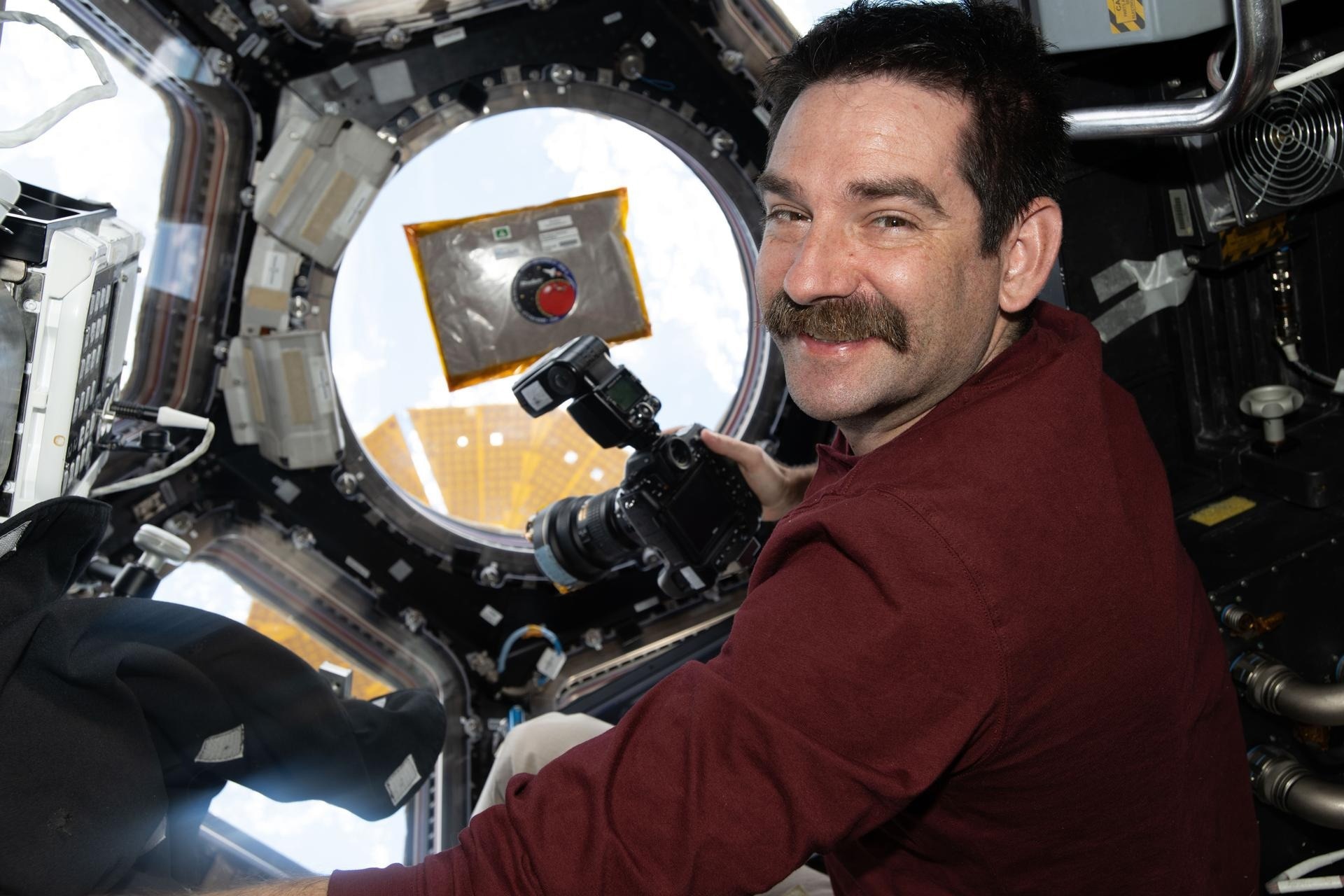
NASA astronaut Jack Hathaway smiles for a portrait inside the International Space Station’s cupola while photographing scientific hardware for a biomanufacturing experiment. Image Credit: NASA/Jack Hathaway
In a recent update from NASA, officials outlined key activities aboard the International Space Station (ISS) as Expedition 74 crew members prepare for a critical spacewalk scheduled for March 18. The update highlights spacesuit maintenance and procedural reviews, ongoing health research using augmented reality and artificial intelligence (AI), biomedical studies on vascular health, and the upcoming departure of the Cygnus cargo spacecraft after a six-month mission.
Background
The ISS remains one of the most significant orbital laboratories, supporting continuous scientific research and international collaboration for more than two decades. Expedition 74 builds on this foundation with a demanding schedule that balances maintenance, research, and operational priorities tied to both immediate mission needs and longer-term exploration goals.
Spacewalks play a central role in maintaining and upgrading the station’s external systems, requiring careful preparation through detailed suit checks and procedural reviews.
At the same time, the crew continues to carry out research that incorporates emerging technologies such as augmented reality and AI to address healthcare challenges in microgravity. These efforts contribute to improved astronaut health monitoring while also supporting the development of more autonomous medical protocols for future missions.
In parallel, cargo resupply missions such as Northrop Grumman’s Cygnus spacecraft remain essential to station operations, delivering supplies and removing waste. The scheduled departure of Cygnus after nearly six months in orbit marks the completion of a successful mission, while also ensuring the safe disposal of station refuse through controlled atmospheric reentry.
Spacewalk Preparations and Hardware Upgrades
As the scheduled spacewalk approaches, NASA flight engineers Jessica Meir and Chris Williams have been focused on preparing both the equipment and themselves inside the Quest airlock. Much of their time has gone into servicing the spacesuits, particularly the cooling loops that regulate body temperature during extravehicular activity, an essential system for astronaut safety.
Beyond that, they have refilled suit components, checked hardware such as the helmet for any signs of wear, and worked through a series of system checks to ensure everything is functioning as expected.
Preparation also extends beyond the physical equipment. The pair has been reviewing the full sequence of procedures they will carry out once outside the station, reinforcing familiarity with each step before entering the vacuum of space.
The spacewalk itself will focus on installing a modification kit and routing cables along the port side of the station. This work is part of a broader effort to expand the ISS’s power capabilities, supporting the future installation of a roll-out solar array. With this being the seventh array planned, the task fits into a longer-term upgrade of the station’s energy systems.
Advanced Health Research
While preparations for the spacewalk continue, research inside the station is advancing in parallel. NASA flight engineer Jack Hathaway and ESA astronaut Sophie Adenot have been working in the Columbus laboratory module with the EchoFinder-2 system, which combines augmented reality guidance with AI-assisted image analysis.
Rather than relying entirely on ground-based specialists, the system allows astronauts to carry out ultrasound scans with onboard support. As Hathaway and Adenot took turns scanning each other’s abdomen and vascular systems, augmented reality provided step-by-step guidance, while AI tools helped interpret the images and confirm organ identification. The result is a more self-sufficient approach to medical care, one that will be essential for missions where communication delays make real-time support less practical.
At the same time, Roscosmos cosmonauts Sergey Kud-Sverchkov and Sergei Mikaev have been examining how microgravity affects the circulatory system. Using a combination of pressure cuffs and wearable sensors, they monitored blood flow and pressure across different parts of the body. The data, transmitted in real time to onboard systems, will help researchers better understand how prolonged exposure to weightlessness alters vascular function.
Station Maintenance Activities
Alongside research and spacewalk preparation, routine maintenance continues to underpin daily life aboard the station. Roscosmos flight engineer Andrey Fedyaev has been working to service life support systems, including the Elektron oxygen generator. His tasks involved purging nitrogen, repressurizing components, and ensuring the system continues to operate reliably.
He also managed water processing tasks, filtering and transferring supplies between tanks to maintain a stable and safe drinking-water system, another reminder of how essential these behind-the-scenes activities are to keeping the station running smoothly.
Conclusion
Taken together, these activities highlight how operations aboard the ISS are constantly interwoven, with maintenance, research, and logistics progressing side by side.
Preparations for the upcoming spacewalk support ongoing upgrades to the station’s infrastructure, while advances in AI-assisted healthcare are gradually shifting more capability onboard. At the same time, biomedical studies continue to deepen our understanding of how the human body adapts to space.
The departure of the Cygnus spacecraft marks the close of another successful resupply mission, reinforcing the importance of reliable logistics in sustaining long-term human presence in orbit.
Disclaimer: The views expressed here are those of the author expressed in their private capacity and do not necessarily represent the views of AZoM.com Limited T/A AZoNetwork the owner and operator of this website. This disclaimer forms part of the Terms and conditions of use of this website.