Model compression and distillation allow large AI systems to run on satellites. This AI approach enables real-time Earth observation processing with minimal data and hardware constraints.
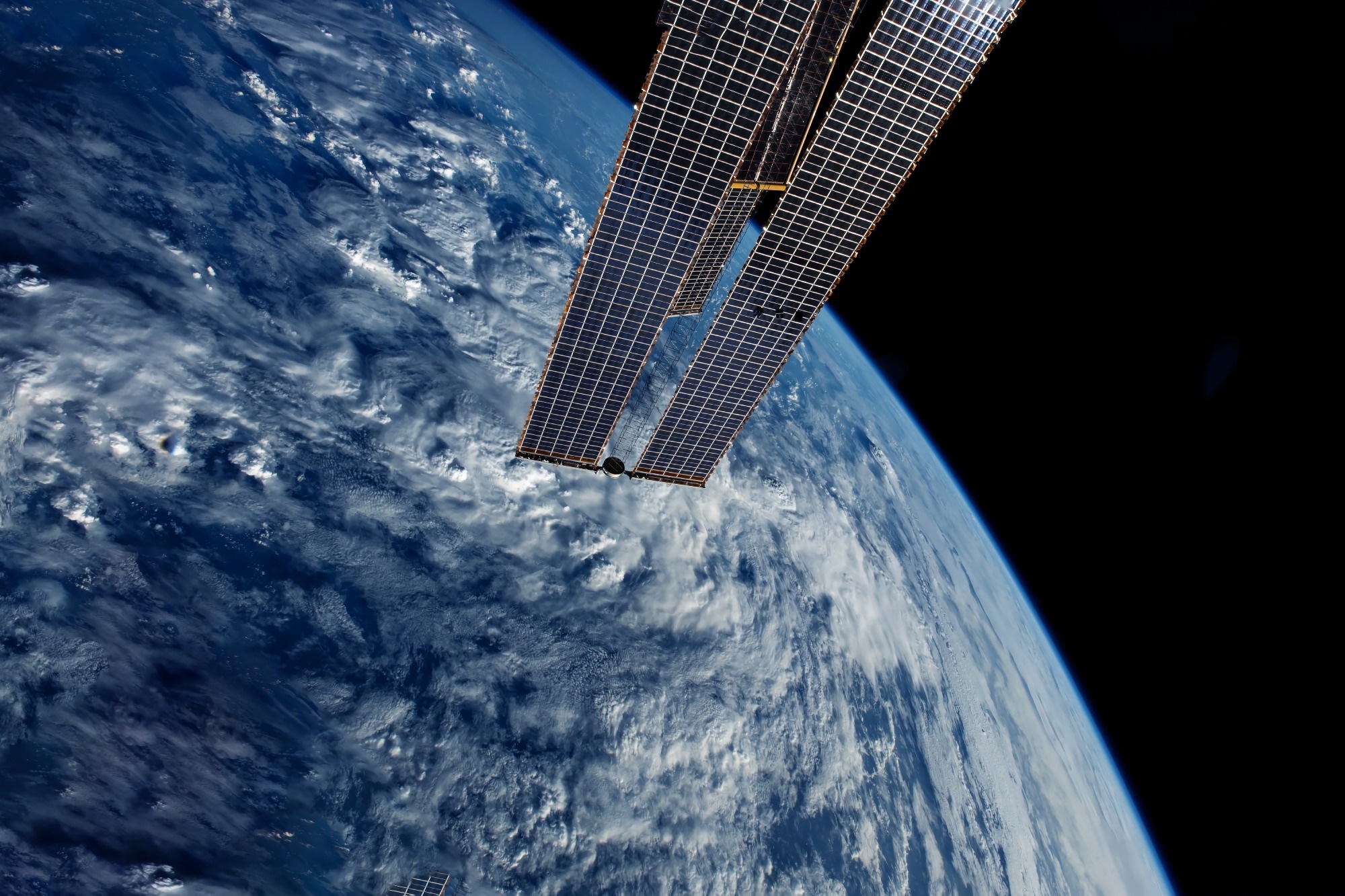 Study: First On-Orbit Demonstration of a Geospatial Foundation Model. Image Credit: Artsiom P/Shutterstock
In an article published by the National Aeronautics and Space Administration (NASA), researchers achieved a significant milestone in artificial intelligence (AI) for space through the first-ever on-orbit demonstration of a Geospatial Foundation Model (GeoFM). The study presented a practical framework for compressing large-scale AI models so they can operate within the strict computational and power constraints of satellites.
From Data Overload to Onboard Intelligence
Earth observation (EO) satellites generate enormous volumes of imagery that are critical for monitoring climate change, responding to natural disasters, managing natural resources, and tracking urban development. As the number of satellites increases and sensor technology improves, the challenge has shifted from collecting data to processing it efficiently.
Early missions like the European Space Agency's Phi-sat-1 demonstrated that lightweight deep neural networks could run on space-qualified hardware, executing relatively simple tasks such as discarding cloudy images before downlink. However, these task-specific models are limited, as each new application requires training and uploading an entirely separate model.
Pretrained on large, diverse satellite datasets, a single GeoFM backbone can power multiple downstream tasks by simply attaching lightweight, task-specific heads. The core challenge has been that most GeoFMs are far too large to deploy on the resource-constrained hardware found aboard satellites, and they are often trained on data from different sensors than those used in actual missions, creating a performance-degrading domain gap.
Compressing Without Sacrificing Performance
The core technical contribution of the study is a compression strategy that makes a large GeoFM suitable for deployment on satellites. The researchers used Prithvi-EO-2.0-300M, a 300-million-parameter vision transformer developed by IBM and NASA, as their starting point.
At over one gigabyte in size, this model is far too large for the limited memory and processing power available on most space hardware. To address this, the team applied a technique called knowledge distillation.
The key architectural change was reducing the patch embedding dimension, which is the size of the internal feature vectors the model uses to represent image patches. By shrinking this dimension from 1,024 to 256, the researchers produced a compact variant they called 256-MAE-D, which is 16 times smaller than the original, dropping from roughly 1.2 GBs to just 73 MBs.
To train this student model effectively, the team developed a novel pretraining approach called dual-masked autoencoder (MAE) distillation, in which both the larger model and smaller model use MAE pipelines independently, with the smaller model trained to match the larger model’s reconstructions at masked image locations.
When evaluated across five downstream EO tasks, including cloud detection, flood detection, landslide detection, and estimation of above-ground biomass, the compact 256-MAE-D model performed on par with the full 300-million-parameter baseline. Differences in metrics such as accuracy, F1 score, and intersection over union were typically within the variability seen across multiple training runs, with the compact model occasionally outperforming its larger counterpart.
Bridging the Domain Gap and Validation
Compressing the model was only one part of the challenge. The researchers also had to contend with the domain gap, a well-known problem in machine learning where a model trained on data from one sensor performs poorly when applied to data from a different sensor.
In this study, the GeoFM was originally pretrained on imagery from the Harmonised Landsat-Sentinel-2 dataset at resolutions of 10 to 30 meters. When applied directly to data from the Kanyini CubeSat, which captures imagery at a much coarser 75-meter resolution, performance on cloud detection tasks dropped sharply, with accuracy falling by nearly 50 percentage points.
To recover performance, the team conducted domain adaptation experiments using imagery captured by Kanyini in orbit. They generated proxy ground truth labels using automated techniques, including the Normalized Difference Water Index for water detection and the Haze Optimized Transform for cloud identification. They then retrained only the task-specific heads on fractions of the available Kanyini data (100%, 50%, and 25%), keeping the GeoFM backbone frozen.
The results showed that the foundation model dramatically reduced the amount of labeled data needed to achieve strong performance. Even with just 25% of the available target-domain labels, the GeoFM with a pretrained head outperformed a randomly initialized baseline trained on the full dataset.
Download the PDF of this page here
The final validation step was the on-orbit demonstration itself. The compact GeoFM was uplinked to the IMAGIN-e payload aboard the International Space Station and executed underground command. Although a power fault in the payload's imaging system prevented the use of live imagery, the researchers uploaded a curated test set to the onboard computer and ran cloud and flood detection inference directly in orbit. Performance metrics matched those obtained in ground testing, confirming numerical equivalence between laboratory validation and genuine on-orbit execution.
Toward Fully Autonomous Satellites
This study marks a significant step forward in the practical deployment of AI for EO. By combining model compression through knowledge distillation, domain adaptation with minimal labeled data, and rigorous hardware-in-the-loop validation, the researchers have demonstrated a clear and replicable pathway from large, ground-based foundation models to compact, flight-ready systems.
The work also highlights the real-world challenges of space deployment, including thermal constraints, hardware-specific toolchain requirements, and the ever-present domain gap between training data and operational imagery. Looking ahead, the authors identify several promising directions, including live-data demonstrations on future missions, expansion to hyperspectral and synthetic aperture radar data, automated architecture search tailored to onboard constraints, and continual in-orbit model adaptation.
Journal Reference
Du et al. (2025). First On-Orbit Demonstration of a Geospatial Foundation Model. ArXiv.org. DOI:10.48550/arXiv.2512.01181, https://arxiv.org/abs/2512.01181
Leese, L. (2026, May 7). NASA’s Prithvi Becomes First AI Geospatial Foundation Model In Orbit. NASA Science. https://science.nasa.gov/science-research/ai-foundation-model-in-orbit/
Disclaimer: The views expressed here are those of the author expressed in their private capacity and do not necessarily represent the views of AZoM.com Limited T/A AZoNetwork the owner and operator of this website. This disclaimer forms part of the Terms and conditions of use of this website.