New research reveals that the number of objects launched from the United States is now over 5,000% higher than ten years ago, with the surge largely driven by private spaceflight ventures. Without adequate decay and deorbiting processes, this rapid expansion will mean a further build-up of space junk, heightening the risk of major collisions in space.
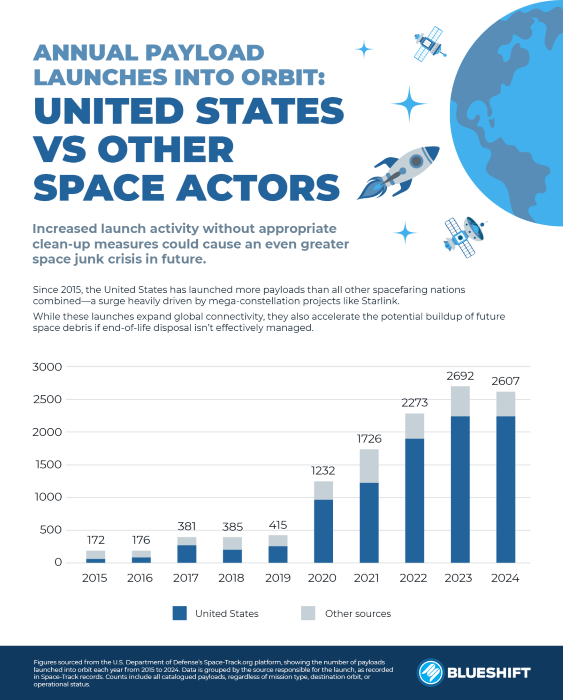 Image Credit: Blueshift
The findings come from Blueshift, a technology leader in thermal protection systems (TPS) for spacecraft and other mission-critical industries. It's report identified which operators and nations account for the largest share of objects launched into orbit, debris currently in orbit, and debris re-entering Earth’s atmosphere.
Commercial space companies are now responsible for most launches from the United States, with SpaceX alone accounting for more than 80% of them. In total, 2,226 American payloads were placed into orbit in 2024, in contrast to just 43 in 2014.
Blueshift's research also highlights the increasing volume of space debris re-entering Earth’s atmosphere from decayed objects. The United States, Russia and China together account for more than 90% of tracked debris re-entries over the past decade. According to Jonathan McDowell, Astrophysicist and Space Sustainability Analyst, an average of one to two satellites from Starlink returned to Earth each day in 2025.
Recent estimates from the European Space Agency (ESA) suggest there are more than 1.2 million pieces of debris between 1 cm and 10 cm in size in orbit, along with over 50,000 larger objects exceeding 10 cm, each capable of damaging or destroying a spacecraft on impact.
Despite growing concerns over the 'space junk' problem, SpaceX has demonstrated an industry-leading approach to satellite design and deorbiting activity. Their Starlink satellites are engineered to deorbit within a year, which is far ahead of the standard 25-year guideline, and are built for complete disintegration upon re-entry, minimizing debris reaching Earth.
“The growth in launch activity alone is astonishing,” says Tim Burbey, Co-Founder and President of Blueshift, “but what goes into orbit doesn’t simply disappear, as a defunct satellite isn't just dead weight, it's a potential collision waiting to happen. “The ESA has warned that the current rate of space debris creation will increase the risk of major collisions by more than four times. Our research confirms that payload launches and debris creation are continuing to climb considerably.
“The industry already has the analysis tools to understand the problem, but there is still a design-culture gap between building spacecraft to perform well in orbit and building them to disappear safely afterward. The biggest gap is that satellites are still mostly optimized to survive launch, thermal cycling, radiation, and years of reliable operation in orbit, while safe end-of-life burnup often rewards the opposite traits: lower-melting materials, earlier breakup, less shielding of dense internals, and less ‘survivable’ joints and packaging.”