A new platform of miniature modular robotic boats has been developed, with the ability to self-assemble into connected structures on water. Using a hybrid coordination framework, each robot navigates independently, avoids collisions, and docks with its neighbors while a lightweight central planner resolves imperfections, enabling flexible, scalable aquatic self-reconfiguration. Inspired by fire ants that self-assemble into rafts through local interactions, the platform, termed FloatForm, was unveiled in an article in Nature Communications.
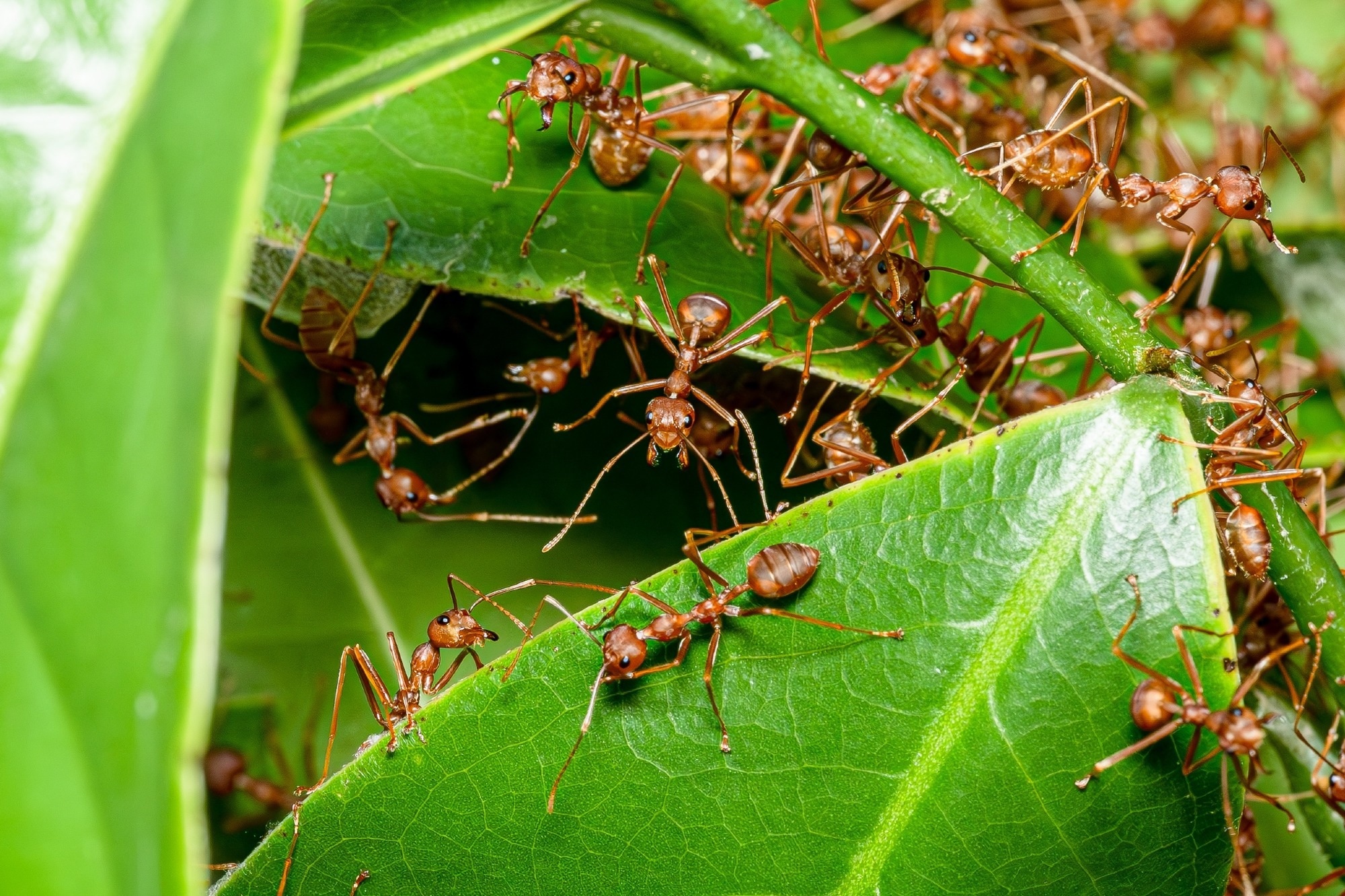 Study: Self-reconfiguring modular robotic boats. Image Credit: Silapavet Konthikamee/Shutterstock.com
Why Water Is the Hardest Frontier
Modular self-reconfigurable robots (MSRRs) can connect and rearrange into adaptable structures suited to changing tasks. On land, systems like Kilobots have assembled over 1000 robots into two-dimensional (2D) shapes using purely distributed local rules, while M-Blocks and SMORES-EP demonstrated hybrid architectures balancing local autonomy with centralized planning.
In the air, ModQuads have achieved midair self-assembly through centralized trajectory planning paired with distributed stabilization. However, aquatic MSRRs have remained comparatively undeveloped to date.
Saving this for later? Download a free PDF copy here!
Existing water-based systems rely on fully centralized coordination, creating single-point failure risks, poor scalability, and sequential dependency, where robots sit idle waiting for a global planner to schedule their movements.
FloatForm addresses these gaps with a hybrid architecture, where distributed onboard controllers handle real-time navigation and collision avoidance, while a lightweight central planner only refines final positioning, enabling simultaneous, decoupled parallel coordination across the entire swarm.
Hardware and Control Architecture
Inspired by fire ants, which form floating rafts through local interactions and physical connections, FloatForm combines largely distributed onboard coordination with minimal centralized oversight to support flexible aquatic self-assembly and reconfiguration.
Each FloatForm module features a square, resin three-dimensional (3D)-printed hull enabling assembly into square lattices. Four custom miniature thrusters provide propulsion, achieving a forward speed of 70 mm/s with a near-zero turning radius.
The thrusters produce large forces relative to the boat's inertia, causing aggressive rotation at low speeds, so stabilizing fins were added to increase hydrodynamic drag and improve low-speed angular control. An acrylic top plate shields the electronics and supports ultrasonic beacons used for localization.
For physical connection, each robot houses a fully enclosed, origami-inspired magnetic latching mechanism. A single central servo motor simultaneously actuates permanent magnets on all four sides through an auxetic rotating structure.
Magnets are arranged with alternating polarities, ensuring reliable docking into square lattice formations. The mechanism requires power only to switch between latched and unlatched states.
Individual robot control uses proportional integral derivative (PID)-based feedback controllers regulating three degrees of freedom (surge, sway, and yaw). Feedback linearization compensates for nonlinear hydrodynamic effects in the yaw axis, while a thrust allocation strategy optimally distributes commands across the four over-actuated thrusters.
The hybrid coordination framework combines distributed onboard controllers with a lightweight central planner. Using an artificial potential field method, an attractive force pulls each robot toward the desired shape region using global position data, while repulsive forces handle collision avoidance and lattice spacing using only relative positions to neighboring boats.
This sensor-agnostic design cleanly separates sensing requirements, namely, global localization (acoustic beacons or global positioning system (GPS)) for navigation, and short-range sensors for neighbor interactions. The system demonstrates three collective capabilities: self-assembly, self-reconfiguration, and collective transport as a single connected unit.
System Validation
The researchers built eight FloatForm robots, each measuring 0.21 × 0.21 × 0.14 m, with a square footprint enabling assembly into arbitrary square lattices. Four thrusters arranged in an "X" configuration provide omnidirectional motion, while stabilizing fins along both axes increase hydrodynamic drag for improved low-speed control.
Each robot carries an origami-inspired magnetic latching mechanism, fully enclosed within the hull. A single central servo motor simultaneously actuates permanent magnets on all four sides. Magnets are arranged with alternating polarities, enabling reliable latching across 10–15 cm gaps.
For localization, four stationary ultrasonic beacons positioned at the tank corners provide fixed reference points, analogous to GPS satellites. Each robot carries two mobile beacons. Time-of-flight trilateration combined with a Kalman filter fusing inertial measurements yields refined estimates of pose, velocity, and acceleration.
The system demonstrates three collective capabilities. In self-assembly, robots gather within an oversized target shape using distributed potential field methods, receive discrete position assignments from a lightweight central planner, navigate to their spots, and latch into a rigid structure.
Self-reconfiguration follows the same sequence after de-latching and dispersing. Once assembled, the swarm executes collective transport as a single cohesive unit. Experiments in a 4.0 m × 2.7 m tank achieved 90% success with four robots and 70% with eight, across 10 trials without human intervention. Simulations further validated the framework up to 64 modules.
Implications and Future Work
FloatForm demonstrates that aquatic self-reconfiguring robots can overcome longstanding barriers through a hybrid coordination framework. By enabling decoupled parallel coordination, the system reduces planning complexity from a global polynomial to local constant-time operations based only on detected neighbors.
Hardware experiments with eight robots achieved successful self-assembly, reconfiguration, and collective transport, while simulations validated scalability up to 64 modules without computational saturation.
Current limitations include algorithmic deadlocks, resolved through stochastic perturbations, and hardware constraints such as limited thruster resolution and acoustic interference. However, the framework showed architectural resilience as lost agents autonomously rejoined without system-wide failure.
Transitioning to open water will require mechanical scaling, outdoor-capable localization like GPS, and learning-based control. FloatForm points toward resilient, reconfigurable robotic collectives capable of operating in the dynamic, uncertain conditions of real-world maritime environments.
Journal Reference
Wang, W., Hagemann, N., Gonzalez-Garcia, A., Ratti, C., & Rus, D. (2026). Self-reconfiguring modular robotic boats. Nature Communications. 17(1). https://www.nature.com/articles/s41467-026-74527-6.
Disclaimer: The views expressed here are those of the author expressed in their private capacity and do not necessarily represent the views of AZoM.com Limited T/A AZoNetwork the owner and operator of this website. This disclaimer forms part of the Terms and conditions of use of this website.