Billions of ants build complex underground cities without any architects. Similarly, thousands of starlings change their formation mid-flight without a leader. These biological collectives solve large, complex problems through the coordinated actions of many simple individuals, each following local rules and responding to immediate neighbors.
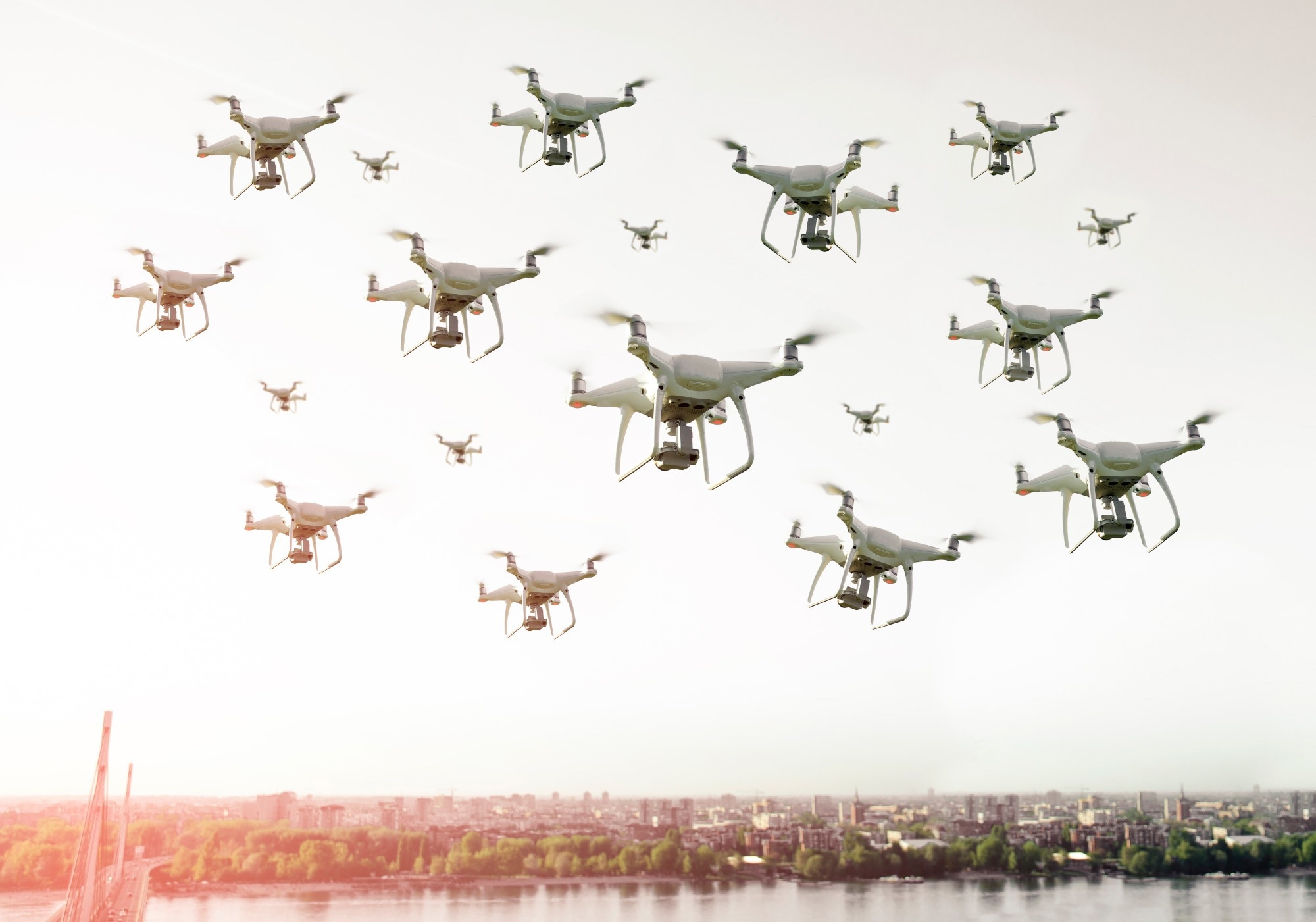 Image Credit: Phoenixns/Shutterstock
Swarm robotics takes this principle and encodes it into machines. By distributing intelligence across groups of autonomous robots rather than centralizing it, engineers are developing systems that are robust, adaptable, and capable of working in challenging environments where a single robot might struggle.
What is Swarm Robotics?
Swarm robotics is the study of how large groups of relatively simple, physically embodied robots can work together to accomplish tasks that no single robot could achieve on its own. Each robot operates autonomously, relies on local perception, and communicates only with its immediate neighbors instead of following instructions from a central command. The system's intelligence lies in the collective, not in any individual robot.1
This decentralized architecture gives swarms four defining properties: 1
- Self-organization
- Robustness
- Adaptability
- Scalability
Adding or removing robots from the group does not require reprogramming the remaining units, and the system continues to function even when individual members fail. These traits make swarm robotics fundamentally different from conventional multi-robot systems governed by a single controller. 1
The Biology Behind the Blueprint
The collective behaviors of animals, from schooling fish to packing wolves and flocking birds, produce fascinating patterns through simple interactions between individuals. In starling murmurations, for example, each bird follows specific rules based on its neighbors’ positions rather than a set physical distance. This allows thousands of birds to communicate and respond quickly to changes without needing a leader. Engineers have translated this directly into robotic flocking algorithms.1
Fish schools operate on three main rules. They attract each other to stay close, avoid collisions, and match speeds for alignment. Similarly, wolves use a hierarchical system during cooperative hunting. This established dominance maintains group cohesion.
Researchers at Beihang University have successfully translated these biological behaviors into unmanned swarm systems. They have clearly outlined the connection between swarms' natural behaviors and engineering principles.1
Insects also contribute valuable lessons in collective behaviors, particularly through stigmergy. This principle allows individual agents to alter their environment, which in turn influences the actions of others. For instance, termites construct complex mounds without any plans, and ants find the best foraging paths using pheromone trails. 2
A recent study published in Communications Engineering introduced an automated design framework for robot swarms based on stigmergy. The framework was tested across four different collective tasks in both simulations and real-world robots, showcasing the potential of using biological principles to enhance robotic systems.3
Swarm Intelligence as an Engineering Discipline
Wang and Beni introduced the term "swarm intelligence" in 1989 to describe the dynamics of robotic systems that exhibit collective intelligent behavior. The field evolved into two main branches: swarm intelligence algorithms for optimization and distributed swarm systems for physical deployment. Both branches share a foundational commitment to decentralization, local interaction, and emergent global behavior.1
The particle swarm optimization (PSO) algorithm, proposed by Kennedy and Eberhart in 1995, models the exploratory movement of virtual particles through a multi-dimensional solution space. Ant colony optimization (ACO) mimics pheromone-based trail reinforcement to solve complex routing and path-planning problems. Both algorithms have become standard tools in robotics engineering, guiding individual agents toward globally optimal behaviors without any agent holding a complete picture of the environment.4
Swarm intelligence design involves three core processes: exploration, integration, and feedback. In the exploration stage, individuals independently survey their problem space. Next, in the integration phase, the gathered information is merged across the group.
During feedback, the combined group information stimulates further exploration. This continuous loop creates systems that continuously refine their collective performance. It mirrors the adaptive cycles seen in biological colonies as they navigate unpredictable environments.1
Aerial Swarms and the UAV Frontier
Unmanned aerial vehicle (UAV) swarms are a rapidly growing area within swarm robotics. In 2016, the US Navy showcased this technology by launching 103 Perdix semi-autonomous drones from three F/A-18 aircraft. This impressive feat demonstrated how drones could work together in the air, making decisions and flying in formation in a way that had mostly been seen in simulations before.1
In 2022, researchers from China developed small, palm-sized drones that navigate complex environments. These drones use bird-inspired flight paths and can independently perceive and understand their surroundings. 1
UAV swarms are classified as centralized, distributed, or hybrid. Distributed systems allow each drone to make independent decisions, resulting in strong adaptability in changing situations. Hybrid systems divide tasks among drones to offer a mix of stability and flexibility. 1
A study published in National Science Review showed that feedback control methods combine positive feedback to amplify weak responses and negative feedback to suppress disturbance. This helps aerial swarms to maintain formation stability under real-world uncertainties. 1
Ground and Marine Swarms
Ground-based swarm robotics includes a range of devices, from tiny micro-nano robots to large unmanned ground vehicles (UGVs). Micro-nanorobots, which are controlled by external magnetic fields, can move together in groups and change their shapes into ribbons, chains, liquids, or vortices. This ability is useful for applications such as drug delivery and minimally invasive surgery.1
Download the PDF of this page here
Underwater swarm robotics takes inspiration from fish schools and cephalopod locomotion. These robotic groups are designed for tasks like distributed sensing and long-distance exploration. They rely on intelligent algorithms and specific communication methods that help them work well in water, even when signals are weak. Military and civilian applications of these underwater swarms include ocean mapping, pipeline inspection, and coordinated surveillance.5
Real-World Applications
Swarm robotics has become useful in many important areas. In agriculture, swarms of robots can monitor soil conditions, nutrient levels, and crop health. This real-time information helps farmers make better decisions about watering and fertilizing crops. Additionally, these robots can imitate the behavior of bees, flying between flowers to pollinate plants and support declining bee populations.6
In disaster response, robot swarms are deployed to locations such as collapsed buildings and flood zones. They gather and share data through sensors and camera feeds, helping rescue teams understand and navigate unfamiliar environments. One innovative system can continuously track targets even when they are obstructed by debris, rearranging itself as needed to maintain coverage. This is particularly useful in areas where communication networks do not exist or are disrupted.6,7
Research is also advancing in swarm 3D printing, where groups of robots work together to build large structures that one printer alone cannot create. In healthcare, tiny robot swarms are being designed to deliver drugs directly to tumors in the bloodstream. A recent development involves a snail-inspired robotic swarm that can climb together and carry objects, showing how nature can inspire new robotics solutions.1,7
Challenges That Remain
Designing individual behavioral rules that reliably produce desired global outcomes remains the central challenge of swarm robotics. The relationship between local rules and collective patterns is indirect and sensitive, making trial-and-error methods costly and unpredictable.
Researchers have proposed automatic design methods using evolutionary computation and reinforcement learning to generate swarm control software, with recent deep reinforcement learning approaches showing promise in collective transport tasks.8
Another major challenge in swarm robotics is maintaining reliable communication across large groups in complex environments. Factors such as time delays, changes in network structure, equipment failures, electromagnetic interference, and noisy channels can disrupt coordination among robots.
Addressing these challenges requires both robust algorithm design and hardware advances in localization, onboard sensing, and energy efficiency. The field is being actively pursued across academic and defense research programs. 1
References and Further Reading
- Duan, H. et al. (2023). From animal collective behaviors to swarm robotic cooperation. National Science Review, 10(5). DOI:10.1093/nsr/nwad040. https://academic.oup.com/nsr/article/10/5/nwad040/7043485
- Boldini, A. et al. (2024). Stigmergy: From mathematical modelling to control. Royal Society Open Science, 11(9), 240845. DOI:10.1098/rsos.240845. https://royalsocietypublishing.org/rsos/article/11/9/240845/92941/Stigmergy-from-mathematical-modelling-to
- Salman, M. et al. (2024). Automatic design of stigmergy-based behaviours for robot swarms. Communications Engineering, 3(1), 30. DOI:10.1038/s44172-024-00175-7. https://www.nature.com/articles/s44172-024-00175-7
- Cui, J. et al. (2024). Multi-strategy adaptable ant colony optimization algorithm and its application in robot path planning. Knowledge-Based Systems, 288, 111459. DOI:10.1016/j.knosys.2024.111459. https://www.sciencedirect.com/science/article/abs/pii/S0950705124000947
- Zhao, Q. et al. (2025). Bio-inspired swarm of underwater robots: a review. Bioinspiration & Biomimetics, Vol. 20, No. 4. DOI:10.1088/1748-3190/ade215. https://iopscience.iop.org/article/10.1088/1748-3190/ade215
- Jude, M. (2023). Exploring the Applications and Challenges of Swarm Robotics. Int J Swarm Evol Comput. Vol. 12, Issue 2. https://www.walshmedicalmedia.com/open-access/exploring-the-applications-and-challenges-of-swarm-robotics-119727.html
- Couzin, I. D. (2025). Collective intelligence in animals and robots. Nature Communications, 16, 9574. DOI:10.1038/s41467-025-65814-9. https://www.nature.com/articles/s41467-025-65814-9
- Kuckling, J. (2023). Recent trends in robot learning and evolution for swarm robotics. Frontiers in Robotics and AI, 10, 1134841. DOI:10.3389/frobt.2023.1134841. https://www.frontiersin.org/journals/robotics-and-ai/articles/10.3389/frobt.2023.1134841/full
Disclaimer: The views expressed here are those of the author expressed in their private capacity and do not necessarily represent the views of AZoM.com Limited T/A AZoNetwork the owner and operator of this website. This disclaimer forms part of the Terms and conditions of use of this website.