Researchers have developed a self-driving laboratory that combines artificial intelligence (AI) and robotics to automate laboratory tasks, from accurately measuring and mixing chemical ingredients to high-temperature furnace processing and sample retrieval.
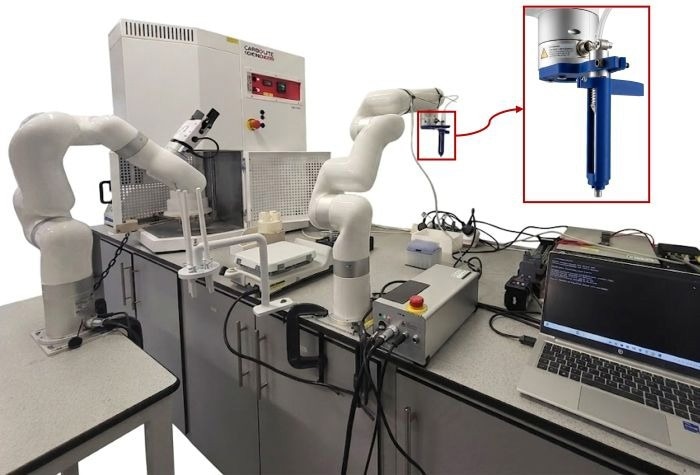 University of Nottingham's Self Driving-Lab. Image Credit: University of Nottingham
The team at the Centre of Excellence in Coating and Surface Engineering (CE-CSE) at the University of Nottingham have developed the system that could support the discovery and optimization of advanced materials for applications including aerospace, energy and high-temperature engineering.
Developing new materials for extreme environments traditionally involves repeated experiments, with researchers preparing samples, processing them and testing their properties. These processes can be time-consuming and require many individual steps.
The Nottingham team has brought these tasks together in a coordinated automated system. Two robotic arms, a specially designed liquid-dispensing tool, laboratory equipment and purpose-built software work together to carry out the process.
The laboratory is also guided by an AI-based approach known as active learning. This approach uses information from previous experiments to help identify which material compositions are worth investigating next. Using this method, the researchers identified and prepared several candidate materials with a particular crystal structure, known as pyrochlore, for investigation as potential thermal barrier coating materials.
Thermal barrier coatings act as protective heat shields, reducing the amount of heat reaching underlying components. They are important in aerospace applications, where engine parts are exposed to intense temperatures and demanding operating conditions. Discovering materials with low thermal conductivity, meaning they transfer heat less readily, is an important step towards developing more effective coatings.
Although robots are increasingly used in laboratories to automate repetitive tasks, connecting chemical preparation, sample handling and high-temperature furnace processing into one reliable workflow presents significant technical challenges.
The research team addressed these challenges by integrating the different stages into a single system. Calibration experiments demonstrated accurate liquid dispensing using different liquids. The team then demonstrated that the laboratory could automatically prepare a precursor solution, transfer the material for furnace processing, manage controlled cooling and retrieve the processed sample.
Professor Tanvir Hussain, Professor of Coatings and Surface Engineering in the Faculty of Engineering, said: “Self-driving laboratories have the potential to change how advanced materials are developed. A key challenge is enabling laboratory robots to work reliably across different stages of an experiment, particularly when liquid handling must be combined with high-temperature processing. Our work addresses an important part of that challenge and creates opportunities for further integration with intelligent experimental planning and optimization.”
Dr. Mohammadreza Lalegani Dezaki, Research Fellow in Mechanical and Manufacturing Engineering at the University of Nottingham, added: “Our aim was to connect laboratory operations that are often carried out separately into one coordinated robotic workflow. By integrating liquid dispensing, robotic handling and high-temperature processing, we have demonstrated how complex materials preparation can be automated from start to finish. This provides an important foundation for more autonomous and reproducible materials research.”
The research demonstrates a practical approach to integrating robotics, laboratory equipment and AI-guided materials discovery. By reducing the need for manual intervention in repetitive laboratory operations, the platform could improve experimental consistency, support reproducible research and provide a foundation for higher-throughput materials development.
The research has been published in Engineering Applications of Artificial Intelligence.
Watch a video demonstrating the robotic system in operation here