Collaborative robots, widely known as cobots, are a distinct category of industrial automation designed to operate alongside human operators in shared workspaces. They use force-limiting joints, proximity sensors, and closed-loop control architectures to operate safely alongside workers.
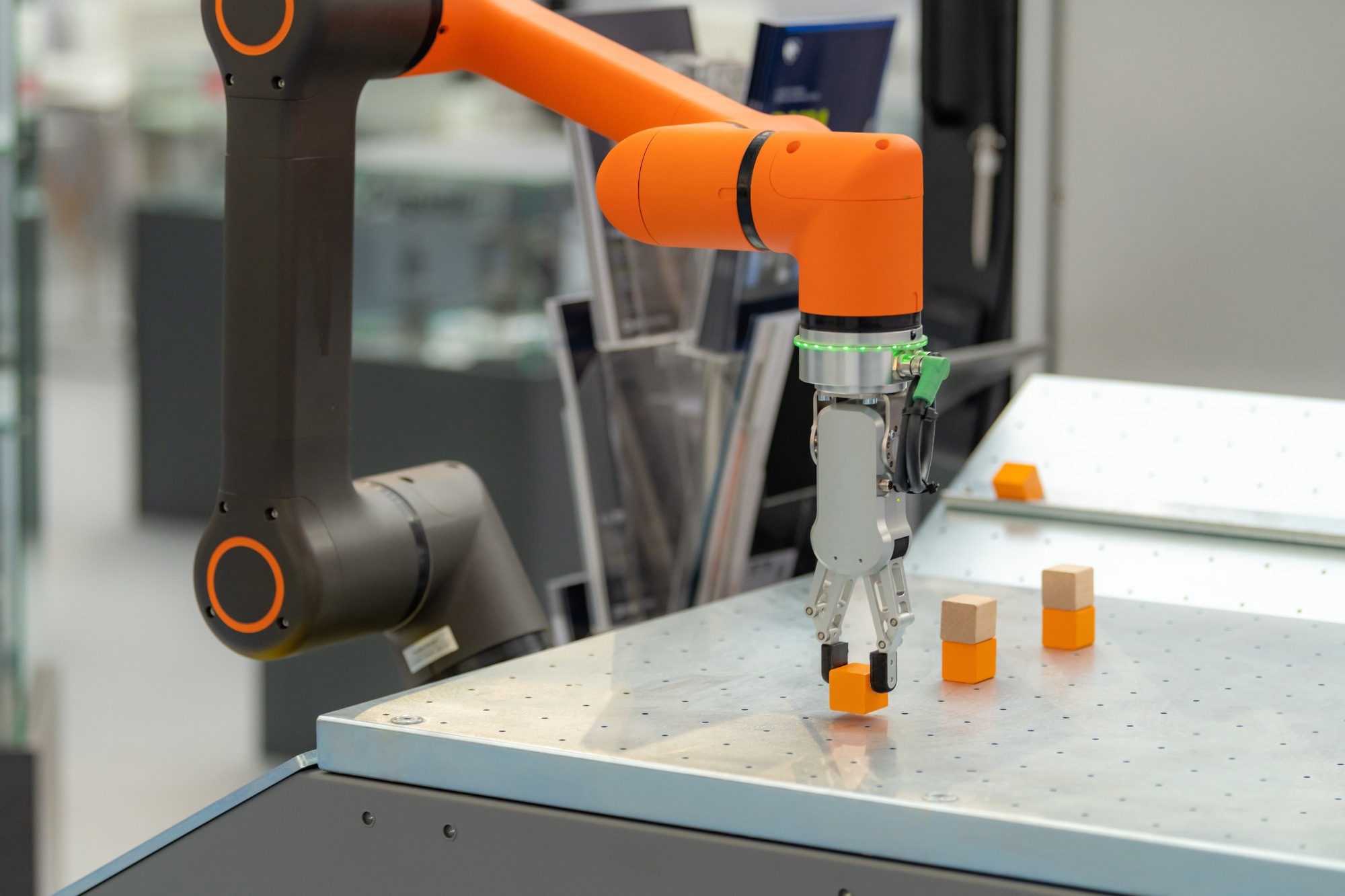 Image Credit: Microgen/Shutterstock
Their design philosophy prioritizes adaptability and safe physical interaction over the raw speed and structural rigidity that define traditional caged industrial robots. These features make them uniquely suited to environments where human judgment and robotic precision must coexist.
What Makes a Cobot Different
Cobots combine programmability, sub-millimeter repeatability, and intuitive teach interfaces. These features make them especially practical for high-mix low-volume production, which is characteristic of both aerospace component manufacturing and medical device assembly. Industries that experience frequent product changeovers and have strict quality requirements find cobots much easier to redeploy compared to conventional automation.1
Defining Micro-Precision in High-Stakes Manufacturing
Micro-precision in industrial assembly refers to accurately placing and fastening components within micron- or millimeter-level tolerances. Aerospace assemblies require drilled holes positioned within ±0.001 inches to ensure proper load paths and prevent stress concentrations while preserving aerodynamic surface geometry. In medical devices, implantable components rely on surface finishes and fits measured in micrometers for biocompatibility and mechanical stability within the body.2
These strict tolerance requirements often exceed what human workers can consistently achieve due to fatigue and natural variability. Modern collaborative robots bridge this gap, offering positioning accuracy of ±0.02 mm and maintaining consistent performance across thousands of operations. In both sectors, dimensional errors can have serious safety implications for end users, making precision central to assembly standards and validation protocols.2
Force-Torque Sensing: The Sensory Foundation
Force-torque sensors are the technical core of precise cobot operation in contact-intensive assembly. Six-degree-of-freedom sensors measure loads across three translational and three rotational axes simultaneously, allowing the controller to modulate joint torques in real time when contact forces deviate from predefined assembly thresholds.
This feedback architecture enables controlled insertion operations, consistent surface finishing, and fastening sequences that prevent over-torquing, a failure mode particularly damaging to ceramic or polymer components used in medical devices and avionics housings.3
Minimizing coupling errors within force-torque measurements directly improves accuracy during contact tasks. Impedance-control strategies based on sensor data enable the robot to dynamically regulate its stiffness throughout each assembly phase.
In orthopedic implant assembly, excessive load on a ceramic femoral component can lead to undetectable microscopic fractures. Real-time force regulation at the joint level protects against these failures at the moment of contact, offering a level of process assurance that downstream inspections cannot provide.3
Aerospace Assembly: Drilling, Deburring, and Structural Scale
Aerospace manufacturing requires millions of precision-drilled and deburred holes across fuselage panels, wing skins, and nacelle assemblies, each held to positional tolerances that directly affect structural load distribution, fatigue life, and aerodynamic performance.4
A fully autonomous cobot system published in the Journal of Intelligent Manufacturing introduced novel end-effector designs customized for deburring and inner-hole painting tasks across large-scale aerospace structures, pairing them with vision-based control algorithms that enabled autonomous multi-task execution without external supervision at any step.4
A complementary development, the Advanced Collaborative Multifunctional End-Effector (ACME), introduced vacuum-assisted clamping and a passive self-normalization mechanism for angular alignment on double-curvature aerospace surfaces, published in MDPI Sensors.5
The system employed a CoreXY carriage architecture that minimized moving mass, enhanced structural stiffness, and achieved repeatable precision on multi-layered composite and metallic stacks in one-up assembly configurations. These engineering advances directly resolve the low stiffness at extended reach that has historically prevented cobots from satisfying aerospace machining standards at production scale.5
Medical Device Assembly in Cleanroom Environments
Medical device manufacturers must meet a layered set of requirements that combine micrometer-level dimensional accuracy with strict contamination control, regulatory documentation, and process validation.6,7
Implantable devices like pacemakers, orthopedic implants, and cochlear components must be assembled in ISO Class 3 to 5 cleanroom environments governed by 21 CFR Part 820 and ISO 14644-1, which set enforceable limits on airborne particle concentrations to protect implant sterility before and during packaging. Cleanroom-rated cobot variants address this by featuring sealed joint housings, inert lubricants, and smooth external surfaces that minimize particle shedding during operation.6,7
Cobots in regulated medical assembly also generate the process data that underpins regulatory validation. Their controllers produce time-stamped motion logs, applied-force records, and vision-system outputs that support the installation, operational, and performance-qualification sequences the FDA requires for any manufacturing process in which finished-product inspection alone cannot verify process adequacy.
This embedded data traceability makes cobots compliance instruments as much as assembly tools, directly reducing audit risk and shortening validation cycle times for manufacturers introducing new device lines into regulated production.6,7
Machine Vision and AI-Guided Precision
Machine vision systems integrated at the cobot wrist or mounted overhead transform static motion sequences into adaptive assembly processes capable of responding to real-world variability. AI-powered vision enables cobots to recognize part variants within a family, detect surface anomalies before placement, correct for positional offsets introduced by upstream process variation, and adjust grip dynamics based on real-time part geometry analysis.8,9
In aerospace fastener assembly, AI-driven vision enables cobots to align connectors and structural fasteners on continuously moving assemblies without halting the line to reposition. In medical device manufacturing, vision-guided cobots verify component orientation and surface condition before every placement operation, intercepting defect categories that manual inspection misses under production fatigue.
These integrated capabilities contribute to a cobot market projected to grow from 1.2 billion dollars in 2023 to over 2.5 billion dollars by 2028, driven primarily by perception and AI integration in precision-sensitive production environments.8,9
Safety Standards and the Regulatory Framework
ISO/TS 15066, now officially part of ISO 10218-2:2025, establishes essential guidelines for the interaction between collaborative robots (cobots) and human workers in shared production environments. The standard sets limits on permissible contact forces and pressures based on biomechanical injury thresholds, delineates four collaborative operation modes, and mandates a documented risk assessment before the deployment of any cobot system in spaces occupied by humans.10,11
The power-and-force-limiting mode, specifically designed for purpose-built cobots, enables the system to detect unusual contact forces. This proactive feature allows the cobot to halt or reverse its movement before reaching critical injury thresholds, ensuring a safer workspace for all involved.10,11
Variable impedance control strategies, guided by ISO/TS 15066 parameters, enable collaborative robots (cobots) to operate at higher speeds while maintaining safe contact forces during incidental interactions with humans. Research indicates that dynamic joint stiffness adjustment surpasses fixed-impedance methods by real-time adaptation of robot behavior according to workspace proximity and task phases.10,11
Saving this for later? Download a PDF here.
In aerospace and medical production environments, compliance with these standards is essential for process qualification. Consequently, safety engineering and precision engineering must be integrated from the earliest stages of cobot deployment to ensure that both operational efficiency and safety are prioritized.10,11
The Engineering Path Ahead
Cobot deployment in aerospace and medical manufacturing will continue to advance as end-effector engineering, AI perception, and force-control algorithms converge within digital twin frameworks that enable full process simulation before physical execution begins.
The IFR identified mobile cobot platforms as a major growth driver for 2025 and beyond, particularly for large-structure aerospace assembly tasks where fixed robotic stations cannot reach internal fuselage bays, wing joints, or engine nacelle interiors without repositioning the entire tooling setup. Digital twin pairing enables engineers to optimize trajectories, contact forces, and tool paths in simulation, reducing physical trials and compressing regulatory validation timelines.8
Remaining barriers, including stiffness limitations at extended reach, complex qualification cycles, and the scarcity of engineers combining robotics and regulatory expertise, continue to attract structured research investment. Cobot-assisted micro-precision assembly now sits at the intersection of control theory, materials science, machine vision, and regulatory engineering, and progress in any single domain produces measurable improvements across all the others.
Industries that build this interdisciplinary capability today will set the traceability and precision benchmarks that govern aerospace and medical manufacturing for the next generation.8
References and Further Reading
- Collaborative Robots - How Robots Work alongside Humans. (2024). IFR Press Room. https://ifr.org/ifr-press-releases/news/how-robots-work-alongside-humans
- Cobot update Summer 2024. (2024). Engineering.com. https://www.engineering.com/cobot-update-summer-2024/
- Rahman, M. M. et al. (2023). Cobotics: The Evolving Roles and Prospects of Next-Generation Collaborative Robots in Industry 5.0. Journal of Robotics, 2024(1), 2918089. DOI:10.1155/2024/2918089. https://onlinelibrary.wiley.com/doi/10.1155/2024/2918089
- Abdulrahman, Y. et al. (2025). A multi-functional autonomous cobot system for large-scale aerospace precision machining. J Intell Manuf. DOI:10.1007/s10845-025-02761-8. https://link.springer.com/article/10.1007/s10845-025-02761-8
- Kazemiesfahani, M. et al. (2025). Design, Analysis, and Prototyping of a Multifunctional Digital Twin-Enabled Aerospace Drilling End-Effector Deployable by a Collaborative Robot. Sensors, 25(24). DOI:10.3390/s25247504. https://www.mdpi.com/1424-8220/25/24/7504
- Medical Device Cleanroom Classification and Requirements. (2024). Arterex Medical. https://arterexmedical.com/medical-device-cleanroom/
- Collaborative robots for medical device manufacturing. Hitbot. https://www.hitbotrobot.com/cobot-for-medical-device-manufacturing/
- Haghighi, A. et al. (2025). A comprehensive review and bibliometric analysis on collaborative robotics for industry: Safety emerging as a core focus. Frontiers in Robotics and AI, 12, 1605682. DOI:10.3389/frobt.2025.1605682. https://www.frontiersin.org/journals/robotics-and-ai/articles/10.3389/frobt.2025.1605682/full
- AI, 3D Vision, and Cobots: The New Standard in Smart Automation. (2025). Revopoint Robot. https://www.revopoint-robot.com/blogs/blog/ai-vision-cobots
- ISO 10218 & ISO/TS 15066 Explained: Robot Safety Standards for Integrators. (2026). AMD Machines. https://amdmachines.com/blog/robot-safety-standards-iso-10218-and-ts-15066-explained/
- Ghanbarzadeh, A. et al. (2025). Safe physical human–robot interaction through variable impedance control based on ISO/TS 15066. Int J Interact Des Manuf 19, 4741–4758. DOI:10.1007/s12008-024-02074-9. https://link.springer.com/article/10.1007/s12008-024-02074-9
Disclaimer: The views expressed here are those of the author expressed in their private capacity and do not necessarily represent the views of AZoM.com Limited T/A AZoNetwork the owner and operator of this website. This disclaimer forms part of the Terms and conditions of use of this website.