*Important notice: This news reports on an unedited version of an accepted paper and is awaiting final editing. Therefore, the paper should not be regarded as conclusive or treated as established information.
A reusable artificial strawberry stem has been made from hot-melt adhesives (HMAs) for robotic harvesting research. Through this approach, researchers have demonstrated repeated cutting, healing, and detachment, with diameter-scaled replicas reproducing the static behavior of real stems. The findings, published in Communications Engineering, suggest the design could provide a practical, low-cost testbed for standardized harvesting tests.
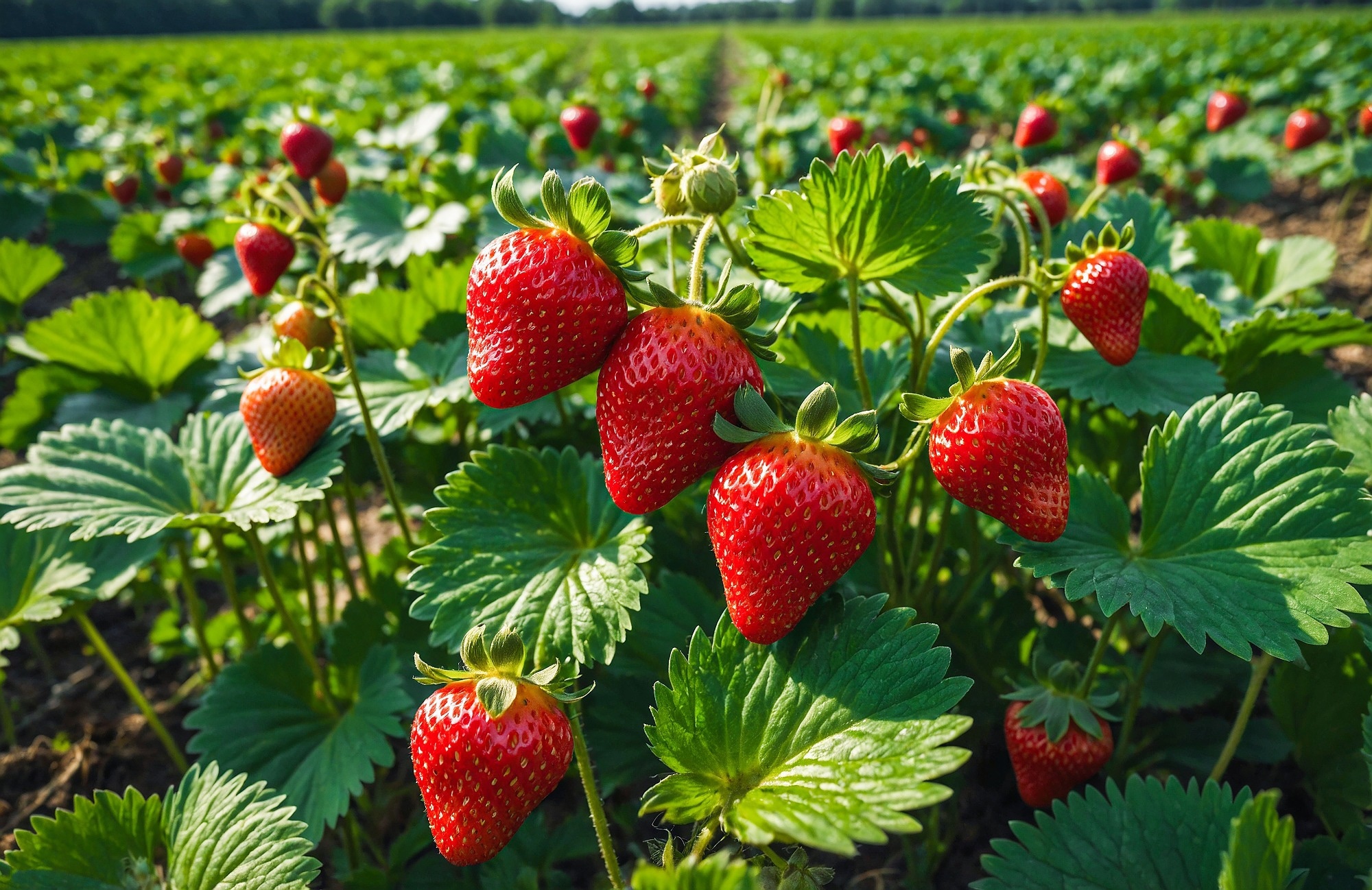 Study: A reusable strawberry stem based on hot melt adhesives for robotic harvesting applications. Image Credit: KVMArt/Shutterstock.com
Challenges in Robotic Strawberry Harvesting
Labor shortages are intensifying interest in field automation: harvesting draws particular focus because its labor accounts for nearly 36% of total production costs, especially for high-value crops like strawberries.
Strawberries grow in clusters on slender stems that are often partially hidden and difficult to access, making harvesting a complex task that demands precise stem manipulation to avoid damaging the fruit.
Robotic harvesting has advanced over the past decades, yet deployment requires extensive testing, which is complicated by field conditions that include limited accessibility, crop loss, poor repeatability, and large sample sizes.
Download a free copy of this page here!
Existing testbeds fall short: plastic replicas ignore mechanical properties, simulators lack fidelity for soft-tissue contact and cutting, and physical twins do not support repeated cutting or controlled repair.
This research presents a reusable artificial strawberry stem made from HMAs to address these gaps.
Designing and Testing Artificial Stems
To characterize real strawberry stems, the authors sampled 53 randomly selected plants of two commercial varieties, Katrina and Zara, at a research farm during the 2023 growing season, recording
berry weight, stem length, and stem diameter.
Because stems deform quasi-planarly under their own weight, three-dimensional reconstructions were mapped onto a locally defined anatomical plane, preserving intrinsic curvature while removing out-of-plane variability.
Diameter distributions from this dataset informed the design of stem molds with multi-diameter channels that capture the natural segment transitions of real stems. These molds were 3D-printed in PLA, with printing time and material use rising sharply at larger scales, from roughly seven hours at standard size to nearly two days at the largest version.
Artificial stems were cast from transparent HMA sticks, an ethylene-vinyl acetate material with a softening point of 86 °C ±5 °C. Artificial berries were cast in Ecoflex™ 00-30 silicone from molds made using a commercially available strawberry, with internal cavities carved and partly filled with HMA to tune weight.
Four experiments followed. Static similarity compared 10 biological stems against five replicas each, across five diameter scaling levels, with the distal 20 mm kept at its exact biological diameter. This scaling was applied only in the static similarity test.
Healing testing was repeated for nine cut-heal cycles on three stem diameters under a universal testing machine. Tensile testing measured detachment loads after zero to nine healing cycles. Fabrication repeatability was tested on 10 independently fabricated stems per diameter from the same mold.
Replicating Natural Stem Mechanics
The surrogate reproduces plant-like passive curvature informed directly by real stem data, using a single widely available material and avoiding multi-material fabrication. Reusability comes from localized reheating, as stems can be cut and reattached using only the heated tip of a glue gun, without added material, and berries of different shapes and weights can be attached using heat for fast modular assembly.
Performance was assessed through curvature error and three variability coefficients. On static behavior, geometric replicas at original scale showed the largest deviation from real stems, with scaled replicas progressively approaching biological behavior.
The highest similarity occurred between two- and three-times scaling, where increased diameter improved bending stiffness and reduced excessive deformation, achieving curvature errors of approximately 3.39 to 11.01% of stem length.
In healing tests, peak cutting loads remained broadly consistent across cycles, though stem length gradually decreased by roughly 4 mm per cycle as material was irreversibly lost at the interface, giving an effective lifespan of about eight to 13 cycles depending on diameter and handling.
Tensile tests showed that unhealed samples had the highest detachment loads, whereas healed specimens were more variable. Fabrication consistency showed similar stiffness and peak cutting loads across replicas, with peak load increasing with diameter.
Advancing Agricultural Robotics Research
The artificial strawberry stem surrogate offers a reusable, low-cost, and mechanically bioinspired platform for agricultural robotics research. It enables controlled studies of manipulation, cutting, and reusability while reducing dependence on biological material.
The authors emphasize that the design is a physical surrogate rather than a physical twin, as it retains the mechanical features governing bending and cutting but does not preserve the exact biological geometry, and the hot-melt adhesive does not fully match the stem’s natural stiffness.
Scaling between two- and three-times diameter produced the closest approximation of real strawberry stems’ static bending behavior. The authors kept the distal 20 mm at its biological diameter to maintain realistic cutting interactions, and all cutting, healing, tensile, and fabrication tests were conducted on unscaled stems.
No clear degradation in mechanical response was seen across the nine cut-heal cycles tested, and the stems remained functional for an estimated eight to 13 cycles, depending on diameter and handling.
Beyond agriculture, the approach could also be explored for low-cost medical phantoms and training platforms, though this was not tested in the study.
Journal Reference
Espejel, J. P., et al. (2026). A reusable strawberry stem based on hot melt adhesives for robotic harvesting applications. Communications Engineering. DOI:10.1038/s44172-026-00804-3. https://www.nature.com/articles/s44172-026-00804-3.
Disclaimer: The views expressed here are those of the author expressed in their private capacity and do not necessarily represent the views of AZoM.com Limited T/A AZoNetwork the owner and operator of this website. This disclaimer forms part of the Terms and conditions of use of this website.