Defining Autonomy with Numbers
Counting the Moments Humans Step In
Knowing Where It Is
Deciding With Incomplete Information
Closing the Loop
Recovering From Its Own Faults
Conclusion
References and Further Reading
Autonomy describes a robot’s capacity to sense its environment, make decisions, and act on them without continuous human direction. Engineers have refined this capacity, and autonomous systems today can operate in mines, warehouses, farms, and disaster sites where communication links are weak or absent. As deployments expand into these settings, developers, regulators, and buyers need precise criteria for assessing the robot’s autonomy and reliability.
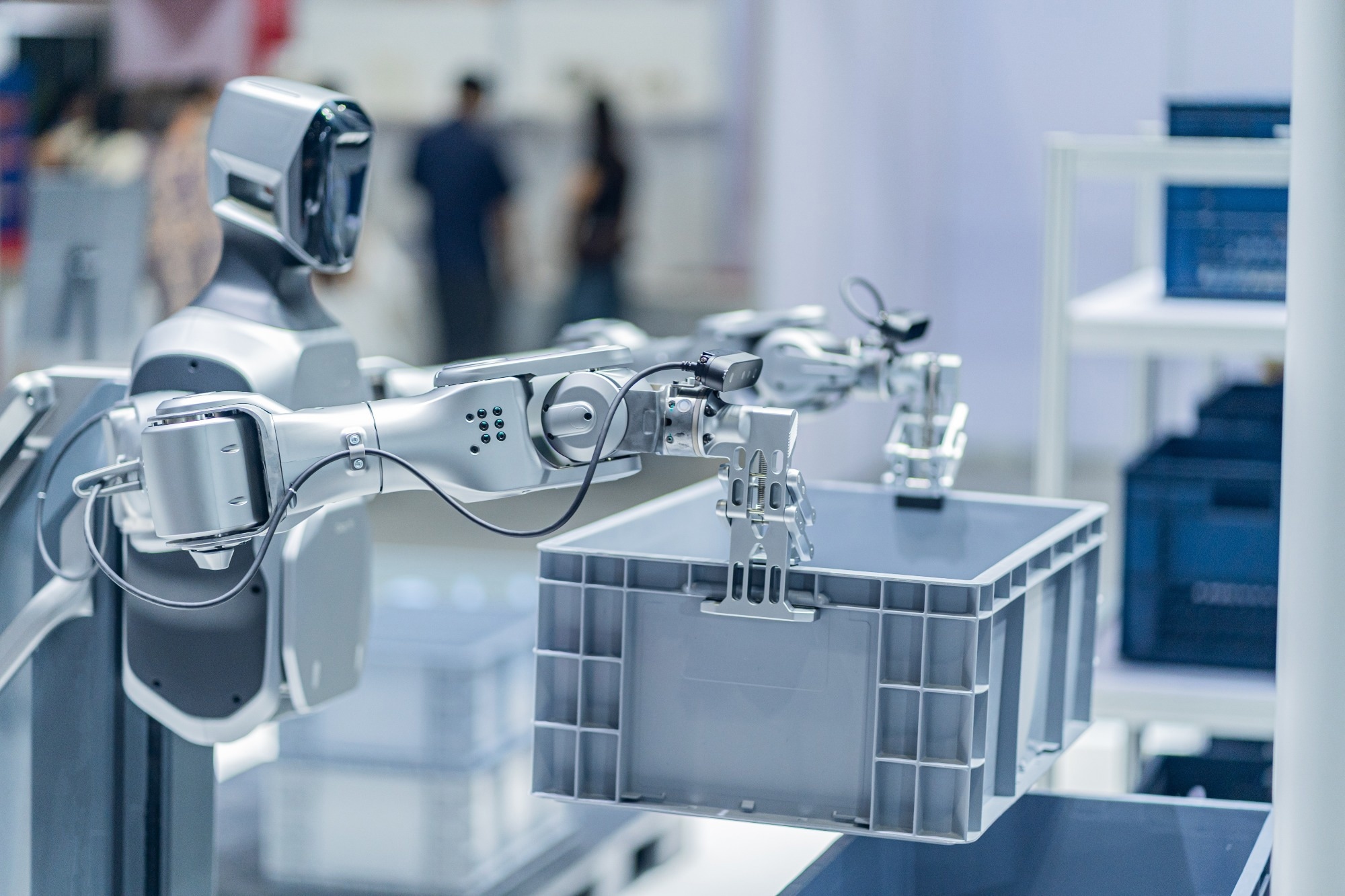 Image Credit: apiguide/Shutterstock
Initial attempts to define robot autonomy utilized ordinal scales, ranging from remotely operated systems to fully autonomous machines. However, these scales primarily documented robot functions without thoroughly addressing their performance in real-world scenarios. This article explores the true essence of robotic autonomy, including its definition, measurement, construction, and safeguarding.1
Defining Autonomy with Numbers
A recent framework published in Drones and Autonomous Vehicles provides a practical starting point for understanding autonomy. It treats autonomy as a two-part measure made of a level and a degree. The level reflects whether a robot possesses the capabilities a task demands, while the degree reflects how well it performs them. This distinction is important, as two robots with identical skill lists can behave differently when they encounter a demanding job in the field.1
The framework derives three metrics from the task itself: requisite capability, reliability, and responsiveness. These metrics are based on the observation that robots often take over work done by skilled people, so robot tasks can be mapped against human job requirements. Tracked in real time, the same metrics can also monitor system integrity, giving operators an early signal when a robot begins drifting below its expected standard.1
Counting the Moments Humans Step In
Another way to assess autonomy is by the frequency of human intervention required. Researchers studying robots used in farming have suggested levels based on how much attention a human supervisor needs to give. At the lowest level, a person stays within sight of the machine as it works. At the next level, an operator can be nearby and handle other tasks, and the expected time between interventions stretches to about an hour.2
Further up the scale, an operator could manage multiple robots and only needs to step in every 8 hours for battery changes or repairs. The next level removes the supervisor from the site, with visits only needed every three days. This requires reliable infrastructure and strong remote connections. The highest-level features robots that learn from their experiences and from each other, improving their operation beyond what designers programmed.2
Knowing Where It Is
To work independently, a robot must know its position and surroundings. Engineers handle this through simultaneous localization and mapping (SLAM). According to a report published in Frontiers in Robotics and AI, localization and mapping were once treated as separate problems. Later, researchers recognized their deep dependency, since an accurate position estimate requires a map, and a reliable map requires an accurate position estimate.3
Visual SLAM addresses this circular problem with cameras, using computer vision to extract and match features as the robot moves. Many systems combine camera data with an inertial measurement unit, which tracks acceleration and rotation, and process the readings quickly. This pairing allows a robot to build a map of an unfamiliar building while tracking its own path, a basic requirement for work in places nobody has charted.3
Knowing its location gives a robot a foundation, but autonomy also requires deciding what to do next. Real environments rarely provide clean data. A recent MDPI Sensors editorial on intelligent robotics suggests that robots must make decisions with incomplete, noisy, or context-dependent information. Therefore, methods that handle uncertainty, such as fuzzy reasoning for path planning, remain useful today.4
The editorial also discusses the growing role of large, general-purpose learning models. These models expand what robots can interpret, including spoken instructions and unfamiliar objects. The authors argue that for safety-critical tasks, these models should work alongside systems that incorporate physical models, constraints, and uncertainty estimates. People will trust learned intelligence more when engineers support it with physics-based rules and confirmed limits.4
Closing the Loop
Autonomy is also influenced by the integration of a robot's components. Perception, decision-making, learning, and control are often developed as separate components, but real-world autonomy requires these elements to interact continuously through feedback. This interaction ensures that every new observation updates the existing plan, while each action generates new observations that the robot must interpret before deciding on its next move.5
Maintaining this feedback loop in physical machines remains difficult. There are many challenges like distribution shift, partial perception, contact uncertainty, and safety constraints. Distribution shift arises when a robot encounters conditions that differ from those in its training data, such as a warehouse robot transitioning into a dimly lit, cluttered storeroom. Each of these challenges assesses the robot's reliability in situations where reality diverges from the engineers' expectations.5
Recovering From Its Own Faults
A truly autonomous robot must also notice when something inside it goes wrong. Researchers at the Fraunhofer Institute and the University of Stuttgart proposed a framework built around skill chains, which are groups of software components that together deliver a specific service. By continuously monitoring its internal state, the robot detects errors before they spread beyond a single chain and disrupt the wider mission.6
Download the PDF of this page here
Once the robot spots a fault, it reviews its current state and available resources. If spare components are available, it reforms the chain or switches to an alternative one that provides the same service. It can also roll back to a previous successful checkpoint and retry the task. In tests on two industrial robot arms, a failed motion planner triggered a backup planner without manual intervention.6
Conclusion
True autonomy in robots requires a combination of key capabilities. These include reliable performance, the ability to operate without human assistance for an extended period, and a comprehensive understanding of its environment. Mapping provides it with a measure of location, structured reasoning guides its choices under uncertainty, continuous feedback ties its systems together, and internal monitoring lets it recover from faults.1-3
Buyers and regulators can judge a robot's autonomy by examining what it can do, how well it does it, and how long it can operate without assistance. A robot is truly autonomous when it can sense its surroundings, make decisions, take action, and self-repair over extended periods in unfamiliar environments with minimal human involvement.4-6
References and Further Reading
- Gyagenda, N. (2026). A Framework for Quantifying Autonomy in Robotic Systems. Drones Auton. Veh., 3 (3):10021. DOI:10.70322/dav.2026.10021. https://journal.hep.com.cn/dav/EN/10.70322/dav.2026.10021
- Know What You Want When it Comes to Autonomy. (2022). No-Till Farmer. https://www.no-tillfarmer.com/articles/11235-know-what-you-want-when-it-comes-to-autonomy
- Al-Tawil, B. et al. (2024). A review of visual SLAM for robotics: Evolution, properties, and future applications. Frontiers in Robotics and AI, 11, 1347985. DOI:10.3389/frobt.2024.1347985. https://www.frontiersin.org/journals/robotics-and-ai/articles/10.3389/frobt.2024.1347985/full
- Haidegger, T. et al. (2026). From Intelligent Control to Integrated Autonomy: Reflections on Advanced Intelligent Robotics and Autonomous Control Systems. Sensors, 26(20), 6460. DOI:10.3390/s26206460. https://www.mdpi.com/1424-8220/26/20/6460
- Closed-Loop Robot Autonomy for Embodied Intelligence. (2026). Frontiers in Mechanical Engineering. https://www.frontiersin.org/research-topics/82866/closed-loop-robot-autonomy-for-embodied-intelligence
- Wu, R. et al. (2025). Enhancing Resilience in Robotic Systems through Self-Awareness and Adaptive Recovery. Proceedings of the 35th European Safety and Reliability & the 33rd Society for Risk Analysis. DOI:10.3850/978-981-94-3281-3_ESREL-SRA-E2025-P6744-cd. https://rpsonline.com.sg/proceedings/esrel-sra-e2025/pdf/ESREL-SRA-E2025-P6744.pdf
Disclaimer: The views expressed here are those of the author expressed in their private capacity and do not necessarily represent the views of AZoM.com Limited T/A AZoNetwork the owner and operator of this website. This disclaimer forms part of the Terms and conditions of use of this website.