The first lunar base will likely take shape before any crew actually sets foot on it. Essential structures like landing pads, shielding berms, and level ground must be established for habitats to be practical. Every hour an astronaut spends on soil grading represents a costly resource. That's where builder robots come in, working during long daylight hours while mission planners monitor progress from Earth.
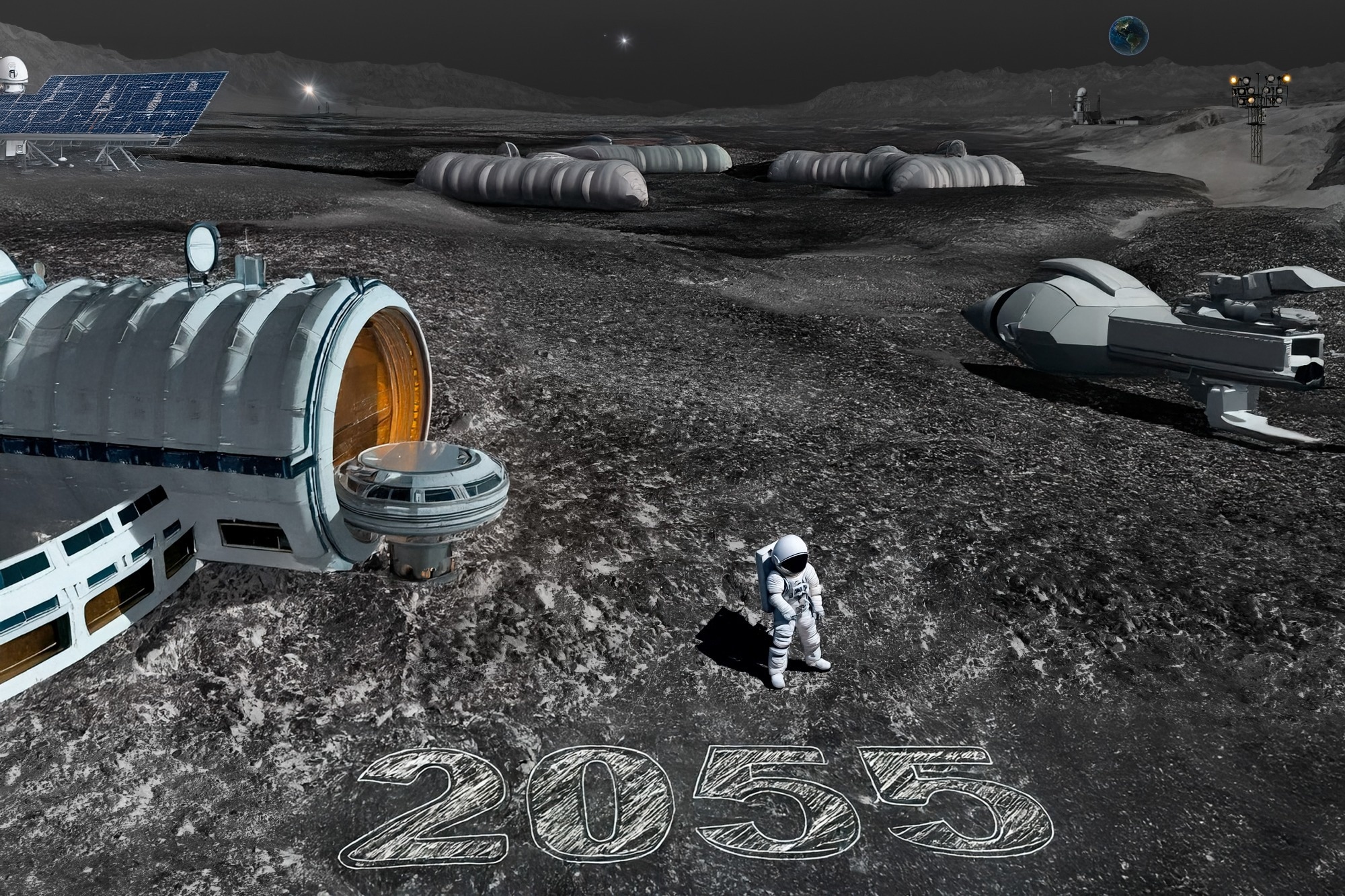 Image Credit: Paul Thomas Curry/Shutterstock
Moreover, transporting materials such as cement and steel over 250,000 miles consumes valuable launch capacity that could otherwise support scientific exploration and life systems. Studies of regolith-based additive manufacturing with sulfur concrete or geopolymer binders suggest payload reductions of up to 90%, shifting the engineering question from what to send toward what a machine can make on arrival.1
Preparing Ground on the Moon
NASA's Marshall Space Flight Center has developed a pre-Phase A architecture for this kind of groundwork, centered on a landing pad built from lunar soil. In this operational concept, a light detection and ranging (LiDAR)-equipped rover surveys the area, while additional rovers strategically place navigation markers at the four corners of the site. Lastly, platforms identify and remove rocks before grading.2
Grading rarely succeeds on the first attempt, so the sequence loops. If inspection reveals obstructions the machines missed, site preparation is repeated until the area is sufficiently level to build on. That patience is the quiet advantage of robotic construction, since a fleet can iterate over many days without fatigue, and a repeated cycle costs power rather than crew safety margin.2
From Loose Dust to Solid Surfaces
Rovers haul sieved regolith in trailers, platform arms pour and compact it into hexagonal layers about 2.5 mm thick and 61 cm wide, and a laser head fuses the material. 20 of these stacked layers form a single solid tile, with the top and bottom 5 layers completely sintered, and the middle 10 layers fused at their edges.2
Energy is a key constraint affecting every fusing method. Traditional furnace sintering of regolith simulant requires temperatures exceeding 1050 °C, which is challenging to maintain using solar arrays in a location without a power grid. A recent study published in ACS Omega used focused microwave heating and achieved solidification at around 300 °C. These experiments demonstrated heating rates of up to 150 °C/min at 100 W.3
These experiments expose how sensitive the physics is to hardware design. Regolith simulant has low dielectric loss, so ordinary multimode ovens failed to heat it without silicon carbide susceptors and insulation. However, a single-mode cavity resonator, which focuses the electric field at its center, successfully heated the material without additives. Additionally, the lower 915 MHz setup enhanced coupling, resulting in larger gravel particles.3
Building with Rocks Left Where They Lie
A quieter approach involves bypassing traditional processing methods entirely. Researchers have proposed an autonomous excavator that gathers naturally occurring boulders, carries them to the site, and stacks them into dry-stone blast shields using techniques already demonstrated by robotic hydraulic excavators on Earth. Since the stones require no crushing, heating, or binder, the energy bill drops sharply compared with thermal methods.4
The numbers make the scale concrete. An Artemis-class landing pad is expected to span 200 m, and a shield at a 50 m radius would need about 1000 m3 of boulders for a full ring, or 250 for a quarter segment. With a vehicle payload of 10 m3, the work becomes a long logistics problem across mapped terrain.4
Fleets Rather than Single Machines
Robotic construction favors specialization, and the proposed mining architectures clearly reflect this pattern. Explorer robots map deposits, excavators scoop icy regolith into capsules, haulers fitted with robotic arms carry the ore to a central hub, and transporter robots move it onward to the processing plant. Two haulers follow each excavator to ensure loading and digging proceed without delay.5
Expectations for productivity must be realistic. For example, NASA's RASSOR 2.0 excavator takes about 42 minutes to dig a single 80-kg block of frozen regolith. Digging 20 blocks requires about 830 minutes for excavation and 23 minutes for transport. This results in a daily output of about 33 blocks, or about 2640 kg of regolith, a pace that is steady rather than fast.5
Download the PDF of this page here
Mobility research feeds the same problem from below. JAXA built a four-track platform rover with a boom, arm, and bucket, then compared terramechanics simulations against experiments on level and sloped ground in a field that mimics lunar soil. Travel and digging behavior showed similar trends in both, providing designers with validated guidance for sizing machines that must move and excavate in powder.6
Challenges that Still Remain
Dust, radiation, and temperature changes damage equipment, while rough soil wears down seals, bearings, and lenses. Researchers agree that building structures in space won’t be done entirely by machines. Humans are still needed to detect problems, make decisions in unpredictable situations, manage risks, and ensure safety in critical tasks that current planning systems cannot handle on their own.1
Signal delay complicates this human-machine partnership. Latency increases the operator's workload and diminishes situational awareness, increasing the likelihood of mistakes, especially when a single person is responsible for supervising multiple semi-autonomous systems simultaneously. Implementing a layered autonomy structure can help mitigate these challenges. At low levels, routine tasks are performed; at middle levels, the system adapts to changing terrain; and at the highest level, ambiguous or dangerous situations are escalated to a human in a control room for resolution.1
A Plausible First Build
The answer is inclined toward yes, with certain conditions. Robots can grade a site, sinter tiles, stack shielding, and extract volatiles at rates measured in tons per day. The architectures for all these tasks are already outlined in design documents and demonstrated in test environments. However, the construction of arch vaults from irregular stones and the development of excavators designed for vacuum conditions still await practical demonstration.4
Consequently, the first lunar base is likely to be a collaborative effort. Machines will pour the pads and raise the berms over months of supervised work, and crews will arrive to finish, inspect, and inhabit what the fleet prepared. The final hurdles to overcome before achieving this outcome are the deployment of field-manufactured regolith and the establishment of high-fidelity testbeds that accurately replicate real communication latency.1
References and Further Reading
- Jafari, A. et al. (2025). Building beyond earth: A roadmap for human-robot collaboration and workforce development in extraterrestrial construction. Frontiers in Space Technologies, 6, 1701442. DOI:10.3389/frspt.2025.1701442. https://www.frontiersin.org/journals/space-technologies/articles/10.3389/frspt.2025.1701442/full
- Triana, S. et al. (2024). An Integrated Architecture Study for Autonomous Lunar Construction. NASA. https://ntrs.nasa.gov/api/citations/20240004101/downloads/Lunar%20Mobility%20White%20Paper%20LSIC.pdf
- Tsubaki, S. et al. (2024). Self-Sufficient Production of Lunar Regolith Gravels on the Moon by Ultrarapid Microwave Sintering. ACS Omega, 9 (20): 22488–22494. DOI:10.1021/acsomega.4c02702. https://pubs.acs.org/acsodf/article/9/20/22488/410619/Self-Sufficient-Production-of-Lunar-Regolith
- Walther, J. et al. (2024). Autonomous construction of lunar infrastructure with in-situ boulders. Frontiers in Space Technologies, 5, 1345337. DOI:10.3389/frspt.2024.1345337. https://www.frontiersin.org/journals/space-technologies/articles/10.3389/frspt.2024.1345337/full
- Tan, J. et al. (2024). Lunarminer Framework for Nature-Inspired Swarm Robotics in Lunar Water Ice Extraction. Biomimetics, 9(11). DOI:10.3390/biomimetics9110680. https://www.mdpi.com/2313-7673/9/11/680
- M. Sutoh. (2024). Development and Evaluation of Mobility and Excavation Rover Toward Lunar Base Construction. J. Robot. Mechatron., Vol. 36 No.2, pp. 334-342. DOI:10.20965/jrm.2024.p0334. https://www.fujipress.jp/jrm/rb/robot003600020334/
Disclaimer: The views expressed here are those of the author expressed in their private capacity and do not necessarily represent the views of AZoM.com Limited T/A AZoNetwork the owner and operator of this website. This disclaimer forms part of the Terms and conditions of use of this website.