Robot kinematics is the analytical study of the motion of a robot manipulator. Suitable kinematics models are formulated for a robot mechanism to analyze the behavior of industrial manipulators.1-4
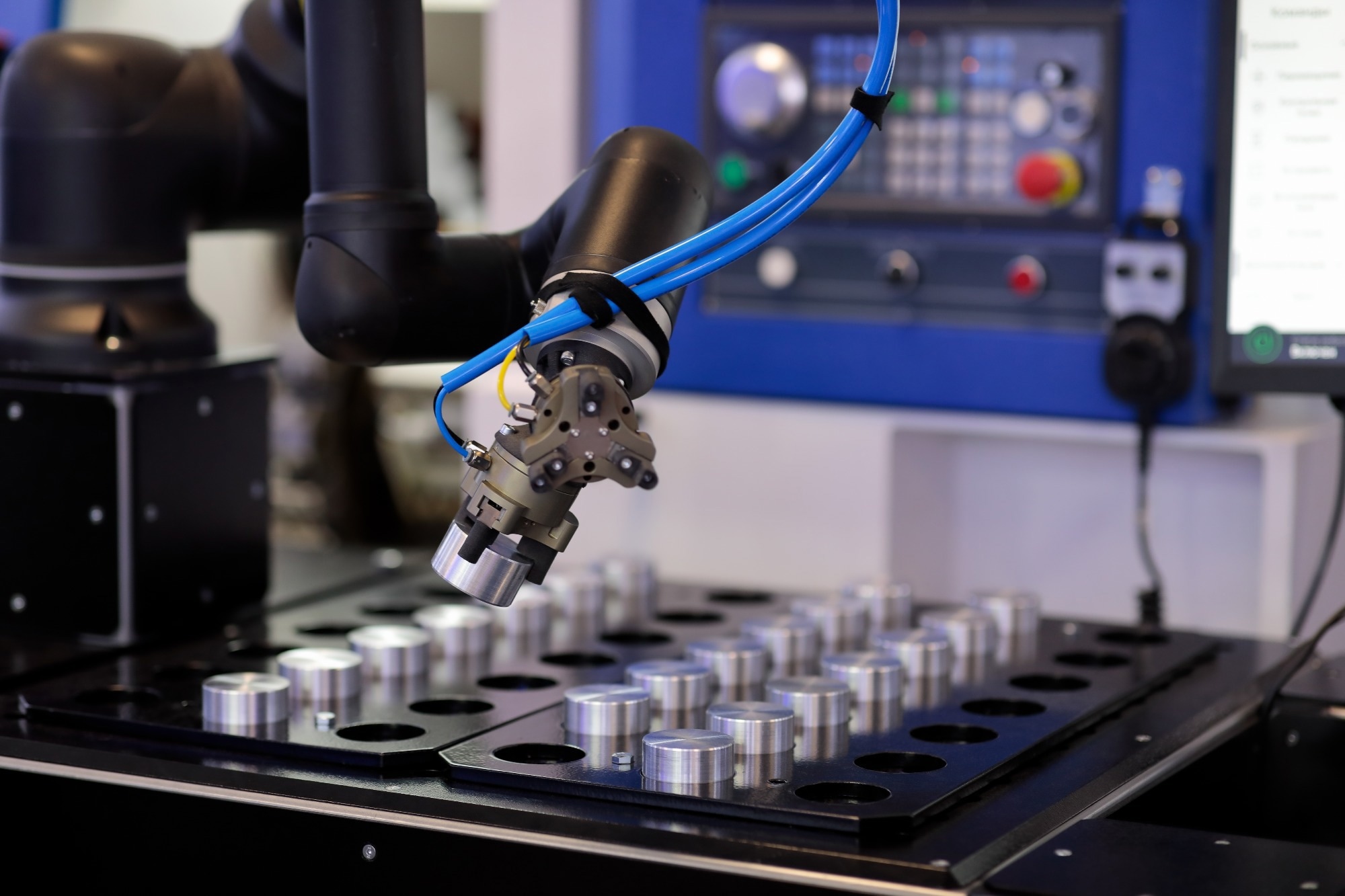 Image Credit: genkur/Shutterstock
An Overview of Robot Kinematics
Kinematics studies the motion of bodies without considering the forces or moments that produce it. In kinematic modeling of manipulators, quaternion and Cartesian spaces are primarily used.1
The transformation between two Cartesian coordinate systems can be decomposed into a translation and a rotation. Rotation can be represented using Hamilton's quaternions, axis-angle, orthonormal matrices, Pauli spin matrices, Cayley-Klein parameters, Gibbs vector, and Euler angles.1
Among those representations, homogeneous transformations based on orthonormal matrices/4 × 4 real matrices are commonly used in robotics. Denavit & Hartenberg (DH) demonstrated that four parameters are required for a general transformation between two joints. These DH parameters are standard for describing robot kinematics.1
Robot kinematics can be classified into inverse kinematics and forward kinematics.1
Forward Kinematics
A robotic manipulator consists of serial links connected to one another through prismatic or revolute joints, from the base frame to the end-effector. The representation of the end-effector orientation and position through the robot geometry/link and joint parameters is known as forward kinematics.1,2
Specifically, it is a set of equations that compute the end-effector's position and orientation from given joint angles. The DH parameters are used to generate the set of equations. A suitable kinematics model must be used to perform forward kinematics in a systematic manner for a robot mechanism.1,2
Four parameters, including the link offset, link twist, link length, and joint angle, are used in the DH method. DH parameters are determined by attaching a coordinate frame to each joint. The Zi axis of the coordinate frame is pointed along the sliding or rotary direction of the joints.1
The forward kinematics problem is simple, and the equations can be derived with minimal complexity. Thus, a forward kinematics solution of a manipulator always exists. Robot forward kinematics is the foundation for robot control and simulation.1-3
It estimates the center of mass of the robot body, identifies potential collisions between robot body parts and the environment, and displays the robot's current state. The robot's pose, which is the combination of its orientation and position, can be represented as a rotation matrix-position vector pair.3
In the case of orientation, both the end-point orientation and the orientation of the joint controlling the last arm link are the same, as the rigid-body robot arm is usually straight. Additionally, the angular and linear velocities of a robot can be expressed in terms of its twist velocity, which is represented by a homogeneous transformation matrix.3
Inverse Kinematics
A robot’s inverse kinematics is the mapping that calculates a set of joint positions when given a goal position to place the end effector of the robot in the specified goal. The inverse kinematics problem involves finding the required manipulator joint values to achieve a desired endpoint orientation and position.1,2
This problem is complex owing to nonlinearity, the absence of a closed-form expression, and the lack of distinct solutions. As nonlinearities and singularities increase the difficulty of solving the problem, complete analytical solutions exist only for a small class of kinematically simple manipulators, like manipulators with an Euler wrist.1,2
Solution for the Inverse Kinematics Problem
The inverse kinematics problem is considerably more complex than forward kinematics and is computationally intensive, making it challenging to solve efficiently for real-time manipulator control.1,2
Tasks that are performed by a manipulator are in the Cartesian space, while actuators work in joint space that is represented by joint angles. The conversion of the orientation and position of a manipulator end-effector from Cartesian to joint space is known as the inverse kinematics problem.1,2
Algebraic and geometric approaches are used to derive the inverse kinematics solution analytically. The geometric approach is primarily applied to simple robot structures, such as a 2-degree-of-freedom (DOF) planar manipulator or a manipulator with fewer DOF and parallel joint axes.1
Download the PDF of this page here
However, the algebraic approach is more suitable for inverse kinematics solutions for manipulators whose arms extend into 3 or more dimensions and have more links.1
Robot Dynamics
Robot dynamics studies the relationship between the torques or forces acting on a robot and the accelerations they produce. Various formulation methods of robot dynamics include Lagrangian Dynamics Formulation and Newton-Euler Dynamics Formulation.3
Lagrangian Dynamics Formulation: Motion is represented by energy as a scalar and is based on the principle of least action. Generalized coordinates are used in place of constraint forces in Lagrangian dynamics, thereby making conservation laws easy to obtain.3
Lagrangian dynamics is extensively used in all domains of physics and effectively handles non-conservative forces.3
Newton-Euler Dynamics Formulation: Motion is described by forces with vectors and is based on Newton’s laws of motion in Newtonian dynamics. Newtonian dynamics involves constraint forces and lacks systematic methods for deriving conservation laws.3
In robot dynamics, two major problems are inverse dynamics and forward dynamics. In forward dynamics, the robot's acceleration, pose, and velocity generated by known forces are calculated. Similarly, in inverse dynamics, given the desired acceleration, velocity, and pose, the required forces to generate them are calculated.3
Kinematic Studies of the KUKA 3R Arc Robot
A paper published in IOP Conference Series: Materials Science and Engineering presented the kinematic analysis of a six-DOF KUKA KR5 Arc robotic arm using the DH method and RoboAnalyzer simulation software.4
Forward and inverse kinematics were analyzed to understand the robot’s kinematic behavior. Forward and inverse analyses of the kinematic model can be realized using the DH model in the RoboAnalyzer software.4
Kinematic studies of the robot provided a foundation for designing robotic systems for applications in warehouses, automobiles, and electronics. The study can also aid the kinematic analysis of robotic grippers with varying link lengths.4
Importance of Robot Kinematics
Robot kinematics is crucial for understanding and controlling robotic manipulators. It provides mathematical models to determine the position, orientation, velocity, and motion of robot joints and end-effectors. Using DH parameters and kinematic models enables systematic robot design and analysis, improving the reliability of robotic systems.
References and Further Reading
- Kucuk, S., & Bingul, Z. (2006). Robot kinematics: Forward and inverse kinematics. Industrial Robotics: Theory, Modelling and Control. DOI: 10.5772/5015, https://www.researchgate.net/publication/221785964_Robot_Kinematics_Forward_and_Inverse_Kinematics
- Salman, A. E., Roman, M. (2022) Robot kinematics. https://www.researchgate.net/publication/365193182_ROBOT_KINEMATICS
- Zhang, J. (2022). Robot kinematics: Motion, kinematics and dynamics. ArXiv. DOI: 10.48550/arXiv.2211.15093, https://arxiv.org/abs/2211.15093
- Jha, A., Soni, M., & Suhaib, M. (2021). Simulation and kinematic analysis of KUKA KR5 Arc robot. IOP conference series: Materials science and engineering, 1149, 1, 012005). DOI: 10.1088/1757-899X/1149/1/012005, https://iopscience.iop.org/article/10.1088/1757-899X/1149/1/012005/meta
Disclaimer: The views expressed here are those of the author expressed in their private capacity and do not necessarily represent the views of AZoM.com Limited T/A AZoNetwork the owner and operator of this website. This disclaimer forms part of the Terms and conditions of use of this website.