A robotic prosthetic hand replaces a missing hand with a powered mechanism that reads signals from the body and converts them into finger motion. Its commands originate in the muscles of the residual limb, which still produce electrical activity when the user attempts to close, open, or rotate the absent hand.
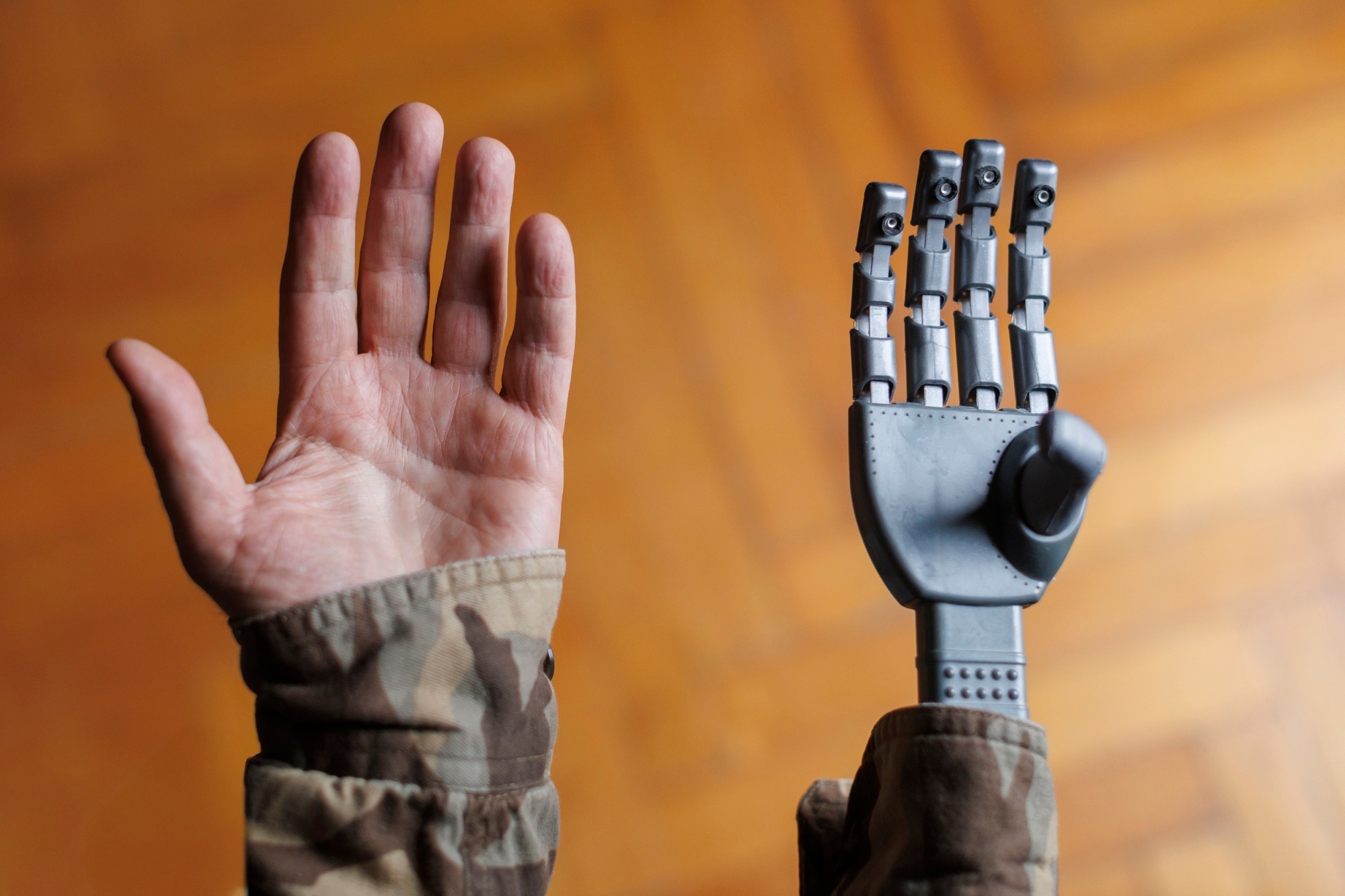 Image Credit: aerogondo2/Shutterstock
Every device of this kind runs the same chain of operations. Electrodes collect muscle activity, a processor interprets the user's intent, and small motors drive the fingers. Sensors then report what the hand is doing, closing the loop between the machine and the person wearing it.1,2
Reading the Muscles
The electrical signal used for control is called an electromyogram. Each motor neuron fires a sequence of pulses that travel to the muscle fibers it controls, and the resulting motor unit action potentials overlap into one composite waveform that reflects how hard and how often the muscle contracts.1
Surface electrodes pressed against the forearm capture this activity without breaking the skin. The recorded waveform typically spans 6-500 Hz, with most of its power between 20-150 Hz, so filters strip out drift below 20 Hz and interference near the 50 Hz power line frequency.1
Channel count is also very important for hand function. Most commercial prostheses rely on only two surface electrodes, which limits users to moving one joint at a time. High-density arrays place more than sixteen closely spaced electrodes over a small area, producing two-dimensional maps of muscle activation.3
Turning Signals into Intent
Direct control takes the amplitude of one or two muscle signals and applies it straight to a motor, so a strong contraction closes the hand and a weaker one opens it. Pattern-recognition control instead classifies the overall shape of the signal to select among stored grip postures.4
Algorithms compute values such as mean absolute value, root mean square, waveform length, and zero crossings, compressing a noisy high-dimensional recording into a compact description that a classifier can separate. No single feature combination has proven best across all users and all movements.1
Continuous estimation predicts joint angles, angular velocities, or torque, moment by moment rather than labeling an entire motion as a single fixed pattern. This approach lets a user modulate grip force and hold a finger partway through its travel, which matters when handling a paper cup or an egg.1
Laboratory reports indicate high accuracy in these systems. Support vector machines, nearest-neighbor methods, and neural networks have achieved high accuracy on controlled gesture sets. Additionally, one high-density sleeve has successfully classified 37 hand gestures with a sequential accuracy of 97.3% and estimated continuous joint angles.5
Building the Hand Itself
The human hand has 29 bones, 38 muscles, and 20-25 degrees of freedom, a level of articulation no prosthesis matches. Designers therefore choose which motions matter most, guided by data showing the thumb participates in about 38% of everyday grasps.1,2
In this context, underactuation closes the gap. One soft prosthetic design uses three direct-current motors and three degrees of freedom, giving the thumb its own tendon cable, the index finger a second cable, and the remaining three fingers a shared third cable. Compliant joints let each finger conform to an object's shape.2
The mechanism also includes position and force sensors. Motor encoders resolve 10,000 pulses per revolution and track finger position through a 1:30 reduction gear. Meanwhile, force-sensitive resistors at the fingertips measure grip pressure. All updates occur within a control loop running every millisecond.2
Giving the Sensation Back
Most commercial hands operate open loop, meaning the user watches the fingers to judge how firmly an object is held. Visual attention handles coarse tasks but proves insufficient for fine-grained grasping control. About 40% of hand prostheses are eventually rejected by their owners.2
In contrast, closed-loop designs provide sensory feedback to the user’s skin. For example, a mechanotactile actuator can apply pressure to the arm corresponding to the force detected by the fingertips. A proportional force controller ensures that this pressure remains accurate across different placement sites and varying muscle states. Participants in studies tolerated forces of up to 8.5 N before experiencing discomfort.2
Additionally, vibration can convey different types of information. Four small vibrating motors arranged along an arm strap encoded open hand, wide grip, narrow grip, and closed hand, and their firing sequence let users perceive how quickly the hand was closing. In this case, participants were able to identify every pattern correctly.2
Surface electromyography is non-stationary, so its statistical properties drift during use. Muscle fatigue, sweat, changes in skin condition, and electrode displacement all shift the signal away from the pattern a classifier learned, producing misidentified gestures and unwanted movement.4
Saving this for later? Download a PDF here.
Limb position adds another failure mode. A classifier trained with the arm resting on a table degrades when the same user reaches overhead, generating wrist and hand motions the person never intended. Pairing electrodes with an inertial measurement unit compensates for some of this variation.2
Laboratory accuracy also overstates daily performance because most tests classify steady contractions held at constant force. Real movement passes through transitions between gestures, and errors concentrated in those transition stages explain much of the gap between offline scores and clinical results.1
What Researchers Are Pursuing?
Implanted sensing addresses the electrode contact problem. Intramuscular electrodes record from specific muscles rather than muscle groups, and implanted myoelectric sensors have remained stable for more than four years without excessive tissue rejection, delivering higher fidelity signals than any skin-mounted array.4
Adaptive algorithms address software-side drift. Context-informed incremental learning uses environmental cues to update itself during ordinary use, reducing the frequency with which a user must recalibrate after electrode shifts or fatigue. Domain adaptation methods transfer a trained model across days and across people.2
However, hardware integration remains a significant challenge. Dense electrode interfaces made from textiles, printed polyester, and flexible circuit boards have shown promising performance in laboratory tests. None have yet been validated inside a working prosthetic socket under everyday conditions, and inadequate socket integration remains a recurring obstacle. Battery life of around three hours further constrains daily use.2,3
A robotic prosthetic hand works by translating residual muscle activity into motor commands, executing them through compact actuators, and returning contact information to its user. Each of those three stages carries its own unsolved problems, and progress in any one of them raises the ceiling for the whole device.1,2
References and Further Reading
- Chen, Z. et al. (2023). A Review of Myoelectric Control for Prosthetic Hand Manipulation. Biomimetics, 8(3). DOI:10.3390/biomimetics8030328. https://www.mdpi.com/2313-7673/8/3/328
- Sariyildiz, E. et al. (2023). Experimental Evaluation of a Hybrid Sensory Feedback System for Haptic and Kinaesthetic Perception in Hand Prostheses. Sensors, 23(20). DOI:10.3390/s23208492. https://www.mdpi.com/1424-8220/23/20/8492
- Quadrelli, D. et al. (2025). Advances in HD-EMG interfaces and spatial algorithms for upper limb prosthetic control. Frontiers in Neuroscience, 19, 1655257. DOI:10.3389/fnins.2025.1655257. https://www.frontiersin.org/journals/neuroscience/articles/10.3389/fnins.2025.1655257/full
- Guo, K. et al. (2024). The Latest Research Progress on Bionic Artificial Hands: A Systematic Review. Micromachines, 15(7). DOI:10.3390/mi15070891. https://www.mdpi.com/2072-666X/15/7/891
- Abdikenov, B. et al. (2025). Emerging Frontiers in Robotic Upper-Limb Prostheses: Mechanisms, Materials, Tactile Sensors and Machine Learning-Based EMG Control: A Comprehensive Review. Sensors, 25(13). DOI:10.3390/s25133892. https://www.mdpi.com/1424-8220/25/13/3892
Disclaimer: The views expressed here are those of the author expressed in their private capacity and do not necessarily represent the views of AZoM.com Limited T/A AZoNetwork the owner and operator of this website. This disclaimer forms part of the Terms and conditions of use of this website.