Visual Components, a specialist in 3D manufacturing simulation and robot offline programming, has announced FactoryLens, a new viewport built directly into its simulation platform, powered by the NVIDIA Omniverse libraries. Developed as the latest step in Visual Components' collaboration with NVIDIA, FactoryLens lets manufacturers take the factory layouts they already use for simulation and move directly into a more realistic digital-twin environment, with real-time rendering in the software they already use.
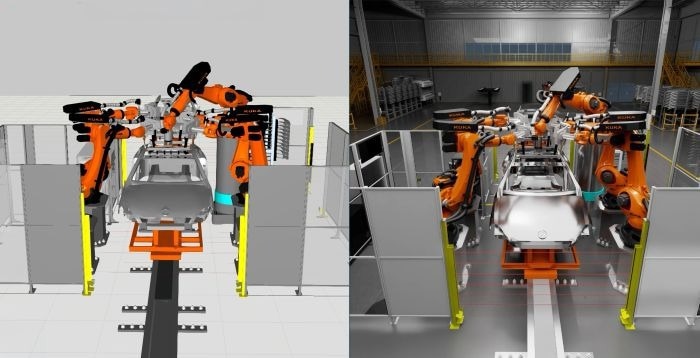 Image Credit: Visual Components
Today's advanced manufacturing equipment, processes, and facilities are increasingly designed and tested first in simulation, and that validation is only as useful as how closely it reflects the real world. Visual Components provides 3D simulation software that lets manufacturers plan, validate, and optimize factory layouts before they are built, and FactoryLens extends those existing workflows into a more realistic digital-twin environment, inside the platform they already know. Rather than recreating factory models in separate visualization software, users can visualize their large-scale layouts in real time, control materials and appearance, record high-quality video, and export factory configurations using Universal Scene Description (OpenUSD) for use in compatible external environments, all without leaving Visual Components.
Visual Components users can build factory and warehouse simulations using a library of more than 4,000 components, including robots, machines, conveyors, autonomous mobile robots, forklifts, and other production equipment. FactoryLens adds a photorealistic layer to these environments, powered by NVIDIA RTX, while NVIDIA PhysX continues to support realistic physics underneath.
Looking further ahead, Visual Components sees FactoryLens as a foundation for future digital twin and physical AI use cases, such as vision-based virtual commissioning, synthetic-data generation, and model and policy training and evaluation, as the platform's capabilities evolve.
"We believe the future of manufacturing is built on connected digital twins, not isolated applications," said Mika Anttila, Chief Technical Officer and Co-founder at Visual Components. "FactoryLens is our first step in bringing NVIDIA Omniverse libraries into Visual Components, so manufacturers can see how their factories will really look and behave before they build them, while keeping the productivity and ease of use our customers already know."
FactoryLens is the next phase of the Visual Components and NVIDIA roadmap. It brings NVIDIA's open libraries and frameworks into the Visual Components ecosystem, laying the groundwork for broader customer workflows such as collaboration, data exchange, interoperability, version control, and multi-user workflows across the OpenUSD ecosystem.
"Integrating NVIDIA technologies into Visual Components brings increased physical accuracy and fidelity to simulated worlds, and is a natural fit for the rise of physical AI and the value simulation brings to that domain," said Mustafa Kamal, Business Development Director at Visual Components. "Combining NVIDIA’s open libraries and frameworks with the fast, easy-to-use simulation products of Visual Components opens the door for everyone to build realistic digital twins."
NVIDIA sees the same opportunity from its side.
"Manufacturers are increasingly using simulation to design, test, and optimize complex production environments and physical AI systems before making changes on the factory floor," said Vikram Natarajan, general manager for Omniverse at NVIDIA. "By integrating NVIDIA Omniverse libraries into FactoryLens, Visual Components is helping engineering teams make faster decisions and extend their workflows to new physical AI applications, including synthetic data generation for model training and fleet-scale validation."
The launch is a continuation of Visual Components' broader digital twin journey, extending simulation into a more visual, more accessible, and more collaborative experience for every stakeholder involved in factory design.
Visual Components will also be at NVIDIA GTC Berlin in October together with KUKA Group, where it will showcase FactoryLens.