By rethinking how thin metal threads are woven into flexible fabrics, EPFL researchers have created a textile actuator capable of lifting over 400 times its own weight.
The breakthrough could pave the way for wearable systems that offer physical assistance without the mechanical bulk of traditional robotics.
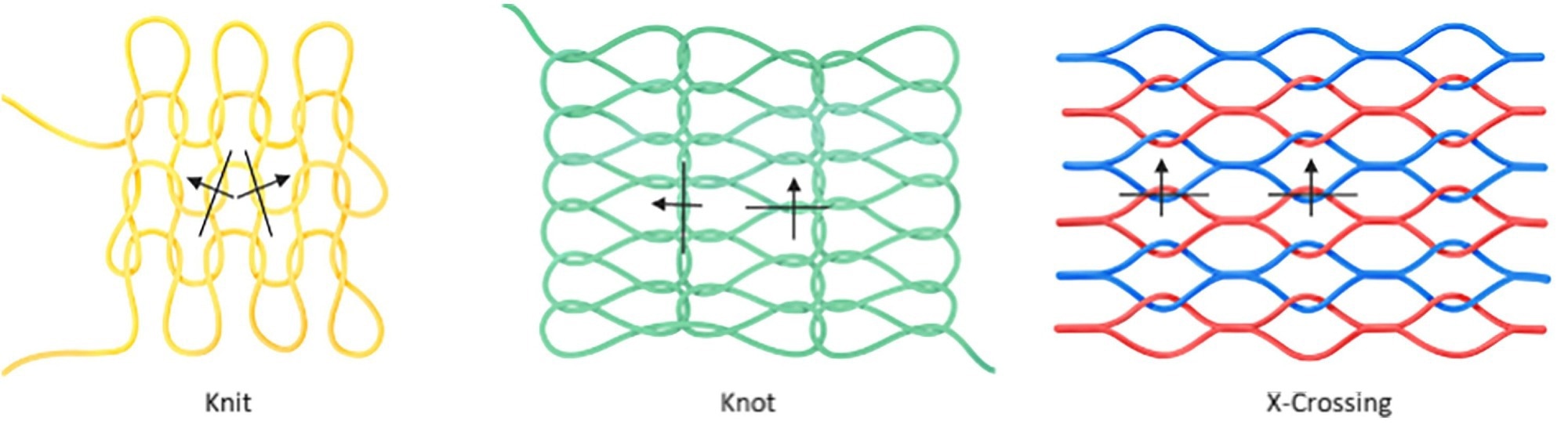 Different fabric architectures and their fiber crossing directions. Image Credit: 2026 LMTS EPFL
Most wearable robotics today rely on rigid components that compromise comfort and often draw unwanted attention. While soft robotic actuators can offer discreet assistance to human muscles, it remains a major challenge to balance strength, range of motion, and flexibility within a fabric that feels natural to wear.
At EPFL’s School of Engineering, the Soft Transducers Lab (LMTS) has taken a significant step forward.
Led by PhD student Huapeng Zhang and LMTS head Herbert Shea, the team designed a new fabric architecture using shape memory alloy (SMA) fibers interlaced in a repeated X pattern, referred to as X-Crossing geometry. When activated, a 4.5-gram patch of this material can lift up to 1 kilogram.
The teams' findings were recently published in Science Advances.
Strength and Flexibility from Cooperating Fibers
The textile's strength comes from how the nickel-titanium SMA fibers are arranged. When heated by an electrical current, these threads contract and become rigid, generating mechanical force.
In traditional knitted or knotted structures, however, SMA fibers often oppose each other, reducing the total force output.
The X-Crossing design solves this by aligning every fiber crossing in the direction of movement, ensuring the forces add up rather than cancel out. This configuration not only improves efficiency but also allows the fabric to stretch to 160 % of its original length, making it flexible enough for easy integration into garments.
We realized that the orientation of fiber crossings plays a critical role in how forces add up inside a textile actuator. By aligning the crossings, we ensure that the forces generated at each intersection contribute constructively, rather than working against each other, resulting in a textile actuator that significantly outperform previous knitted or knotted designs.
Huapeng Zhang, Ph.D. Student and Study First Author, Soft Transducers Lab, EPFL
Wearable Assistance and Compression
To explore real-world applications, the team developed two wearable prototypes using their X-Crossing actuators. One was a sleeve fitted on a mannequin’s arm to assist with elbow bending. The fabric actuator lifted a 1 kg weight through a 30° range of motion, doing so smoothly and in a controlled manner.
The second prototype focused on on-body compression, a key function in medical wear and athletic clothing. The actuator applied consistent compression pressure without the need for constant energy input.
The researchers also introduced a detailed mechanics model that predicts how SMA fibers respond to temperature and stress. Unlike earlier models, this one factors in how stiffness varies throughout each fiber during phase transitions, enabling more accurate predictions of force and contraction under different operating conditions.
Shea highlights that a significant benefit of the X-Crossing design is its efficiency, which enables it to sustain compression pressure without incurring any energy costs.
Beyond improved actuator design, this work also highlights the potential for textiles to do more than cover the body; they can actively support it.
While textiles traditionally serve solely as passive apparel, the transition to fabrics that function as powerful actuators enables a new class of comfortable, unobtrusive, practical wearable robotics that provide support for daily activities.
Herbert Shea, Head, Soft Transducers Lab, EPFL
SMA Fabric Actuators with Aligned Fiber Crossings for Active Textiles
Video Credit: EPFL
Journal Reference:
Zhang, H., et al. (2026) Mechanics-informed fabric actuators with aligned fiber crossings. Science Advances. DOI: 10.1126/sciadv.aeb6760. https://www.science.org/doi/10.1126/sciadv.aeb6760