A generative artificial intelligence (AI) model, Evo 2, has been used to design novel bacteriophage genomes to kill Escherichia coli (E. coli) in a proof-of-concept study. The team synthesized and tested nearly 300 AI-generated phages, ultimately identifying 16 that were exceptionally effective.
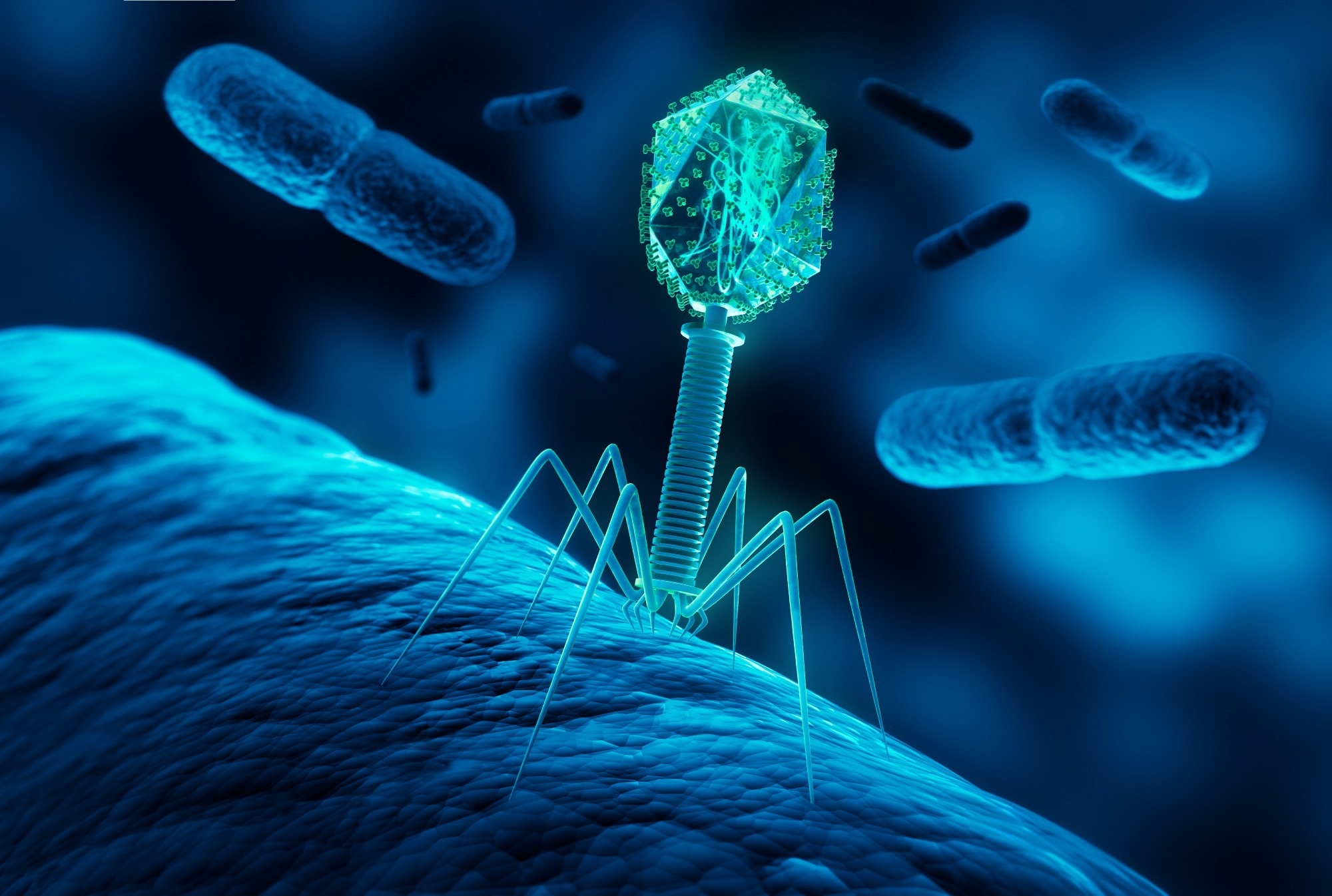 Study: Generative design of bacteriophages with genome language models. Image Credit: peterschreiber.media/Shutterstock.com
This work, detailed in Stanford Report, demonstrates a potential path toward new, resistance-resistant antibiotics and highlights the value of open-source AI tools in biological research.
Phage Biology Meets Generative AI
Bacteriophages are viruses that kill bacteria, and scientists are investigating engineered phages as a possible new class of antibiotics. The term “bacteriophage” literally means “bacteria eater,” and while that image is not perfectly accurate, phages are indeed lethal to bacteria.
Stanford chemical engineer Brian Hie and bioengineering graduate student Samuel King focused their work on bacteriophage ΦX174, a virus with a genome of fewer than 6000 base pairs. By comparison, the human genome contains about three billion base pairs.
Download a PDF copy of this page for later!
The small size of ΦX174 makes it relatively simple to study, yet its ability to kill bacteria makes it a useful test case for AI-driven genome design. Hie created Evo 2, a generative AI model that writes new deoxyribonucleic acid (DNA) sequences in response to biological challenges.
Given only a small starting snippet of ΦX174 DNA, Evo 2 can produce entire novel phage genomes designed to target E. coli, a bacterium that can cause serious and sometimes deadly infections.
Designing and Generating Novel Phage Genomes
The central goal of the project was for Evo 2 to generate complete phage genomes from beginning to end in a single left-to-right pass, without any human additions. Hie explained that the model produced thousands of candidate sequences, and in laboratory tests, some of Evo 2’s suggestions showed higher fitness than the native ΦX174 phage.
The team synthesized nearly 300 of these AI-written genomes and tested them for their ability to kill E. coli. From that larger group, they narrowed the results to 16 phages that performed exceptionally well.
A major technical challenge was making sense of the generated sequences. Even though the ΦX174 genome is short, Hie noted that it is extremely difficult to examine a string of roughly 5400 characters and interpret it gene by gene.
To address this, King developed a computational framework that helped the researchers evaluate the genomes and reduce the list of candidates from thousands to only those considered most interesting for further study.
The framework involved several steps: generating genomes with Evo 2, evaluating options against design criteria, selecting optimal candidates, chemically synthesizing them, and testing them in the lab.
King explained that a key part of the design process was determining which traits the genomes should have based on ΦX174 and related phages. Because DNA synthesis remains expensive, this framework allowed the team to focus only on the most viable alternatives.
Resistance, Open-Source Access, and Future Directions
The reason for developing multiple genetically distinct phages relates to the problem of bacterial resistance. Over time, bacteria can evolve immunity to antibiotics, making the drugs less effective. Hie
pointed out that if bacteria become resistant to a single phage, that medication becomes useless.
However, if a treatment contains multiple genetically different phages, it becomes much harder for bacteria to develop resistance against the entire mixture. The researchers demonstrated that their cocktail of 16 phages rapidly overcame resistance in E. coli already immune to the native ΦX174.
This suggests that phage cocktails could lead to resistance-resistant antibiotics. Similar strategies might be used to target other harmful bacteria, including tuberculosis, methicillin-resistant Staphylococcus aureus (MRSA), and Pseudomonas aeruginosa, a leading cause of drug-resistant hospital-acquired infections.
Hie has made Evo 2 freely available as an open-source tool; this openness has prompted discussions about safety and security. Hie acknowledges that modified versions of the tool could potentially be misused, but he emphasizes that naturally occurring pathogens currently pose a greater risk than AI-designed ones.
Unlike natural evolution, AI tools can include built-in safety checks. Hie also argues that open access is essential for accelerating research and achieving real-world results. He is now collaborating with other researchers to extend Evo 2’s capabilities and to create additional bacteriophages.
He is also exploring longer and more complex DNA, potentially including small bacterial genomes that could lead to engineered microbes for producing chemicals, medicines, and fuels. His key research questions concern achieving greater genetic novelty and greater control over outcomes.
Advancing Phage Engineering with AI
The researchers demonstrated that a generative AI model can write entire phage genomes that function in real-world laboratory tests. By synthesizing and evaluating nearly 300 AI-generated phages, the researchers identified 16 that were especially effective against E. coli, including strains resistant to the native ΦX174 virus.
The project required overcoming significant technical hurdles, particularly the difficulty of interpreting long DNA sequences, which King addressed with a computational framework that filtered thousands of candidates to the most promising.
The open-source release of Evo 2 reflects the researchers’ belief that broad access will speed scientific progress and provide tools to counter both natural and man-made biological threats. King noted that the work has opened new doors in science because of what can now be done with these models.
Journal Reference
King, Samuel H., et al. Generative design of bacteriophages with genome language models. Science. (393). DOI:10.1126/science.aec2657. https://www.science.org/doi/10.1126/science.aec2657.
Disclaimer: The views expressed here are those of the author expressed in their private capacity and do not necessarily represent the views of AZoM.com Limited T/A AZoNetwork the owner and operator of this website. This disclaimer forms part of the Terms and conditions of use of this website.