*Important notice: This news reports on an unedited version of an accepted paper and is awaiting final editing. Therefore, the paper should not be regarded as conclusive or treated as established information.
A recent study has found that, when designed with human-like vertical hip motion (HVM) rather than fixed hip height (FHH), biped robots have approximately 14% lower energy consumption per unit distance. The results of the simulation were published in Scientific Reports, with the reduced energy consumption primarily attributed to reduced stance knee energy use.
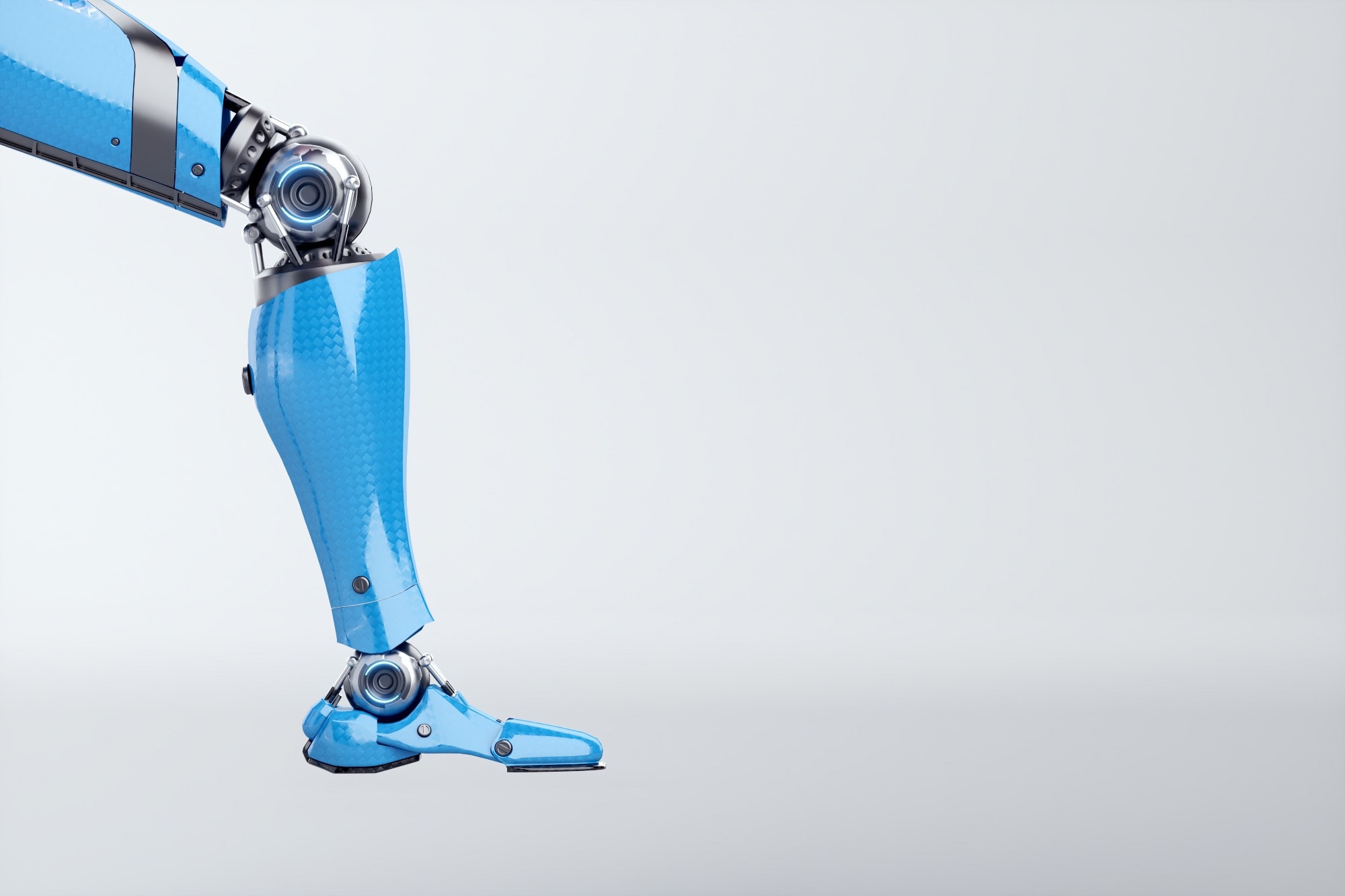 Study: Hip vertical motion effects on walking gait for biped robots. Image Credit: Marko Aliaksandr/Shutterstock.com
Human-Inspired Motion for Efficient Biped Gaits
Biped robots have drawn significant attention in research settings for their human-like appearance. However, achieving stable and efficient walking remains challenging due to their nonlinear, hybrid,
and high-dimensional dynamics.
Existing dynamic models include passive, under-actuated, and fully actuated robots, with the latter being the least energy-efficient. Gait generation methods include ZMP-based approaches and optimization techniques using polynomial approximations, often applied to five-link or seven-link models.
However, in such models, hip height was consistently maintained during walking, causing unnatural motion and significant knee bending in the stance phase that demands higher torque and energy. While human walking exhibits rhythmic HVM (peaking during single support and minimizing during double support), this had not been fully incorporated into biped gait planning.
This study addressed that gap by proposing a gait pattern using hip vertical motion and comparing its modeled mechanical energy consumption against FHH.
Biped Dynamics and Trajectory-Based Gait Design
This study focused on simulating a two-dimensional, five-link biped robot moving in the sagittal plane, consisting of a trunk and two structurally identical legs with rigid links and revolute joints.
The walking cycle comprises a double-support phase and a single-support phase, with the double-support phase assumed to occupy about 20% of the full cycle, consistent with human walking.
Because the stance ankle remains stationary during a step, the robot is treated as a fixed-base system with five generalized coordinates, and the equations of motion are derived using the Lagrange formulation.
Click here to download a free copy of this page.
During the double-support phase, both feet contact the ground, and holonomic constraints allow the dynamics to be treated similarly to the single-support phase by applying torque at the stance ankle while keeping the swing ankle torque-free.
Gait patterns are defined by planning the hip and ankle trajectories through polynomial interpolation, with joint angles obtained via inverse kinematics. The swing ankle follows a third-order polynomial horizontally and a fifth-order polynomial vertically, while the hip's horizontal trajectory is built from third-order polynomials satisfying continuity and cyclic conditions.
Two gait patterns are developed, differing only in the hip's vertical trajectory. In the first, the hip oscillates vertically, reaching a minimum at mid-double support and a maximum at mid-single support, generated by fifth-order polynomials and inspired by human biomechanics. In the second, hip height remains constant. The torso angle is held vertical and is not a focus of the study.
Energy-Based Optimization of Biped Gait Parameters
This study formulates an optimization problem to determine the gait design parameters, with the objective of minimizing modeled mechanical work per unit distance, reflecting the energy required for joint motion rather than actual electrical consumption.
Stability is ensured through the ZMP criterion, while additional constraints keep the hip-to-ankle distance within leg length and ensure both knees bend forward, mimicking human walking.
Joint angles are obtained analytically through inverse kinematics, and angular velocities and accelerations are derived by differentiating the kinematic relationships. Joint torques are computed via inverse dynamics, with the double-support phase treated as overactuated and resolved using a least-squares solution.
A standard genetic algorithm solves the optimization, chosen for its robustness with non-convex, multimodal problems, and repeated runs ensure stability. Design variables cover hip and swing ankle trajectory parameters, bounded by biomechanical and geometric feasibility.
Comparative Energy Performance Across Gait Conditions
Using physical parameters from a laboratory prototype, two walking patterns were optimized and compared under varying gait periods and step lengths. Simulation results show that hip vertical motion achieves approximately 14.5% lower modeled mechanical energy consumption per unit distance than FHH when step length is fixed and gait period varies, and about 14.1% lower on average when gait period is fixed and step length varies.
Both patterns show minimum energy use at moderate gait periods, and energy rises with longer strides. Hip-height parameters increase with longer gait periods but decrease with longer step lengths, whereas hip oscillation amplitude increases with step length.
The energy savings in hip vertical motion stem mainly from reduced stance-knee effort, since FHH requires greater knee flexion when the torso passes over the supporting foot. The authors note modeling limitations, including neglected joint friction and a simplified model without feet, and emphasize the need for hardware validation.
Implications for Efficient Biped Gait Planning
Inspired by human walking, this study investigated whether HVM improves biped robot walking efficiency. A periodic gait pattern was established for a five-link biped robot, with hip and swing-ankle trajectories planned via polynomial interpolation, joint trajectories obtained via inverse kinematics, and actuator torques determined using dynamic and constraint equations.
A genetic algorithm optimized gait parameters across various step lengths and periods. Simulation results suggest that hip vertical motion reduces modeled mechanical energy consumption per unit distance by over 14% compared to FHH, primarily through reduced stance-knee energy use.
However, these findings remain simulation-based, and experimental validation on physical hardware, along with robustness tests, remains important future work.
Journal Reference
Li, L., et al. (2026). Hip vertical motion effects on walking gait for biped robots. Scientific Reports. DOI:10.1038/s41598-026-70222-0. https://www.nature.com/articles/s41598-026-70222-0.
Disclaimer: The views expressed here are those of the author expressed in their private capacity and do not necessarily represent the views of AZoM.com Limited T/A AZoNetwork the owner and operator of this website. This disclaimer forms part of the Terms and conditions of use of this website.