Surviving the Weight of the Water
Powering Machines Far from the Surface
Navigating and Communicating Through Seawater
Borrowing Designs from Deep-Sea Life
Giving Robots the Ability to Decide
Conclusion
References and Further Reading
The deep ocean begins around 1,000 m beneath the surface and plunges to nearly 11,000 m in the deepest trenches. Researchers estimate that about 95% of this region remains uncharted, even though it shapes climate, fisheries, and much of the planet's biology. Crewed submersibles allow only brief human visits, so robotics has become the primary means by which scientists observe, measure, and sample these cold, dark, and high-pressure environments.
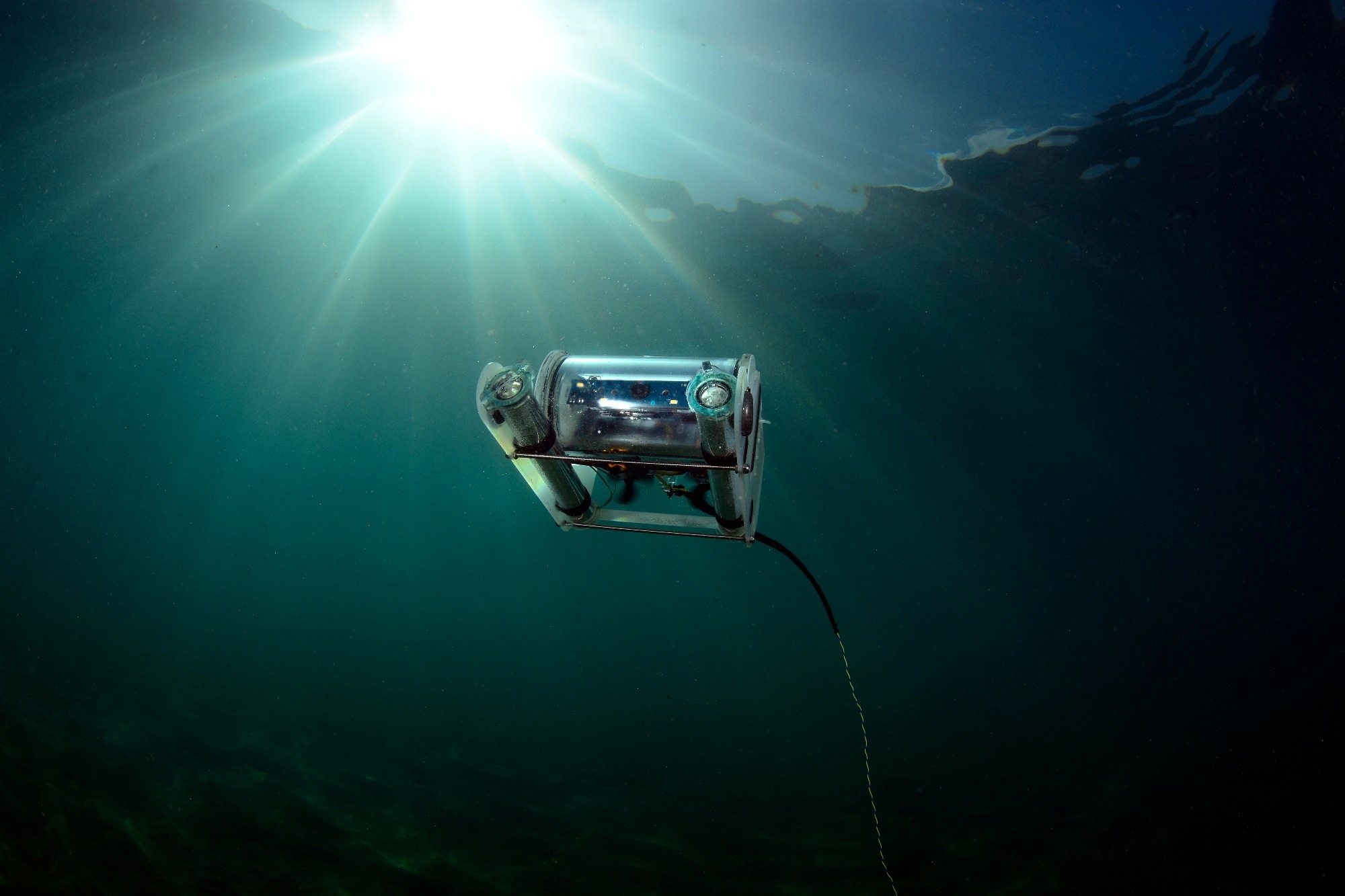 Image Credit: Humberto Ramirez/Shutterstock
Developing reliable machines for the deep ocean involves addressing interconnected engineering challenges, where each solution often imposes new constraints on the design. This article examines how engineers build deep-sea robots to withstand high pressure, operate for extended periods, and communicate underwater. It also discusses how they draw inspiration from marine life and work autonomously.1
Surviving the Weight of the Water
Pressure is the first problem that any deep-sea design must address. Seawater adds about 10 MPa of pressure for every 1,000 m of depth. Therefore, a robot operating at 6,000 m experiences around 600 atm pressure at the surface. Temperatures near the seafloor also remain between 0 and 4 °C, which affects the long-term behavior of batteries, seals, and flexible materials.2
Engineers handle the pressure in two broad ways. Closed designs place electronics inside rigid hulls maintained at 1 atm, which provides components with a stable, dry environment. Past 2,000 m, hull walls thicken sharply, and structure dominates the vehicle's weight. Pressure-balanced designs fill the housing with oil or use flexible membranes to equalize internal and external pressures. This approach, reported in an MDPI Energies article, cut the system weight by about 18% at 6,000 m.2
Powering Machines Far from the Surface
Energy storage determines the life and depth rating of a deep-sea robot. Batteries in sealed hulls need heavy housings, and that added weight requires more flotation foam, which increases the vehicle's size and raises hydrodynamic drag. Researchers describe this chain as a nonlinear weight-amplification effect, in which adding batteries can cancel out part of their own benefit. So, engineers judge energy density across the whole system, including packaging and buoyancy materials.2
Pressure-tolerant batteries are one solution, but they entail their own physics. Cells soaked in dielectric oil feel the full ocean pressure, which can compress separators, crush electrode particles, and reduce capacity over time. Solid-state batteries, with their stiffer electrolytes, may better resist these effects. A longer-term idea treats the battery as part of the vehicle's frame, so it stores energy and carries mechanical loads simultaneously.2
Navigating and Communicating Through Seawater
Once a robot reaches the seafloor, it must calculate its precise location. Satellite positioning fails underwater due to the strong absorption of radio waves by seawater, with 800 MHz signals experiencing about 825 dB of loss per meter. Consequently, deep-sea vehicles utilize a combination of onboard inertial sensors and acoustic tracking systems. Sound travels well in water, and acoustic waves lose only about 0.035 dB/m, allowing signals to propagate over many kilometers between a ship and a vehicle.3
The Orpheus vehicle, designed at Woods Hole Oceanographic Institution between 2018 and 2024 and rated to 6,000 or 11,000 m, exemplifies this integrated approach. It uses a Doppler velocity log to estimate motion over the seafloor and supports ultra-short baseline acoustic tracking from the surface. With four thrusters and drop weights for descent and ascent, it surveys 2-3 m above the bottom for 6 to 12 h.4
Download the PDF of this page here
Underwater communication presents a distinct, more challenging limitation. Acoustic links reach up to 20 km but typically carry only 5-10 kbps of data, which is sufficient for brief status messages. Optical links can reach 1 Gbps, though only over distances of 10 to 100 mand with a clear line of sight. In turbid water, the effective range diminishes further, prompting the use of adaptive systems that switch from optical to acoustic modalities as turbidity increases.3
Borrowing Designs from Deep-Sea Life
Rigid machines face several drawbacks in the deep sea. Their metal pressure vessels can suffer fatigue over repeated dives, and their hard grippers can harm delicate marine life. The risk of mechanical failure is a serious concern, as highlighted by the loss of the hybrid vehicle Nereus, which imploded at a depth of 9,900 meters due to a pressure-vessel failure. These limits have pushed many researchers toward soft robots modeled on animals that thrive under extreme pressure without any protective shell.1
A compelling model for this approach is the hadal snailfish, whose skull is composed of small, segmented pieces embedded within soft tissue. Engineers copied this idea by distributing electronics across small circuit boards sealed in a soft matrix, thereby reducing internal stress to under 110 MPa. Remarkably, a robot fish built this way was actuated at a depth of about 10,900 m in the Mariana Trench. Additionally, soft hydraulic grippers have proven effective at collecting fragile organisms at depths of up to 2,224 m.1
Giving Robots the Ability to Decide
Narrow bandwidth and slow acoustic signals make constant remote control impractical for deep-sea robots and require onboard decision-making capabilities. While tethered remotely operated vehicles (ROVs) rely on direct human control and skilled crews, their dependence on large ships and movement-restricting cables can be limiting. In contrast, autonomous vehicles remove the tether and reduce crew demands, placing the burden on software to interpret the surroundings and act correctly without a human pilot.5
The DeepSTARia system exemplifies this evolution in autonomy. It integrates a machine-learning detector, a stereo camera tracker, and a vehicle controller, coordinated by a supervisor that alternates among searching, acquiring, and tracking tasks. In trials at Monterey Bay, this system successfully followed a Solmissus jellyfish for over 11 min, generating nearly 2.5 times as many images of individual animals as traditional transects.6
In industrial applications, the need for precise manipulation raises the stakes, as robots must accurately select targets, position themselves, and apply appropriate force. Although human operators currently make these critical decisions, emerging resident systems are progressively narrowing this gap. For example, the Seaeye Sabertooth can stay on the seabed for up to six months with a docking station, and Kawasaki's SPICE returns to its dock autonomously to recharge and upload data.5
Conclusion
Deep-ocean robotics advances through a series of connected engineering choices, each shaped by the physics of seawater. Pressure-balanced housings and distributed electronics let machines withstand extreme loads, while system-level thinking enhances battery life. Acoustic tracking and onboard sensing further ensure precise navigation. Soft, animal-inspired designs handle fragile marine life more safely, and growing autonomy allows robots to explore and inspect with reduced reliance on ships and pilots.1-6
These innovations are interdependent. A lighter hull extends battery life, and smarter onboard software reduces the need for scarce communication bandwidth. The next generation of deep-sea machines will thrive by integrating pressure, power, sensing, and decision-making, ultimately revealing more of the ocean’s uncharted territories.
References and Further Reading
- Li, G. et al. (2023). Bioinspired soft robots for deep-sea exploration. Nature Communications, 14(1), 7097. DOI:10.1038/s41467-023-42882-3. https://www.nature.com/articles/s41467-023-42882-3
- Lin, Z. et al. (2026). Review of Energy Technologies for Unmanned Underwater Vehicles. Energies, 19(3), 592. DOI:10.3390/en19030592. https://www.mdpi.com/1996-1073/19/3/592
- Theocharidis, T. & Kavallieratou, E. (2025). Underwater communication technologies: a review. Telecommun Syst, 88, 54. DOI:10.1007/s11235-025-01279-x. https://link.springer.com/article/10.1007/s11235-025-01279-x
- Orpheus AUV. (2024). Nautilus Live. https://nautiluslive.org/tech/orpheus-auv
- Nauert, F., & Kampmann, P. (2023). Inspection and maintenance of industrial infrastructure with autonomous underwater robots. Frontiers in Robotics and AI, 10, 1240276. DOI:10.3389/frobt.2023.1240276. https://www.frontiersin.org/journals/robotics-and-ai/articles/10.3389/frobt.2023.1240276/full
- Barnard, K. et al. (2024). DeepSTARia: Enabling autonomous, targeted observations of ocean life in the deep sea. Frontiers in Marine Science, 11, 1357879. DOI:10.3389/fmars.2024.1357879. https://www.frontiersin.org/journals/marine-science/articles/10.3389/fmars.2024.1357879/full
Disclaimer: The views expressed here are those of the author expressed in their private capacity and do not necessarily represent the views of AZoM.com Limited T/A AZoNetwork the owner and operator of this website. This disclaimer forms part of the Terms and conditions of use of this website.