Control units for automotive safety systems must function perfectly under all conditions, which means 100 % testing of all circuit boards used is essential. This process is now faster and more flexible than ever, thanks to robotics.
The Task
Human lives are highly dependent on the reliable functioning of electronic assistance systems. One renowned automotive supplier working with Stäubli has installed a state-of-the-art, ultra-flexible inspection system designed for the 100 % testing of PCBs set for use in sensitive electronics applications, including demanding high-temperature testing at 140 °C.
Motor vehicles’ electronic components and systems are exposed to extreme temperatures, so these environmental conditions must be replicated in test procedures to ensure proper component functioning.
Amberg-based automation specialist Baumann GmbH initially focused on the design and construction of test systems to meet this need, typically relying on the highly modular standard cells developed in-house.
The supplier received an inquiry from a multinational Tier 1 manufacturer looking for a fully automated line for circuit board testing at room temperature and above, prompting Baumann’s engineers to develop an individualized standard solution.
The Solution
The te|box was selected. This flexible, standardized platform for PCB test applications can accommodate temperatures on either side of room temperature, from -40 °C to +140 °C.
Its flexible features and design allow this multipurpose system to test PCBs of highly varying types. This specific case required 100 % room temperature and high-temperature tests to be performed under rigorous cycle time criteria.
The flexibility of the setup in practice is demonstrated by the customer-specific test line. For example, the system is comprised of two fully automated test cells on either side of an oven, with each cell fitted with the ESD (electrostatic discharge) version of the Stäubli TX90L six-axis robot.
The first cell tests the PCBs at room temperature, while the second cell tests at the high temperature of 140 °C.
This system’s power stems from its sophisticated features, including the ability to:
- Retool with no interruption to cycle times
- Undertake high-temperature tests with minimal energy consumption
- Allow for variations in the number of test stations
- Reliably eliminate electrostatic discharge
- Simultaneously test two different types of PCB
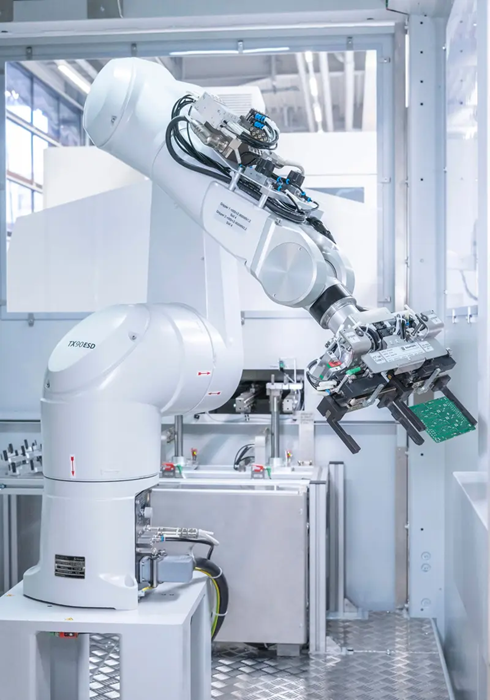
The ESD version of the Stäubli TX90L for handling printed circuit boards. Image Credit: Stäubli Robotics
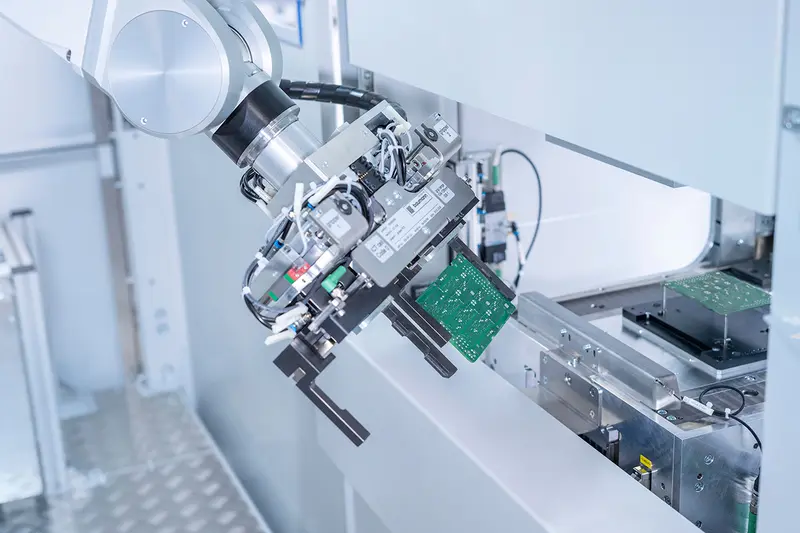
The six-axis robot impresses in the test cell with its high dynamics and exemplary precision. Image Credit: Stäubli Robotics
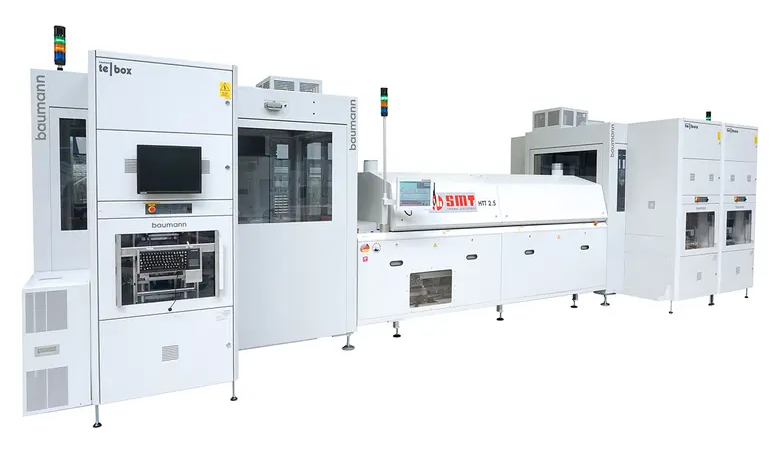
The complete test line consists of two linked test cells with docked test stations. The oven for heating the circuit boards is shown in the center of the photo. Image Credit: Stäubli Robotics
Customer Usage
The deployment of six-axis robots in the te|box around 10 years ago signaled the beginning of a new era in electronics testing. This development marked the end of rigidly linked process steps and the advent of improved flexibility.
Protection from electrostatic discharge continues to play a crucial role, and the development of such highly flexible standard test equipment would not have been possible without Stäubli ESD robots.
All Stäubli robot series are now available as electrostatic discharge (ESD) versions with all arm segments grounded from the tool to the pedestal. Robots are given a special ESD-compatible coating, while every accessible element and surface is electrically conductive.
The two Stäubli TX90L ESDs in the line’s two test cells have consistently demonstrated that their performance is no way inferior to that of standard robots in complex handling processes. These machines ensure maximum process reliability while preventing potential damage to electronic components.
The six-axis robots in this system are responsible for managing PCB handling in the test cells, making a clear contribution to the entire line’s short cycle times and high availability.
Acknowledgments
Produced from materials originally authored by Staubli Corporation.

This information has been sourced, reviewed and adapted from materials provided by Stäubli Robotics.
For more information on this source, please visit Stäubli Robotics.