The European DEEP-TECH (Disruptive Underwater Technology Capability Enabler for Next-Generation EU Deep-Sea Operations and Autonomous Subsea Technologies) project has officially kicked off, bringing together a multidisciplinary consortium of 18 organizations from 10 European countries.
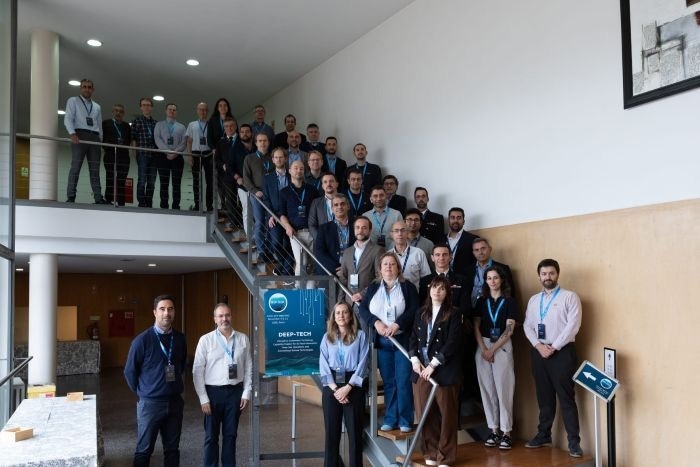 Image Credit: INESC TEC
Coordinated by INESC TEC – Institute for Systems and Computer Engineering, Technology and Science, the project addresses one of the most demanding frontiers of technological innovation: the development of advanced systems capable of operating autonomously and sustainably in the extreme conditions of the deep ocean.
Developed within the context of the European Defence Fund (EDF) and its research topic on Great-depth Enabling Technologies, DEEP-TECH aims to advance disruptive underwater technologies that will strengthen Europe's capabilities in deep-sea operations, maritime security, and the protection of critical underwater infrastructure.
Exploring New Technological Frontiers at 6,000 Meters Below the Surface
The deep ocean remains one of the world's most challenging environments for technological exploration and operation. Extreme hydrostatic pressure, low temperatures, GNSS-denied environments, limited communication capabilities and restricted access to energy sources impose significant barriers to the deployment and long-term operation of underwater systems.
DEEP-TECH seeks to overcome these barriers by researching and developing a new generation of enabling technologies designed specifically for extreme underwater environments.
The project envisions a future in which intelligent and autonomous subsea systems can remain underwater for extended periods, performing monitoring, inspection, surveillance, infrastructure protection and other complex missions with reduced dependence on surface support vessels.
This vision introduces a shift from conventional, intermittent underwater operations towards more persistent, connected and autonomous deep-sea capabilities.
Protecting Europe's Critical Underwater Infrastructures
The importance of underwater technological capabilities has expanded as Europe becomes increasingly dependent on critical subsea infrastructures.
Submarine telecommunications cables, offshore energy installations and underwater pipelines form essential networks supporting Europe's communications, economy, energy security and societal resilience.
DEEP-TECH aims to contribute to their protection through technological research that supports persistent underwater monitoring, advanced anomaly detection, autonomous inspection, and improved situational awareness.
The project also recognizes the dual-use potential of several of these innovations, with possible applications in offshore energy, ocean exploration, environmental monitoring, maritime infrastructure inspection and marine robotics.
From Research to Experimentation: Testing Technologies in Real Maritime Environments
A distinctive feature of DEEP-TECH is its research and experimentation approach, designed to progressively mature emerging technologies through modelling, simulation, integration and validation.
These environments will support iterative research activities, technical assessments and proof-of-concept demonstrations, connecting scientific research with operational requirements.
European Collaboration at the Heart of DEEP-TECH
The DEEP-TECH kick-off meeting, held on 9/10 November at ISEP - Porto Technical University School of Engineering, brought together the consortium partners to align their vision, discuss the project's technological objectives, define collaboration mechanisms and coordinate the first research and innovation activities.
The consortium combines the complementary capabilities of research institutions, universities, technology companies, SMEs, industrial organizations and operational end-users.
The DEEP-TECH consortium includes:
INESC TEC (project coordinator), ASilvaMatos, Exail, Alcatel Submarine Networks (ASN), Thales Italia (THALIT), AKMON, SOTIRIA, Centre for Research and Technology Hellas (CERTH), WECO, PowerUP, SINTEF Ocean, SINTEF AS (Digital), Unplugged, University of Copenhagen (UCPH), Space Applications Services (SPACE APPS), Spanish National Research Council (CSIC), SOLiTHOR and the Portuguese Navy.
Through this collaboration, DEEP-TECH will bring together European scientific excellence, industrial know-how and operational expertise to advance strategically important technologies and reinforce European technological capabilities in the underwater domain.
Shaping the Future of Great-Depth Underwater Operations
With the kick-off meeting marking the beginning of its collaborative activities, the DEEP-TECH consortium will now focus on defining technological requirements, conducting feasibility studies, advancing innovative concepts and preparing future experimentation campaigns.
The project's ambition goes beyond individual technological components: it seeks to establish the foundations for a new generation of interconnected, resilient and autonomous deep-sea systems.
From the ocean surface to depths of 6,000 meters, DEEP-TECH is advancing the technologies needed to unlock new possibilities in underwater operations.