How a Metal Remembers Its Shape?
Why Engineers See a Muscle?
From Wires to Grippers and Fabrics
The Heat Problem
Fatigue, Hysteresis, and Control Issues
Engineering Around the Limits
Conclusion
References and Further Reading
Shape-memory alloys (SMAs), such as nickel-titanium (nitinol), exhibit unique properties where they can remember and return to a programmed shape after being bent or stretched. Moreover, their pulling motion resembles the contraction of a living muscle. This unique property has drawn significant interest from robotics researchers seeking to develop robotic actuators that mimic biological muscle contractions.
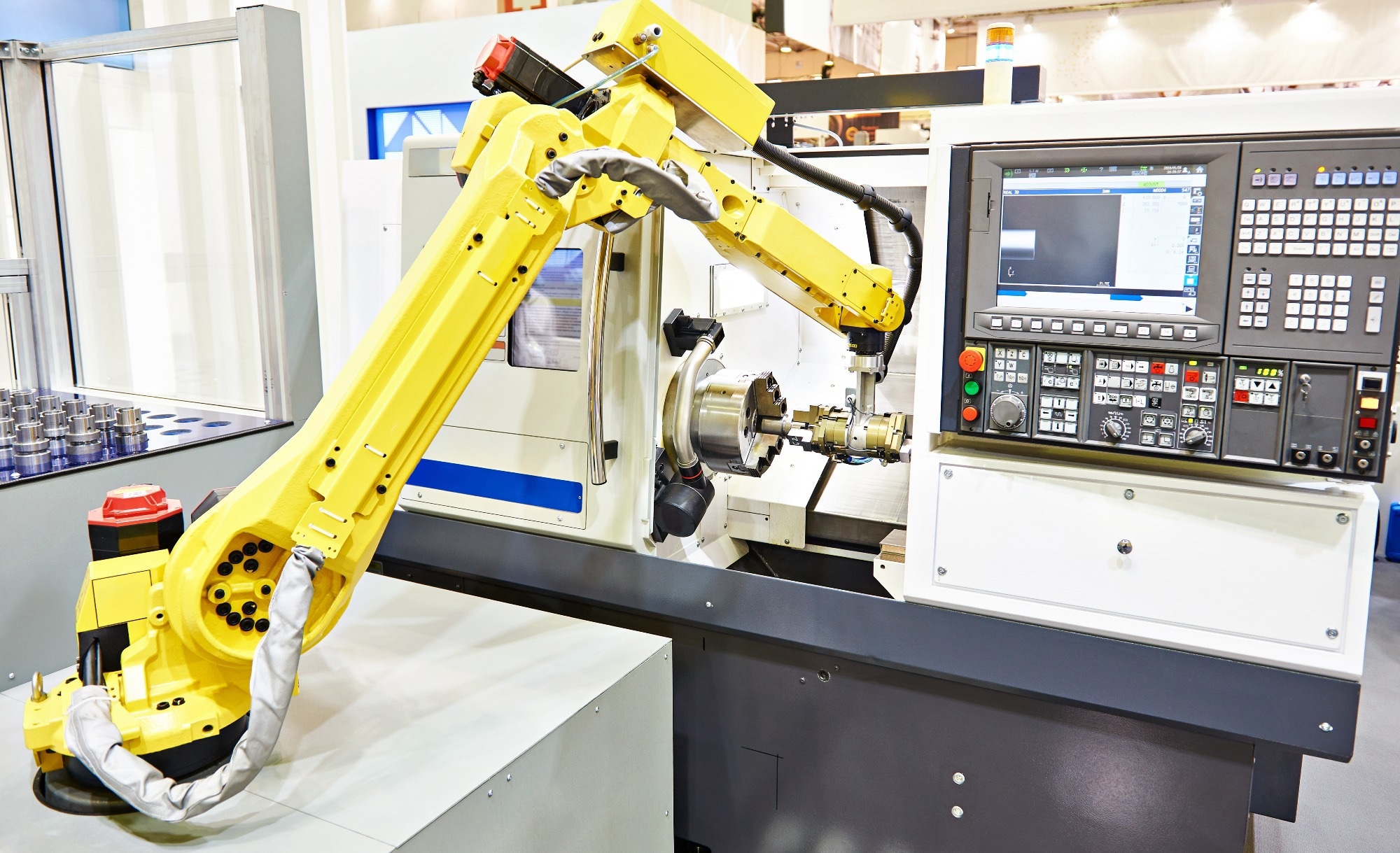
This article asks whether SMAs could become practical robotic muscles and explains why engineers compare them to biological tissues. It also explores recent devices made from these alloys and discusses the challenges and design strategies to address them.1,2
The memory behavior of these alloys is due to their atomic arrangement. At lower temperatures, nitinol exists in a soft phase known as martensite, which can be easily deformed. When the alloy is heated above a specific transition temperature, it transforms into a harder phase called austenite, and the metal springs back to its original form. Upon cooling under a load, the alloy returns to martensite and expands again, completing a repeatable cycle.2
In robotic devices, engineers usually supply the heat electrically. As current flows through the wire, it encounters resistance and generates heat through Joule heating. In a textile actuator study published in MDPI Sensors, a 200 μm nitinol wire shortened by about 6-8% once it exceeded 68 °C. Additionally, the alloy became considerably stiffer after the transformation, with its modulus increasing from 26 GPa in the martensite phase to 75 GPa in the austenite phase.3
Why Engineers See a Muscle?
A skeletal muscle works by contracting along its length and pulling on a tendon. Similarly, a heated shape-memory wire performs this function by drawing two anchor points closer together. Since the alloy can only exert a pulling force, designers pair it with a spring or a second wire that stretches it back, much like the biceps and triceps oppose each other. This antagonistic layout gives the metal a familiar, muscle-like role inside a machine.4
The comparison also depends on performance. Researchers value these alloys for their high energy density, meaning a small amount of metal can generate a significant force relative to its weight. The wires also run silently, fit into tight spaces, and are compatible with human tissue. These characteristics make them particularly appealing for applications in mobile robots, robotic hands, wearable devices, and medical tools, where bulky electric motors and gearboxes would be impractical.1
From Wires to Grippers and Fabrics
An MDPI Sensors research showed that a single 0.15 mm wire can power a gripper. The scientists looped the wire inside a flexible plastic frame, so the frame itself supplied the returning force. A current of 0.3 A made the wire contract by 3% and pull with about 2.8 N. This contraction then moved the gripper's jaws by about 1.2 cm.5
Although the gripper could hold objects up to 35 grams, its output force was only 0.38 N, 7.4 times weaker than the wire's pulling force. Mechanical amplification converted the force into movement. Designers accept this trade-off because a wire that contracts by just a few percent must be leveraged to produce significant motion for effective grasping.5
Other research groups weave the alloy directly into fabric. In the textile study, nitinol wire was wrapped in polyester and knitted into a stockinette stitch. The uneven geometry caused the actuator to curl in a predictable direction when heated. Soft grippers built this way can bend gently around delicate objects, and knitted or woven structures let the metal spread across a surface, much like muscle fibers spread through tissue.3
The Heat Problem
Speed is the largest obstacle to muscle-like performance of SMAs. Heating can be accelerated by increasing the current, while cooling depends on how quickly the wire dissipates heat to the surrounding air. A recent Materials & Design article on wearable devices reported that a 20 cm long, 0.5 mm wire took about 6 seconds to heat and about 40 seconds to cool. A living muscle, by comparison, relaxes within a fraction of a second.4
The same thermal cycle also consumes considerable electrical power. The article also reported a maximum energy efficiency of 10-15% for these actuators, largely because current must continue to flow to keep the wire in its contracted state. A broader review of artificial muscles published in Frontiers in Bioengineering and Biotechnology identified low operating frequency and high manufacturing cost as key barriers. It argued that alloy-based muscles remain far from mass production.6
Fatigue, Hysteresis, and Control Issues
Repeated cycles of heating and cooling gradually degrade the metal. For example, a wire under a load of 310 MPa shows a drop in recoverable strain from 4.5% to 3.5% after the first 100 cycles, and then remains stable for the next 20,000 cycles. To protect the alloy, it is crucial to keep strain changes below 4%.4
Saving this for later? Download a PDF here.
Controlling the system poses a separate challenge. The alloy follows one path during heating and a different one during cooling, resulting in a phenomenon known as hysteresis. Its response to stress and temperature is highly nonlinear, complicating precise positioning. As the wire transforms, its electrical resistance also shifts, enabling the actuator to function as its own sensor. However, to turn these readings into reliable position data, careful modeling is required.2
Engineering Around the Limits
Researchers attack the heat problem at several levels. Thinner wires cool faster because they retain less heat, and moving air improves the cooling. Research shows that a 0.4 mm wire cools in about 7 seconds with airflow compared with about 20 seconds in still air. Proposed next steps include microchannel cooling, highly conductive composite casings, and layouts that place the wire where heat can escape quickly.2,4
In addition, innovative geometric designs address the issue of limited stroke length. For instance, winding wires around pulleys fits a longer active length into a compact body, while one robotic finger employed a pulley system to amplify wire contraction sixfold. Coiled springs provide greater displacement, but at the expense of force and speed. On the control side, researchers apply fuzzy logic, sliding-mode methods, and neural network models to predict the alloy's behavior and compensate for hysteresis.2
Conclusion
SMAs already behave like simple robotic muscles. Their atomic phase change produces a quiet, lightweight pull, and recent grippers and knitted actuators show that this motion can handle real tasks. However, slow cooling, moderate efficiency, fatigue, and hysteresis still limit their application to scenarios where speed is less critical than size and quiet operation. Progress in cooling, geometry, and control will decide how closely these metals can replicate the speed of living muscles.2
References and Further Reading
- Kim, M. S. et al. (2023). Shape Memory Alloy (SMA) Actuators: The Role of Material, Form, and Scaling Effects. Advanced Materials, 35(33), 2208517. DOI:10.1002/adma.202208517. https://advanced.onlinelibrary.wiley.com/doi/10.1002/adma.202208517
- Zhang, R. et al. (2026). Wire-form shape memory alloy actuators: Modeling, design, and control. Microsystems & Nanoengineering, 12(1), 76. DOI:10.1038/s41378-026-01161-z. https://www.nature.com/articles/s41378-026-01161-z
- Shin, J. et al. (2023). Shape Memory Alloys in Textile Platform: Smart Textile-Composite Actuator and Its Application to Soft Grippers. Sensors, 23(3), 1518. DOI:10.3390/s23031518. https://www.mdpi.com/1424-8220/23/3/1518
- Liu, Q. et al. (2023). Shape memory alloy actuators for haptic wearables: A review. Materials & Design, 233, 112264. DOI:10.1016/j.matdes.2023.112264. https://www.sciencedirect.com/science/article/pii/S0264127523006792
- Then Mozhi, G. et al. (2023). Design and Control of Monolithic Compliant Gripper Using Shape Memory Alloy Wires. Sensors, 23(4), 2052. DOI:10.3390/s23042052. https://www.mdpi.com/1424-8220/23/4/2052
- Jing, Y. et al. (2023). Advances in artificial muscles: A brief literature and patent review. Frontiers in Bioengineering and Biotechnology, 11, 1083857. DOI:10.3389/fbioe.2023.1083857. https://www.frontiersin.org/journals/bioengineering-and-biotechnology/articles/10.3389/fbioe.2023.1083857/full
Disclaimer: The views expressed here are those of the author expressed in their private capacity and do not necessarily represent the views of AZoM.com Limited T/A AZoNetwork the owner and operator of this website. This disclaimer forms part of the Terms and conditions of use of this website.